Career Planning 101: Break the Salary Monoculture
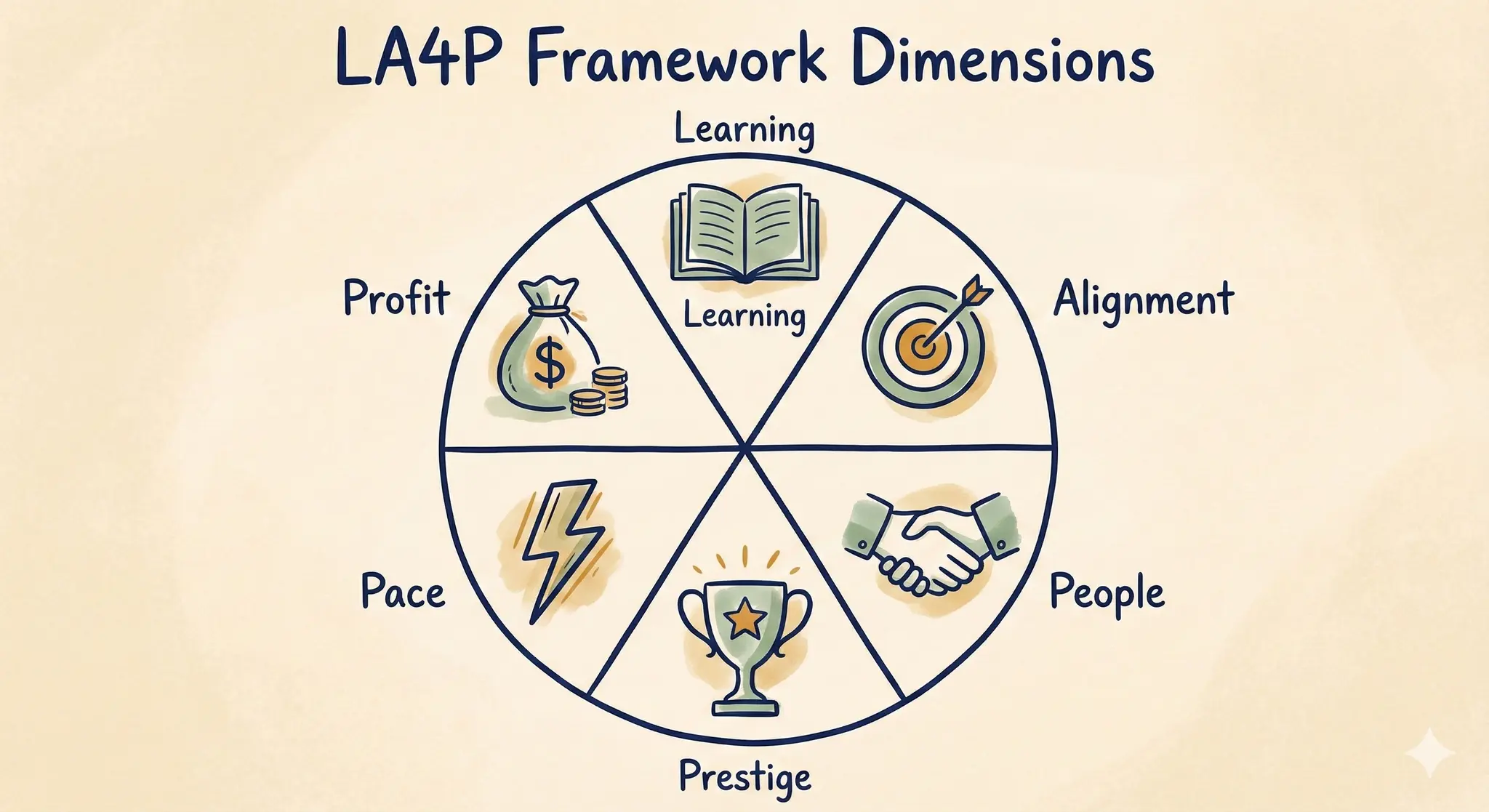
Most careers are optimized for 1 of 6 dimensions. Learn the LA4P system to build a meaningful career across Learning, Alignment, People, Prestige, Pace, and Profit.

40yearscareer Expert Panel
Career Strategy Research
Written by our expert panel: career coach, psychologist, HR leader, and product designer. Every article includes exercises you can try in the app.
Career Planning 101: Break the Salary Monoculture
Most people plan their next vacation more carefully than their next 40 years of work.
(Guilty? Same.)
You'll spend roughly 80,000 hours in your career. That's 40 years × 2,000 hours per year. Yet most professionals optimize for one thing: salary.
The result? By 45, many high-performers realize they built careers that looked impressive on LinkedIn but felt hollow in practice.
Most people spend more time planning a vacation than planning their career. Then they wonder why they ended up somewhere they didn't choose.
Dr. Rachel Martinez
Career Coach, 15+ years
Career planning isn't about predicting your future. It's about creating a system for making better decisions when opportunities arise.
Hours in 40-year career
Dimensions that matter (not just salary)
Compounding effect of strategic choices
Breaking the Salary Monoculture
Here's the uncomfortable truth: most careers are optimized for 1 of 6 dimensions.
You chase the highest salary. You ignore everything else—your manager, your learning, your pace, your alignment with the work. Then five years later, you're burned out and wondering what went wrong.
Western culture has a salary monoculture problem. We've reduced the complexity of meaningful work to a single number.
Dr. Elena Okonkwo
Cultural Anthropologist
The cost of single-dimension optimization:
- Burnout: You took the highest-paying role. Pace was 1/5. Now you work weekends and resent it.
- Misalignment: You optimize for Prestige. The work doesn't match your values. You're successful and unhappy.
- Plateau: You prioritize easy Pace. Learning drops to 2/5. Five years later, your skills are stale.
The solution isn't to ignore salary. It's to evaluate careers across all six dimensions.
The LA4P System: A Complete Framework
Career planning isn't just rating your job satisfaction. It's a complete system with building blocks, rituals, and tools that work together.
Think of it like personal finance: you need building blocks (income, expenses, savings, investments), rituals (monthly budget review, quarterly rebalancing), and artifacts (spreadsheets, apps, statements).
The LA4P framework works the same way:
Building Blocks: The Foundation
The 6 Dimensions – What you measure
Six core dimensions that predict career satisfaction: Learning, Alignment, People, Prestige, Pace, and Profit. You'll rate each 1-5 to create a hexagon pattern that reveals your career health.
Chapters – How you structure time
Your 40-year career = 8 chapters of ~5 years each. Each chapter has different LA4P priorities. What you optimize for at 25 (Learning) looks different from 45 (Alignment, Pace).
Experiences – What you build
The specific roles, projects, and skills that compound over time. Not just "job titles" but the capabilities and relationships that unlock future opportunities.
Rituals: The Practice
Four time-based rituals that turn one-time assessment into sustainable habit:
- Weekly: 10-minute Friday Check-In – Track scores, catch early warnings
- Monthly: 20-minute Pattern Scan – Spot 4-week trends
- Quarterly: 1-hour Compass Check – Strategic 12-week review
- Annual: 2-3 hour Chapter Review – Assess if you're in a new chapter
Artifacts: Your Tools
Concrete worksheets and visualizers that make the system practical:
- Career Compass – Hexagon visualizer for current state
- LA4P Tracker – Score history over weeks/months/years
- Chapter Planner – Map your 5-year priorities and milestones
- Comparison Worksheets – Evaluate job offers side-by-side
You don't need to master everything today. Start with the building blocks (the 6 dimensions), then add rituals as they become useful.
The 6 Dimensions: Your Building Blocks
The LA4P system gives you six dimensions to evaluate any role. Not vague feelings—specific, trackable scores.
Here's what this looks like. Rate your current role:
Your Career Compass
Rate each dimension 1-5. The shape reveals your patterns.
💡Rating Scale
1 = Dealbreaker • 2 = Concerning • 3 = Neutral
4 = Strength • 5 = Exceptional
Current Role | |
|---|---|
| learning — Learning | 1 2 3 4 5 |
| alignment — Alignment | 1 2 3 4 5 |
| people — People | 1 2 3 4 5 |
| prestige — Prestige | 1 2 3 4 5 |
| pace — Pace | 1 2 3 4 5 |
| profit — Profit | 1 2 3 4 5 |
| Total Score | 0/30 |
💡 Remember: The pattern often surprises people. A balanced hexagon = sustainable career. A spiky shape = trade-offs to manage.
Try the Interactive Visualizer →Take 30 seconds. Be honest. The pattern often surprises people.
See Your Career in 6 Dimensions
Get a personalized assessment of your current role across all six LA4P dimensions. Takes 5 minutes, provides insights for years.
The Six Dimensions
LA4P Quick Reference
| Dimension | What It Measures | Why It Matters |
|---|---|---|
LLearning | Skill growth, challenging work, development velocity | Skills learned on job = 46% of lifetime earnings (McKinsey, N=~1M workers) |
AAlignment | Mission fit, values match, meaningful work | Toxic culture 10.4x more predictive of attrition than pay (MIT Sloan, N=34M profiles) |
PPeople | Manager quality + team quality (averaged) | Managers account for 70% of engagement variance (Gallup, N=112K teams) |
PPrestige | Brand recognition, resume value, career capital | Signal effect persists ~5 years, then depreciates (IZA research) |
PPace | Work-life balance, sustainability, burnout risk | Burnout symptoms = 6x more likely to exit within 3-6 months (McKinsey, N=14,969) |
PProfit | Total comp, equity, financial security | Workers with advanced digital skills earn 65% more (Gallup/AWS) |
Let's break down each dimension:
1. Learning – Are you developing valuable skills?
What it measures: Skill growth, knowledge expansion, career capital accumulation.
Why it compounds: Learning in years 1-10 unlocks opportunities in years 20-40. Skills are the foundation of everything else.
The 1-5 scale isn't arbitrary. It forces you to confront trade-offs instead of vague 'it's fine' thinking.
Dr. James Chen
Behavioral Psychologist
Example: Francisco, 26, took a startup role at $90k (Profit: 2/5) instead of a corporate job at $130k because Learning was 5/5. Three years later, his startup skills got him a $180k FAANG offer that wouldn't have been available otherwise.
2. Alignment – Does this work match your values?
What it measures: Value alignment, meaning in work, intrinsic motivation.
Why it compounds: Misalignment drains you slowly. Three consecutive roles at Alignment 2/5 predict career crisis.
Example: Sarah left McKinsey ($280k, Alignment 2/5) for a startup ($140k, Alignment 5/5). Five years later, she's still there—and doesn't regret the pay cut.
3. People – Do you respect your colleagues and manager?
What it measures: Manager quality, team dynamics, peer relationships.
Why it compounds: Your manager affects every other dimension. A 2/5 manager tanks your Learning, Pace, and Prestige.
People don't leave companies, they leave managers. Yet nobody tracks manager quality like they track salary.
Patricia Williams
VP of People, 12+ years
Example: Maya stayed in a toxic team (People: 1/5) for the salary. Eighteen months later, she was burned out and job hunting anyway—but now with a gap in skills and confidence.
4. Prestige – Does this role enhance your reputation?
What it measures: Brand value, career capital, optionality for future moves.
Why it compounds: Prestige opens doors. But optimizing only for Prestige (without Learning) is a trap.
Example: David joined AWS (Prestige: 5/5) but Learning dropped to 2/5 over four years. When he left, the brand helped—but the skill gap hurt.
5. Pace – Is the workload sustainable?
What it measures: Work-life balance, hours, intensity, recovery time.
Why it compounds: Pace below 3/5 for more than 18 months predicts burnout. Your body keeps score.
Example: Francisco worked at a high-growth startup (Pace: 2/5, Learning: 5/5) for two years. That was strategic. Five years? That would've destroyed him.
6. Profit – Does compensation support your goals?
What it measures: Salary, equity, benefits, financial runway.
Why it compounds: Money buys optionality. But optimizing only for Profit ignores the other 5/6 of satisfaction.
Example: Marcus chased the highest offer at every turn (Profit: 5/5). Ten years later, he's well-paid and miserable. Skills plateaued, values misaligned, burned out.
💡Pattern Recognition Over Single Scores
A single 2/5 score isn't a crisis. Three consecutive roles with the same dimension at 2/5? That's a pattern you're creating—and patterns predict your future.
How Dimensions Interact
This isn't a checklist. Dimensions influence each other.
- Low People tanks Learning (bad manager blocks growth)
- Low Pace eventually tanks Alignment (burnout kills meaning)
- High Prestige can compensate for lower Profit (brand = future money)
- High Learning often means lower Pace (steep curves are intense)
The goal isn't perfection. It's pattern awareness.
Three consecutive roles with the same dimension at 2/5? That's not bad luck. That's a pattern you're creating.
Dr. James Chen
Behavioral Psychologist
The Four Core Rituals
The LA4P system works whether you track it in a notebook, spreadsheet, or digital tool. What matters is the practice.
Here are the four rituals that turn the framework into a sustainable habit:
Your Career Practice Rituals
Weekly: The Friday Check-In (10 minutes)
Friday at 4pm – Rate your week across all six dimensions. Catch dangerous trends 8-12 months before burnout.
Monthly: The Pattern Scan (20 minutes)
Last Friday of the month – Review 4-week trends. Three consecutive weeks of decline signals action needed.
Quarterly: The Compass Check (1 hour)
End of quarter – Zoom out to see 12-week patterns. Strategic decisions require 3-month perspective.
Annual: The Chapter Review (2-3 hours)
End of year – Assess whether you're still in the same chapter. What changed? What should change?
If career planning feels like homework, you won't do it. That's why we built rituals that start at 10 minutes weekly.
Alex Rivera
UX Designer, 8+ years
Why rituals work: They're predictable, lightweight, and reveal patterns over time. You don't need discipline—you need a system.
Why Career Planning Compounds
Your career isn't a series of jobs. It's an investment portfolio that compounds over 40 years.
Decisions you make in year 5 create opportunities (or close doors) in year 20.
Your career is a 40-year investment portfolio. Stop optimizing for this quarter's returns.
Dr. Rachel Martinez
Career Coach
Francisco's Compounding Success Story
Bootcamp → Startup (Year 1)
Took $90k startup role over $130k corp job. Learning: 5/5. Profit: 2/5. Strategic sacrifice.
Startup → Scale-up (Year 3)
Startup experience unlocked $150k mid-size SaaS role. Learning still 4/5. Profit jumped to 4/5.
Scale-up → FAANG (Year 5)
Startup + scale-up experience opened $220k FAANG senior role. All dimensions 4-5/5. Portfolio compounded.
Francisco's year-1 decision to optimize for Learning (not Profit) compounded into opportunities that wouldn't have been accessible otherwise.
The Counter-Example: Short-Term Thinking
Reactive Career Planning
Strategic Career Planning
Think in decades, execute in quarters.
Marcus Johnson
Product Manager, 8+ years
The compounding principle: Optimize for Learning and People in years 1-10. Profit and Prestige compound as a result in years 11-40.
The Artifacts: Your Career Toolkit
These are your tools. You can build your own versions, or use ours.
1. Your Career Compass
Visual hexagon showing your current state across all six dimensions.
What it does: Turns six numbers into an instant pattern. A balanced hexagon = sustainable. A spiky shape = trade-offs to manage.
You can: Track it in a spreadsheet, or use our tool to visualize patterns automatically. The tool uses AI to spot dangerous patterns—like three consecutive low scores in one dimension.
2. LA4P Tracker
Spreadsheet or tool for tracking your six dimensions over time.
What it does: Logs your monthly ratings. Reveals trends. "Learning went from 5 → 3 → 1 over 18 months" is a pattern you need to see.
You can: Use a simple spreadsheet with six columns, or use our tracker that auto-generates charts and alerts you to patterns.
3. Chapter Planner
5-year phase planning tool.
What it does: Maps your career in chapters, not jobs. "Years 1-5: Deep expertise in domain X. Years 6-10: Transition to leadership."
You can: Write this in a notebook, or use our planner that helps you set milestones and tracks progress.
4. Comparison Worksheets
For evaluating offers or roles.
What it does: Side-by-side comparison of multiple roles across all six dimensions. Makes trade-offs explicit.
You can: Create a simple comparison table, or use our worksheet that calculates weighted scores and highlights dangerous patterns.
We built these because tracking 6 dimensions over 40 years gets messy. The AI helps spot patterns you might miss.
Five Steps to Start Using the System
You don't need to master everything today. Here's how to start.
Step 1: Assess Your Current Position
Before you can plan where you're going, understand where you are.
Rate your current role:
Rate Your Current Role
Score each dimension 1-5. Be honest—this is for you, not LinkedIn.
💡How to Use This Tool
| Dimension |
|---|
Pattern Recognition |
What dimensions are consistently low (1-2)?________ |
What patterns do you notice?________ |
What one dimension would you change in your next role?________ |
📊 Track your dimensions
Spot patterns over 4-6 weeks
Start Tracking Your Dimensions →Look for patterns in your last 2-3 roles:
- Which dimensions consistently score high? (Your strengths/values)
- Which consistently score low? (Your risk areas)
- What's the trend? (Improving or declining?)
Interpretation guidance:
- 1-2 – Draining, unsustainable, misaligned (crisis territory)
- 3 – Neutral, "fine I guess" (acceptable but not energizing)
- 4-5 – Energizing, excellent fit, sustainable (aim here)
Three consecutive roles with any dimension at 1-2? That's a pattern requiring immediate action.
Step 2: Define Your Destination
You don't need to know your exact title in 2045. But you should know your principles.
Define Your Career Principles
Identify your energizers
What kind of work makes you lose track of time? (Alignment clue)
Define your must-have skills
What capabilities do you want to master in 10 years? (Learning direction)
Map your life stages
What lifestyle do you want at 35? 45? 55? (Pace + Profit priorities)
Set phase priorities
Which dimensions matter most right now? (They'll shift—that's normal)
Your priorities will shift. In your 20s, Learning and Prestige. In your 30s with kids, Pace and Profit. In your 40s, Alignment. That's not inconsistency—that's life.
Dr. Rachel Martinez
Career Coach
The goal isn't to lock in priorities forever. It's to consciously choose priorities for this phase instead of drifting.
Step 3: Identify Your Path
How do you get from where you are to where you want to be?
This isn't about listing specific job titles. It's about identifying the types of experiences and skills that will compound over time.
Deep Expertise Phase
Build deep expertise in domain. Prioritize Learning over Profit. Accept high Pace if Learning is strong.
Leverage Phase
Transition to leadership or specialization. Balance Learning with Prestige. Profit increases naturally.
Optimization Phase
Optimize for Alignment and Pace. Leverage accumulated career capital. Choose roles strategically.
Key question: What capabilities do you need to develop now to unlock the opportunities you want in 10 years?
Step 4: Set Milestones
Break your long-term path into achievable checkpoints.
Category | Bad Milestones | Good Milestones |
|---|---|---|
| Happiness focus | Be happier at work | Improve Learning score from 2/5 to 4/5 in next role |
| Promotion goal | Get promoted | Lead 3 major projects and develop 2 direct reports over 18 months |
| Work-life balance | Find better work-life balance | Rate Pace 4/5 or higher for 6 consecutive months |
| Skill development | Learn new things | Ship 2 projects using technology X, mentor 1 junior on it |
Good milestones are observable and measurable. You should know when you've achieved them.
Plan your next chapter:
Plan Your 5-Year Chapter
Define your current career phase and set concrete milestones
Chapter Definition | |
|---|---|
| Chapter Title | e.g., Build Foundation, Scale Impact |
What is this chapter about? e.g., Becoming genuinely senior in my domain and building a strong network | |
What trade-offs am I willing to make? e.g., Lower Profit for higher Learning, moderate Pace for skill growth | |
What does "done" look like? e.g., Strong expertise in X, network of 20+ peers, ready for next phase | |
LA4P Priorities for This Chapter | |
| Learning | 1 2 3 4 5 |
| Alignment | 1 2 3 4 5 |
| People | 1 2 3 4 5 |
| Prestige | 1 2 3 4 5 |
| Pace | 1 2 3 4 5 |
| Profit | 1 2 3 4 5 |
Key Milestones | |
| Year 1 milestone | e.g., Ship 2 major projects in new domain |
| Year 2 milestone | e.g., Lead a team or major initiative |
| Year 3 milestone | e.g., Recognized expert, strong network |
| Year 5 outcome | e.g., Ready for senior leadership or specialization |
📖 Plan your next chapter
Define your 5-year career chapter
Build Your Chapter Plan →Recommended checkpoint intervals:
- Weekly: Friday Check-In (10 minutes) – Track LA4P scores, flag issues
- Monthly: Pattern Scan (20 minutes) – Review 4-week trends
- Quarterly: Compass Check (1 hour) – Review 12-week patterns, adjust strategy
- Annually: Chapter Review (2-3 hours) – Major career decisions and direction check
Step 5: Review and Adjust Regularly
Your career plan is a living document, not a contract.
Friday Check-In
10 min
Pattern Scan
20 min
Compass Check
1 hour
Chapter Review
2-3 hours
Quarterly review questions:
- Are my LA4P scores improving, stable, or declining?
- Am I spotting any dangerous patterns? (3+ roles with dimension at 1-2)
- Have my priorities shifted?
- Do my next 1-2 moves still align with my 5-10 year direction?
- What new opportunities or threats have emerged?
When to make major adjustments:
- A dimension scores 1-2 for three consecutive roles
- Your priorities fundamentally shift (new family, health, life stage)
- Your industry is disrupted
- An unexpected high-leverage opportunity appears
The world changes. You change. Your circumstances change. The best career plans adapt while maintaining strategic direction.
Spotting Dangerous Patterns Early
Most career regrets come from patterns, not single decisions.
I haven't rated my current role on LA4P in over 6 months
You're flying blind. Career drift happens when you stop tracking patterns. Set a monthly reminder.
I take jobs based on a single dimension (usually Profit or Prestige)
You're optimizing for 1/6 of career satisfaction. The other 5 dimensions will eventually cause problems—burnout, misalignment, or skill plateau.
I can't explain how my current role connects to my 5-year goals
You're drifting, not planning. Either find the connection or acknowledge you're in the wrong place.
I'm consistently scoring 1-2 on the same dimension across multiple roles
This is the most dangerous pattern. Three consecutive roles with the same dimension at 1-2 predict a career crisis. You're not learning from past mistakes—you're repeating them.
My career plan hasn't changed in 3+ years
You're following a script written for a past version of you. Life changes, priorities shift, industries evolve. If your plan hasn't adapted, it's stale.
I'm always job hunting but never satisfied with new roles
You're changing jobs without changing your selection criteria. The pattern repeats because you haven't identified what dimensions matter most.
⚠️Critical Threshold
If a dimension scores 2/5 or below in three consecutive roles, you're not experiencing bad luck—you're creating a pattern. This predicts burnout, skill plateau, or career crisis within 18-24 months. Act now.
Three consecutive roles with the same dimension at 2/5? That's not bad luck. That's a pattern you're creating.
Dr. James Chen
Behavioral Psychologist
Where to Go Deeper
This guide introduced the LA4P system—the building blocks, rituals, and artifacts. Here's where to go next:
→Dimension Deep-Dives
Learn to evaluate each dimension like an expert:
- How to Spot a 4/5 Manager in Interviews (People dimension)
- The Learning Dimension: Skill Growth vs Busy Work (coming soon)
- The Alignment Dimension: Values, Mission, Meaning (coming soon)
- The Pace Dimension: Sustainable vs Burnout Patterns (coming soon)
→Decision Frameworks
Apply LA4P to real decisions:
- How to Decide Between Two Job Offers (using LA4P comparison)
- When to Leave a Good Manager for a Better Learning Environment (coming soon)
- The 3-Month Pattern Rule for Career Decisions (coming soon)
→Pattern Recognition
Get better at spotting patterns:
- Career Pattern Library: 12 Common Trajectories (coming soon)
- Red Flags in Company Culture That Predict Manager Quality (coming soon)
- When Your Great Manager Leaves: Decision Framework (coming soon)
→Advanced Rituals
Level up your practice:
- Year Compass: Annual Career Ritual (coming soon)
- Quarterly Career Review Template (coming soon)
- Career ROI Calculator: Weighted Multi-Timeframe Analysis (coming soon)
The system is the foundation. These guides help you master each piece.
The Career Planning Mindset
The best career planners share three characteristics:
1. Pattern Recognition Over Decisions
They don't obsess over any single job choice. They track patterns across multiple roles and make decisions that improve those patterns.
2. Long-Term Compounding Over Short-Term Optimization
They ask: "What does this unlock in 5-10 years?" not just "What do I gain this year?"
3. Flexibility Within Structure
They have strong principles and frameworks but adapt tactics as circumstances change.
This is a practice, not a one-time event. The professionals who reach 45 and think "I built exactly the career I wanted" aren't luckier or smarter. They just had a system.
Start Your Practice Today
The best time to start planning your 40-year career was on day one. The second-best time is today.
Your immediate next steps:
- Rate your current role on all six LA4P dimensions (5 minutes)
- Rate your last 2-3 roles (10 minutes)
- Identify any dangerous patterns (scores of 1-2 across 3+ roles)
- Write down your top 2 priorities for this phase of your career
That's it. You now have more career clarity than 90% of professionals.
See Your Career Patterns
Take the 5-minute assessment. Visualize your LA4P dimensions. Spot patterns before they become problems.
Remember: Planning ≠ Predicting
You can't predict where you'll be in 2045.
But you can create a framework that ensures wherever you end up, you got there through intentional choices aligned with your values—not by drifting from one reactive decision to the next.
Career planning is an ongoing practice, not a one-time event. Revisit your roadmap quarterly. Track your patterns. Adjust your course.
The LA4P system works whether you track it in a notebook, spreadsheet, or digital tool. What matters is the practice: monthly ratings, quarterly pattern checks, annual compass, and decision framework.
We built the 40yearscareer tool because tracking 6 dimensions over 40 years gets messy. The AI spots patterns you might miss—like three consecutive low scores, or dangerous trends in specific dimensions. But the system is universal.
The professionals who reach 45 and think "I built exactly the career I wanted" aren't luckier or smarter.
They just had a map.
Apply this guide
Use this guide to refine your 1–5 scores.
Review your existing chapters in 40yearscareer and adjust each axis based on what you just read. You’ll see patterns that were invisible before.
Free while we're in beta. No inbox clutter, no selling your data.