The Reversibility Matrix: How to Stop Overthinking Career Decisions
Learn when to decide in 72 hours vs 3 weeks. The Reversibility Matrix shows how switching costs determine deliberation time—and why experts decide faster as they gain experience.

Dr. James Chen
Career, product, and psychology team
Written by our expert panel: career coach, psychologist, HR leader, and product designer. Every article includes exercises you can try in the app.
The Reversibility Matrix: How to Stop Overthinking Career Decisions
Francisco: 3 weeks analyzing a Staff Engineer promotion, 12 scenario spreadsheets, missed the window. Sarah: 72 hours to leave McKinsey, no analysis, correct decision.
Same decision type. Wildly different deliberation times. Both were right.
The question isn't whether you're overthinking. It's whether your deliberation time matches your decision's reversibility.
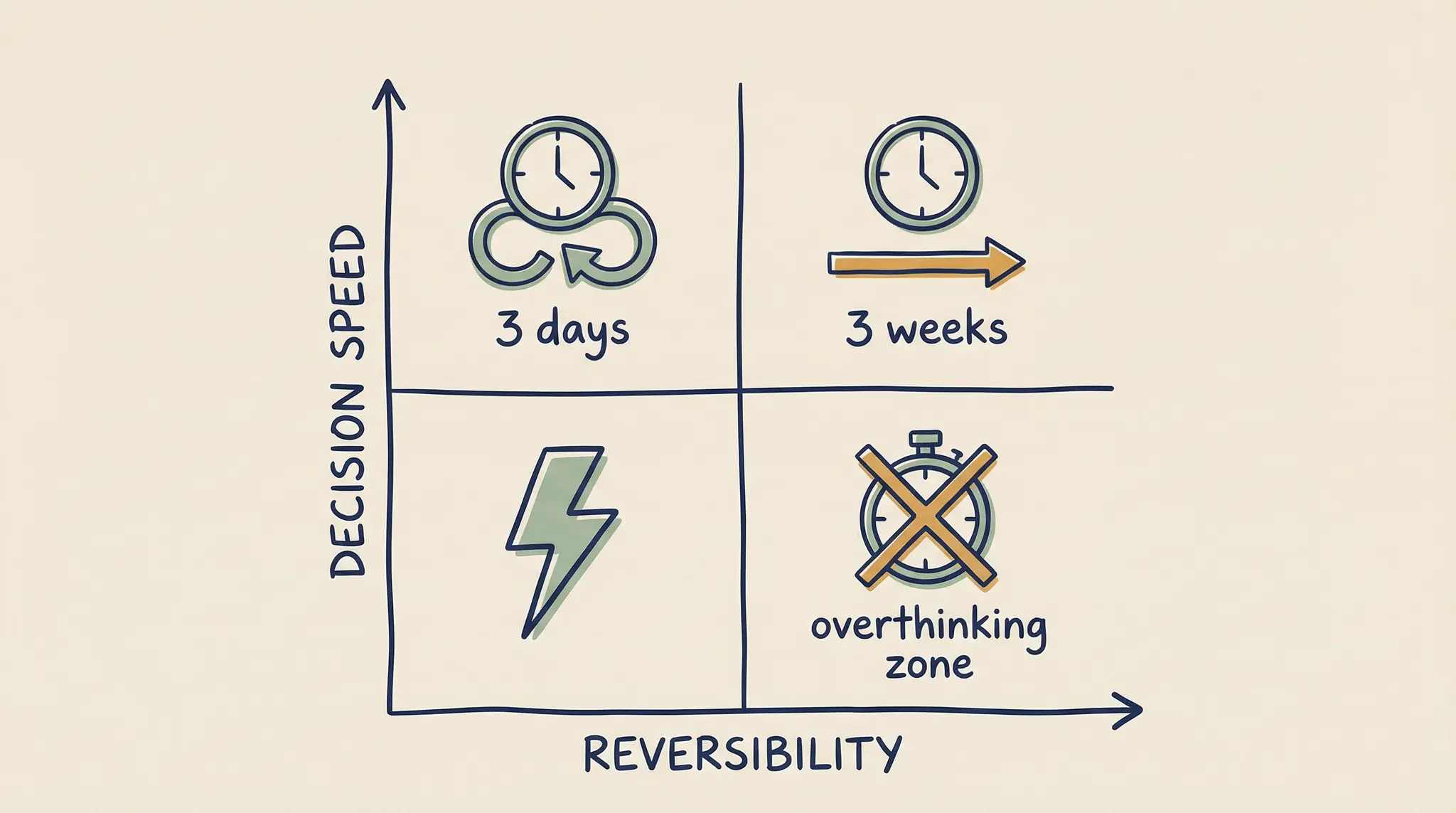
The Reversibility Matrix: Your Decision Timer
Not all decisions deserve equal analysis time. Some you can reverse easily. Others lock you in for years. The difference should determine how long you deliberate.
The Matrix:
Decision Type Examples | Switching Cost How hard to undo | Pattern Recognition Time to understand situation | Due Diligence Time to verify & plan | Total Time Maximum deliberation | |
|---|---|---|---|---|---|
| Irreversible | 2-year MBA, cross-country move, founding startup | High: difficult to undo, long commitment | Early career: 3-5 days Experienced: 1-2 days | Early career: 2-3 weeks Experienced: 1 week | Early career: 3-4 weeks Experienced: 8-10 days |
| Semi-reversible | Accepting promotion, changing companies in same city | Medium: possible but costly | Early career: 2-3 days Experienced: 4-8 hours | Early career: 1 week Experienced: 3-5 days | Early career: 10-14 days Experienced: 4-6 days |
| Reversible | Joining new team internally, taking project lead, trying new tech stack | Low: easy to course-correct | All levels: 1-2 days | All levels: 2-3 days | All levels: 3-5 days |
Pattern recognition time is how long it takes you to recognize what type of situation you're in. Experts do this in minutes because they've seen the patterns before. Beginners need days to even understand the decision landscape.
Due diligence time is verifying your pattern match—checking references, negotiating terms, planning logistics. This compresses with experience but never disappears entirely.
Francisco's mistake wasn't overthinking. It was treating a semi-reversible decision (Staff Engineer promotion—he could have stepped back to IC after 6 months) like an irreversible one. He spent 3 weeks building spreadsheets when 5 days would have been sufficient. Meanwhile, his peer accepted a similar role and was already shipping code.
Your 40-year career gives you thousands of opportunities to practice on low-stakes reversible decisions before facing high-stakes irreversible ones. The Career ROI Framework shows how early-career decisions compound—which is why it's worth spending 3-4 weeks on major transitions that set your trajectory, but not on internal moves you can reverse in months.
How to Use the Matrix
Step 1: Classify your decision
Ask: "If this goes wrong, how hard is it to undo?"
- Can I reverse it in 3-6 months with minimal cost? → Reversible
- Can I reverse it in 1-2 years with moderate cost (reputation, money, time)? → Semi-reversible
- Will this lock me in for 2+ years or create permanent consequences? → Irreversible
Most decisions people overthink are actually reversible or semi-reversible. Francisco's promotion was semi-reversible. He could have returned to IC work after 6 months if the leadership track wasn't right. But he analyzed it like a 10-year commitment.
Step 2: Check your experience level
How many times have you made a similar decision?
- 0-2 times? You're in early-career mode for this decision type
- 3-10 times? You're building pattern recognition
- 10+ times? You're experienced—trust your gut
Sarah had evaluated 8 roles over 12 years. When she felt the McKinsey misalignment, she recognized the pattern instantly. She'd seen it before in herself and 200+ colleagues. Her 72-hour decision wasn't impulsive—it was expert pattern recognition.
Step 3: Set your deadline
Look up your decision type and experience level in the Matrix. That's your maximum deliberation time. Put it on your calendar.
Francisco should have set a 5-day deadline (semi-reversible, early-career for leadership decisions). Instead, he let it drift to 3 weeks because he had no forcing function.
Step 4: Use the LA4P Career Tracker to build your pattern library
When you catch yourself in week 2 of analysis, pull out your LA4P map. Which layer is this decision actually impacting?
- Learn layer (new tech stack, project lead): If you're still analyzing after 5 days, you're overthinking
- Align layer (mission fit, values match): If you can't decide after 2 weeks, the answer is probably no
- Advance layer (promotion, company change): 1-2 weeks is appropriate
- People layer (team quality, manager fit): Trust your gut after 3-5 conversations
- Pace layer (sustainability, work-life balance): You know this within days
- Profit layer (compensation, equity): Run the numbers once, decide
The LA4P Career Tracker helps you score decisions across all six dimensions—so you build the pattern library that lets you decide in days, not weeks. Each decision becomes a data point. After 20 decisions, you start recognizing patterns. After 50, you're an expert.
Decision Velocity = Learning Velocity
Here's what nobody tells you: Your learning rate isn't about courses—it's about decision velocity.
Francisco spent 3 weeks on one decision and learned nothing. Sarah made 3 decisions in that time and gained pattern-matching experience from each outcome.
Every decision you make creates a feedback loop:
- Decide based on current pattern recognition
- Observe the outcome over 3-6 months
- Update your pattern library
- Next similar decision gets faster
When you're stuck in analysis paralysis, you're not just delaying one decision—you're delaying the entire learning cycle. The person who makes 10 career decisions per year learns 10x faster than the person who makes 1.
This is why experienced professionals decide faster. It's not that they're more confident or care less. They've run more feedback loops. They've built a richer pattern library.
David Park's learning plateau isn't about technical skills—it's about decision-making skills. The VP who can evaluate a new opportunity in 48 hours has a massive advantage over the VP who needs 3 weeks. They can explore more options, run more experiments, and compound their learning faster.
Why Overthinking Happens (And How to Stop It)
Analysis paralysis isn't a time management problem. It's a cognitive load problem with three causes:
Choice overload: Beyond 5-7 criteria, more options make us less satisfied with whatever we pick. Anticipated regret: We're terrible at predicting how we'll feel about future outcomes, so we keep analyzing to guarantee we won't regret our choice. Decision fatigue: Decision quality deteriorates after 3-4 consecutive complex decisions.
Here's your Circuit Breaker Protocol:
When you catch yourself overthinking:
If you have choice overload (10+ criteria, endless spreadsheets):
- Reduce to 3 criteria maximum
- Ask: "What are the only 3 things that actually matter here?"
- Everything else is noise
If you have anticipated regret ("What if I'm wrong?"):
- Schedule one 6-month reassessment point
- Write it down: "I'll evaluate this decision on [date]. Until then, I commit."
- This gives you permission to stop analyzing
If you have decision fatigue (analysis getting worse, not better):
- Time-box with hard deadline: "Friday 2pm regardless of completeness"
- Make the decision with whatever information you have
- Imperfect action beats perfect planning
Francisco's relief when the promotion window closed wasn't rational—it was his body saying "I've been hoping this decision would make itself." Your gut feelings aren't irrational impulses. They're compressed pattern recognition. When gut and analysis conflict, you've found the real question.
Decision Pattern Self-Assessment
How do you know if you're overthinking? Run this quick diagnostic:
1. How many times have you revisited this decision in the past week?
- 0-2 = Healthy deliberation
- 3-5 = Yellow flag—you're circling
- 6+ = Paralysis mode
2. How many new information sources in the past 3 days?
- 0-2 = Healthy research
- 3-5 = Diminishing returns
- 6+ = Avoidance behavior
3. Can you articulate your top 3 criteria without notes?
- Yes = You're ready to decide
- No = You're overloaded—cut criteria
4. Has someone else made a similar decision faster than you?
- No = You're on track
- Yes = Study their process—they have pattern recognition you lack
If you scored yellow flags or worse on 2+ questions, you're overthinking. Use the Circuit Breaker Protocol above.
Building Pattern Recognition: The Skill That Compounds
Sarah tracked six things across her three roles over 8 years: how fast she was learning (Learning), whether the mission mattered to her (Alignment), if her team was exceptional (People), what career capital she was building (Prestige), whether the pace was sustainable (Pace), and what she was paid (Profit). Each rated 1-5.
When Alignment dropped below 2 for three months straight at McKinsey, she knew from experience what came next. She'd watched 200+ consultants burn out the exact same way. She'd run this pattern before in her own career at her second role.
This is Recognition-Primed Decision-making. Experts don't analyze—they recognize. They see a situation and instantly know what it means because they've chunked thousands of data points into recognizable patterns.
Here's how to build it:
Track your decisions systematically
Every time you make a career decision:
- Write down your top 3 criteria
- Score them 1-5 before deciding
- Set a 6-month review date
- At review, score again and note what changed
After 10 decisions, you'll start seeing patterns. After 20, you'll recognize situations instantly.
Study other people's patterns
Sarah didn't just track her own decisions—she observed 200+ colleagues. When you see someone make a fast, good decision, ask them: "How did you know?" They'll reveal their pattern-matching shortcuts.
Compress your deliberation time deliberately
If you normally take 2 weeks to decide, try 10 days next time. Then 7 days. Then 5 days. Force yourself to decide with less information. You'll discover you don't need as much as you think.
The goal isn't to decide instantly. It's to match your deliberation time to your pattern-matching ability. As your ability grows, your deliberation time should shrink.
Your optimal deliberation time should decrease as you gain career experience. A 25-year-old with 2 years of experience needs 2 weeks to analyze a job offer because they lack pattern-matching ability. A 45-year-old with 20 years of experience can make the same decision in 3 days because they've seen the patterns before.
This is why Sarah's 72-hour decision worked. She wasn't being impulsive. She was being expert.
When Your Team Is Overthinking
If you're a manager like David Park, you need to help your team escape analysis paralysis without making decisions for them.
When someone on your team is overthinking a decision, ask:
What would you need to know to decide in 48 hours?
If they can't answer, they're not missing information—they're avoiding discomfort. Your job is to name the pattern: "It sounds like you're hoping this decision will make itself. It won't. What's the real fear here?"
If they CAN answer but keep analyzing anyway, they're in paralysis mode. Your job is to set the deadline: "You have until Friday at 2pm. Make the best decision you can with the information you'll have by then. We'll course-correct if needed."
The best managers don't provide more data. They provide decision frameworks and forcing functions.
The Reversibility Mindset
Here's the final insight: Most career decisions are more reversible than you think.
Francisco treated his promotion like a 10-year commitment. In reality, he could have stepped back to IC work after 6 months if leadership wasn't right. The perceived irreversibility was in his head.
When you're stuck in analysis paralysis, ask: "What's the actual cost of being wrong?"
Often, it's much lower than you fear. You can change teams. You can leave companies. You can pivot careers. The 40-year timeline gives you room to experiment.
The only truly irreversible decision is the one you never make.
Stop Overthinking Your Next Career Decision
Use our interactive Reversibility Matrix to classify your decision and set the right deadline.
Your Reversibility Decision Template
Use this template to classify your current decision and set your deliberation deadline:
Your Reversibility Decision Template
Classify your decision type and set your maximum deliberation time
| Dimension | Current Decision | Alternative Path |
|---|---|---|
Decision Classification | ||
| What decision am I making? | e.g., Accept Staff Engineer promotion | e.g., Stay as Senior IC |
| If this goes wrong, how hard to undo? | e.g., Could step back after 6 months | e.g., Can apply for promotion later |
| Reversibility type | Reversible / Semi-reversible / Irreversible | Reversible / Semi-reversible / Irreversible |
Experience Level Check | ||
| How many similar decisions have I made? | e.g., 0-2 times (early career) | |
| Pattern recognition time needed | e.g., 2-3 days | |
| Due diligence time needed | e.g., 1 week | |
Maximum Deliberation Time | ||
| Total time allowed (from Matrix) | e.g., 10-14 days | |
| Decision deadline | e.g., Friday, March 15 at 2pm | |
Overthinking Check | ||
Circuit Breaker Protocol | ||
Final Decision | ||
Decision ________ | ||
Why (in 2-3 sentences) ________ | ||
| 6-month review date | ________ | ________ |
✨ Ready to make your decision?
Use our interactive calculator to save and compare your options
Use Our Interactive Decision Timer →💡 Remember: Remember: The only truly irreversible decision is the one you never make. Most career decisions are more reversible than you think.
Use Our Interactive Decision Timer →Ready to build your decision-making pattern library? The LA4P Career Tracker helps you score every decision across all six dimensions—so you can recognize patterns faster and decide with confidence. Start tracking today.
Sources & Further Reading
-
Analysis Paralysis: How Overthinking Freezes Your Decision-Making - Medium Explores the psychological mechanisms behind analysis paralysis and how excessive deliberation can freeze decision-making.
-
Steps to Effective Decision-Making in Organizations - Gallup Research-backed framework for improving decision quality and velocity in organizational contexts.
Apply this guide
Use this guide to refine your 1–5 scores.
Review your existing chapters in 40yearscareer and adjust each axis based on what you just read. You’ll see patterns that were invisible before.
Free while we're in beta. No inbox clutter, no selling your data.