The Chapter 1 Playbook: Your First 5 Years Set Your Next 35
Your first job teaches you what normal looks like. Learn the LA4P framework for Chapter 1 (years 1-5): how to score opportunities, avoid toxic baselines, and build pattern recognition that compounds for 40 years.

Dr. James Chen
Career Framework Architect
Written by our expert panel: career coach, psychologist, HR leader, and product designer. Every article includes exercises you can try in the app.
The Chapter 1 Playbook: Your First 5 Years Set Your Next 35
Most early-career advice tells you to "find your passion" or "build your network." Nobody tells you the meta-game: Your first job teaches you what normal looks like. If normal is toxic managers and stagnant learning, you'll tolerate it for a decade before realizing everyone else's normal is different.
Chapter 1 (years 1-5) isn't about getting ahead. It's about building pattern recognition that compounds for 40 years. The decisions you make between 22-27 create the decision-making frameworks you'll use until you're 62.
This is your tactical playbook.
⚠️The Pattern-Setting Problem
If People=2 is your baseline in your first role, you'll tolerate bad management for years before you realize it's not normal. Your first manager sets your expectations for the next decade.
Why Your First Role's "Normal" Compounds for Decades
Consider three people who started their careers in 2015:
Sarah joined a startup where her manager never explained the "why" behind projects. Just handed her tasks and expected execution. She thought this was normal management. By 2025, she'd worked for four different managers—all similar. She didn't realize she was choosing them until a friend asked, "Why do you keep joining teams with unclear direction?"
Marcus took a FAANG role where Learning=3 (solid but not exceptional). But his manager provided weekly 1:1s, monthly career development discussions, and introduced him to senior leaders (People=5). When he left after two years, he knew exactly what great management looked like. He's never tolerated less since.
Priya optimized for compensation at 23, taking a finance role at $120k with Learning=2 and People=2. By 27, she'd made $480k but built skills that only worked in one narrow context. Switching industries meant starting over—at a $65k pay cut.
The pattern you learn in Chapter 1 becomes your filter for Chapter 2, 3, and 4. Sarah's pattern cost her roughly 3-4 years of career velocity (18 extra months in each bad situation). Marcus's pattern gave him a quality bar that accelerated every subsequent move. Priya's pattern created golden handcuffs that took five years to break.
How to Use This Playbook
Most people optimize only for salary. We break the salary monoculture by tracking six dimensions: Learning, Alignment, People, Prestige, Pace, and Profit.
When evaluating opportunities in Chapter 1, score them across six dimensions:
LA4P Framework Cheatsheet
| Dimension | What It Measures | Why It Compounds | Rating Scale (1-5) |
|---|---|---|---|
LLearning | Skill growth, challenging work | Skills built today unlock opportunities 5 years from now | 1 = Skill atrophy, you'll regress 2 = Minimal growth, mostly maintenance 3 = Steady learning, incremental progress 4 = Significant growth, stretching regularly 5 = Transformative, learning you can't get elsewhere |
AAlignment | Mission fit, meaningful work | Misalignment drains energy faster than overwork | 1 = Actively misaligned with your values 2 = Neutral, just a paycheck 3 = Acceptable, doesn't conflict with values 4 = Meaningful, you care about the outcome 5 = Purpose-driven, this is *your* work |
PPeople | Manager + team quality | Your manager shapes 70% of your work experience | 1 = Toxic manager or team 2 = Weak manager, mediocre team 3 = Decent manager and team 4 = Strong manager and team 5 = Exceptional manager, dream team (Note: Rate manager and team separately, then average) |
PPrestige | Brand recognition, career capital | Opens doors for ~5 years, then your work speaks for itself | 1 = Unknown, possibly hurts resume 2 = No-name, neutral career capital 3 = Respectable, recognized in industry 4 = Strong brand, opens doors 5 = Elite brand, career-defining credential |
PPace | Sustainability, work-life balance | Burnout takes 3-6 months to recover from—prevention is cheaper | 1 = Burnout guaranteed, unsustainable 2 = Consistently overworked, health risk 3 = Manageable, occasional crunch 4 = Healthy balance, flexibility exists 5 = Exceptional balance, life-friendly |
PProfit | Total compensation | Fair pay = freedom to choose based on other dimensions | 1 = Below market, financial stress 2 = Below average, limits options 3 = Market rate, covers needs 4 = Above market, building wealth 5 = Exceptional comp, financial freedom |
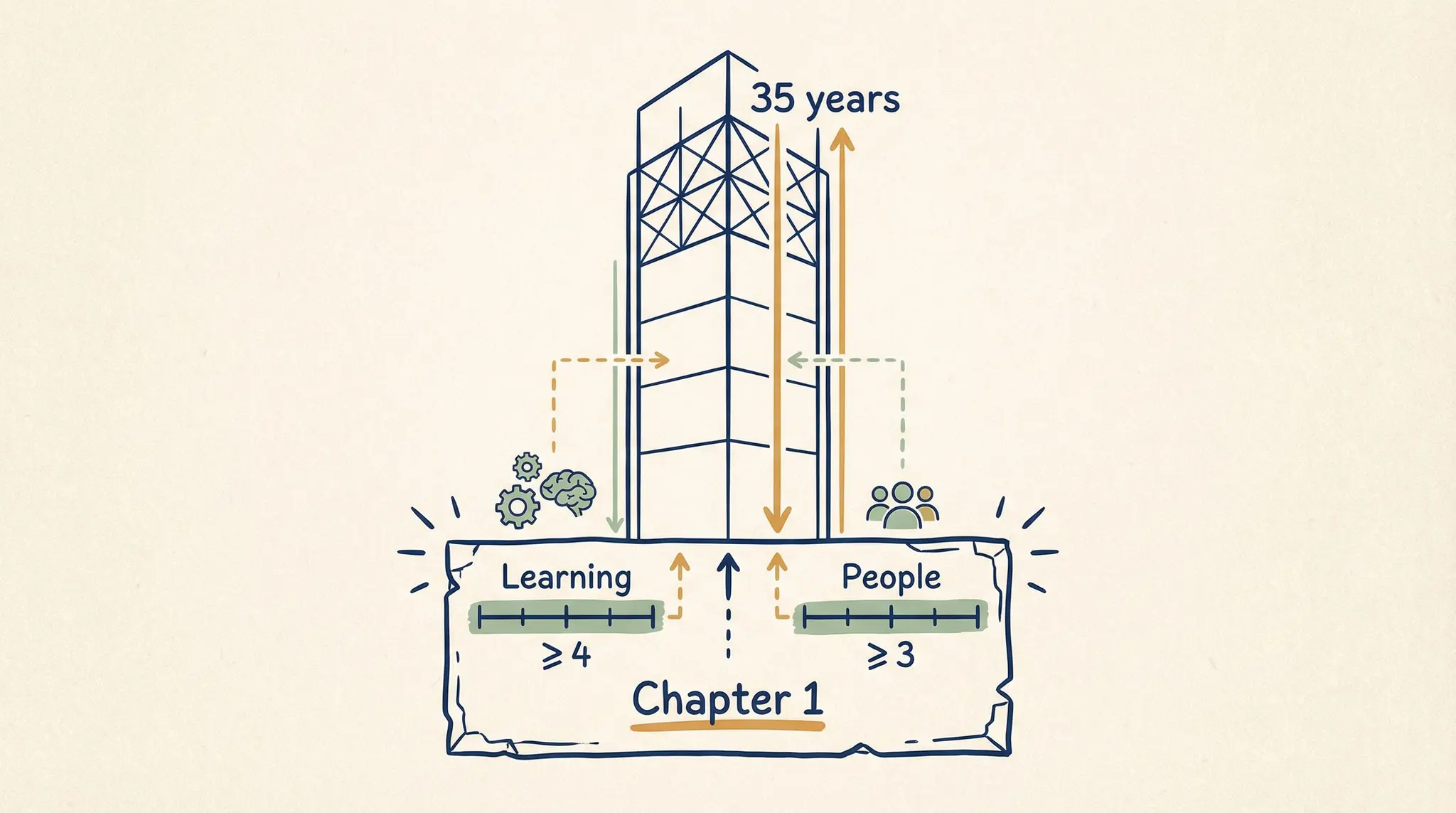
Chapter 1 hierarchy: Learning greater than or equal to 4 (non-negotiable) → People greater than or equal to 3 → Alignment greater than or equal to 2 → Others as tiebreakers
But here's what makes Chapter 1 different: the weights change dramatically in later chapters. In Chapter 3 (years 11-20), Alignment might become your top priority. In Chapter 5 (years 26-40), Pace often dominates. Right now, in Chapter 1, you're building the foundation that makes those later optimizations possible.
The Non-Negotiables: Learning + People
These two dimensions set your baseline for everything that follows. Get them wrong and you'll spend years unlearning bad patterns.
Learning: Your Skill Velocity Engine
What Learning=5 looks like: You're building skills that transfer across domains. Your manager gives you problems 2-3 levels above your current role ("Here's the customer retention analysis—figure out what's driving churn"). You're learning how to learn, not just executing playbooks. Example: A product manager role where you ship features, analyze user data, talk to customers, and present to executives—all in your first six months.
What Learning=3 looks like: Solid skill development in your function with some strategic exposure. You're getting better at your craft but mostly within defined boundaries. Example: A software engineering role where you write good code and occasionally join architecture discussions, but mostly implement specs others created.
What Learning=1 looks like: Repetitive execution. Skills only work in one context. You're doing the same type of work month after month with no exposure to adjacent problems. Example: A data analyst role where you run the same reports every week with minor variations.
Chapter 1 threshold: If Learning is below 4 for 6+ months, you've stayed 9-12 months too long. Your skill growth velocity in years 1-5 determines your ceiling in years 6-15.
People: Your Management Baseline
What People=5 looks like: Your manager explains why behind every project, not just what. Weekly 1:1s focused on your development, not just status updates. Monthly career conversations about where you want to go. Direct feedback culture where you know exactly how you're performing. Access to senior role models who show you what's possible. Example: A manager who says, "I'm giving you this project because you need to learn stakeholder management. Here's how I'd approach it, but I want you to try your way first."
What People=3 looks like: Competent manager who provides occasional mentorship. Bi-weekly 1:1s that mix status and development. Quarterly feedback that's mostly constructive. Functional team dynamics without toxicity. Example: A manager who answers your questions and gives you room to grow, but doesn't proactively invest in your development.
What People=1 looks like: Manager delegates without context. No growth investment—you're a resource, not a person. Toxic behavior is normalized (yelling, blame culture, political games). Example: A manager who says, "Just get it done" when you ask for clarification, or who criticizes your work in public channels.
Chapter 1 threshold: People=2 with no improvement after 3 months is the most common career regret we see in LA4P framework analysis. If you can't get to People=3 within your first quarter, start interviewing.
For more on evaluating manager quality during interviews, see How to Spot a 4/5 Manager in Interviews.
The Nice-to-Haves: Prestige + Pace + Profit
These matter, but they're not worth sacrificing Learning or People in Chapter 1.
Prestige: The Brand Signal
What Prestige=5 looks like: Top-tier brand that opens doors for a decade. Alumni network becomes a career asset. Example: Google, McKinsey, Goldman Sachs—names that make recruiters respond to cold emails.
What Prestige=3 looks like: Respected in your industry. Decent signal to future employers. Example: A Series C startup that's well-known in tech circles, or a regional consulting firm with strong local reputation.
What Prestige=1 looks like: Unknown company with limited brand value. You'll need to explain what they do in every interview. Example: A local business with no industry presence.
Chapter 1 trade-off: Accept Prestige=2 if Learning=5 and People=4. The skills compound more than the logo. But if you're career-switching or from a non-target school, Prestige=4-5 for 18-24 months can be worth Learning=3.
Pace: The Sustainability Question
What Pace=5 looks like: Sustainable 40-45 hours/week with clear boundaries. You can maintain hobbies, relationships, health. Example: A company with strong work-life balance culture where 6pm Slack messages are rare.
What Pace=3 looks like: Busy but manageable 50 hours/week. Occasional late nights during crunch periods. Example: A startup in growth mode where you're working hard but not burning out.
What Pace=1 looks like: Burnout culture where 60+ hours is expected. Weekends are work time. Health and relationships suffer. Example: Investment banking analyst programs or early-stage startups with unrealistic timelines.
Chapter 1 trade-off: You can sacrifice Pace short-term (12-24 months) if Learning=5 and you're building skills you'll use for decades. But Pace=1 for longer than two years often creates health issues that follow you into Chapter 2.
If you're experiencing burnout symptoms, use our 6-Dimension Burnout Diagnostic to identify exactly what's broken.
Profit: The Compensation Reality
What Profit=5 looks like: Top 10% compensation for your role and location. Example: $140k total comp for a software engineer in SF, or $95k for a product manager in Austin.
What Profit=3 looks like: Market rate for your role. You're not underpaid but not getting premium compensation. Example: $110k for a software engineer in SF, or $75k for a product manager in Austin.
What Profit=1 looks like: Below market rate, often significantly. Example: $70k for a software engineer in SF, or $50k for a product manager in Austin.
Chapter 1 trade-off: Accept up to 30% less compensation if Learning jumps from 3 to 5. The skill velocity compounds. But don't accept Profit=1 unless you have financial support—money stress kills learning.
The Wildcard: Alignment
Alignment is the dimension that varies most by person. Some people need it at 5 from day one. Others can tolerate Alignment=2 in Chapter 1 while building skills.
What Alignment=5 looks like: The mission deeply resonates. Work feels meaningful daily. You're building skills in a domain you want for the long term. Example: A climate tech role if you care about sustainability, or an education startup if you want to improve learning.
What Alignment=3 looks like: You don't hate the work. You can see the impact. Not actively misaligned with your values. Example: A B2B SaaS role where you're neutral on the product but enjoy the craft.
What Alignment=1 looks like: Building skills in a domain you plan to exit. Work feels meaningless or actively conflicts with your values. Example: A finance role when you want to work in healthcare, or an ad-tech role when you hate advertising.
Chapter 1 threshold: Alignment greater than or equal to 2 is the minimum. If Alignment=1, you're building skills you'll never use again. That's fine for a 6-month internship, but not for your first 2-3 years.
How to Actually Score Your Options (Not Just Gut Feel)
Here's how to turn fuzzy feelings into numbers:
Scoring Learning (1-5)
Ask yourself:
- Am I building skills that work in multiple contexts, or just this company's tools?
- Do I see problems 2-3 levels above my role, or just my immediate tasks?
- Am I learning how to learn, or executing playbooks?
Behavioral indicators:
- Learning=5: You're shipping work, analyzing results, talking to customers, and presenting to leadership—all in one project cycle. Your manager gives you problems without solutions.
- Learning=3: You're getting better at your core function with occasional cross-functional exposure. Your manager gives you problems with suggested approaches.
- Learning=1: You're doing similar work every week. Your manager gives you tasks with step-by-step instructions.
Scoring People (1-5)
Ask yourself:
- Does my manager explain why or just what?
- How often do we discuss my development vs. just project status?
- Do I have access to senior role models?
Behavioral indicators:
- People=5: Weekly 1:1s focused on development. Monthly career conversations. Manager introduces you to senior leaders. Direct feedback within 24 hours of events.
- People=3: Bi-weekly 1:1s mixing status and development. Quarterly feedback sessions. Manager answers questions but doesn't proactively mentor.
- People=1: Rare or no 1:1s. Feedback is vague or delivered publicly. Manager delegates without context. Toxic behavior (yelling, blame) is normalized.
Scoring Alignment (1-5)
Ask yourself:
- Do I care about this problem domain long-term?
- Does the work feel meaningful, or am I just collecting a paycheck?
- Am I building skills I'll want to use in 10 years?
Behavioral indicators:
- Alignment=5: You talk about your work at dinner parties because you find it interesting. You read industry news in your free time.
- Alignment=3: You're neutral on the mission but enjoy the craft. You don't think about work outside of work hours.
- Alignment=1: You're counting down to the weekend. You're building skills in a domain you plan to leave.
Scoring Prestige, Pace, Profit (1-5)
These are more objective:
Prestige: Google the company + "careers" and see if articles exist. Ask friends if they've heard of it. Check if alumni are at companies you admire.
Pace: Ask current employees: "What time do people typically leave?" and "How often do you work weekends?" Check Glassdoor for work-life balance ratings.
Profit: Use Levels.fyi, Glassdoor, or Blind to benchmark compensation. Compare to market rate for your role/location.
Real Chapter 1 Decisions (Worked Examples)
Here's how to apply the framework to actual trade-offs:
Example 1: High Learning vs. High People
Offer A Early-stage startup | Offer B Mid-size tech company | |
|---|---|---|
| Learning | 5 (building product, talking to customers, wearing multiple hats) | 3 (solid skill development in defined role) |
| People | 2 (founder-CEO with no management experience) | 4 (experienced manager, good team) |
| Alignment | 4 (mission resonates) | 3 (neutral on mission) |
| Prestige | 2 (unknown company) | 3 (respected in industry) |
| Pace | 2 (60-hour weeks) | 4 (sustainable 45-hour weeks) |
| Profit | 3 ($85k + equity) | 4 ($95k) |
Decision framework:
- If you have external mentors (advisor, peer group, strong network): Choose A for 18-24 months max. The Learning=5 compounds, and you can get People development elsewhere. Set a calendar reminder to re-evaluate at 18 months.
- If this is your only management exposure: Choose B. People=2 as your baseline is more dangerous than slower learning. You'll learn what good management looks like, which helps you evaluate every future role.
Why: In our LA4P framework analysis, professionals who started with People=2 and no external mentorship spent an average of 18 additional months in each subsequent bad management situation—roughly 3-4 years of career velocity lost to a pattern learned at 23.
Example 2: Prestige vs. Learning
Offer A FAANG company | Offer B Series B startup | |
|---|---|---|
| Learning | 3 (solid but not exceptional) | 5 (building across product, data, strategy) |
| People | 3 (competent manager, functional team) | 4 (great manager, strong team) |
| Alignment | 2 (don't love the product) | 4 (mission resonates) |
| Prestige | 5 (top-tier brand) | 2 (unknown outside tech circles) |
| Pace | 3 (manageable 50-hour weeks) | 3 (busy but sustainable) |
| Profit | 5 ($140k total comp) | 3 ($105k + meaningful equity) |
Decision framework:
- If you need the brand to open doors (non-target school, career switching, international student needing visa): Choose A for 24 months, then move to a Learning=5 role. The Prestige=5 gives you optionality that compounds.
- If you already have credibility signals (target school, strong internships, technical portfolio): Choose B. The Learning=5 and People=4 combination is rare and compounds exponentially.
Why: Prestige has diminishing returns after 2-3 years. The brand opens doors, but Learning=5 determines how far you walk through them. If you take Offer A, set a 24-month timer to move before you get comfortable.
Example 3: Compensation vs. Everything
Offer A Finance/consulting | Offer B Tech startup | |
|---|---|---|
| Learning | 2 (repetitive execution) | 4 (strong skill development) |
| People | 2 (sink-or-swim culture) | 4 (great manager) |
| Alignment | 1 (building skills you'll never use) | 4 (mission resonates) |
| Prestige | 4 (strong brand) | 2 (unknown company) |
| Pace | 1 (70-hour weeks) | 3 (manageable) |
| Profit | 5 ($120k) | 2 ($70k + equity) |
Decision framework:
- If you have student loans over $80k or family financial obligations: Consider A for 12-18 months to build savings, then move. But set a hard deadline—golden handcuffs form fast.
- If you have financial flexibility: Choose B. The Learning=4 + People=4 + Alignment=4 combination is worth the short-term pay cut. You'll make up the $50k difference within 3-4 years through faster skill growth.
Why: Taking Offer A without a clear exit plan is how you end up at 27 with $480k in savings but skills that only work in one narrow context. The switching cost grows every year.
Example 4: The Balanced Option
Offer A: Series C startup
- Learning=4 (strong growth opportunities)
- People=4 (experienced manager)
- Alignment=3 (neutral on mission)
- Prestige=3 (respected in industry)
- Pace=4 (sustainable)
- Profit=4 ($100k + equity)
Decision: This is a "no red flags" offer. Nothing is exceptional, but nothing is broken. In Chapter 1, this is often the right choice—you're building a solid foundation without major trade-offs. Take it, stay 2-3 years, and re-evaluate when you hit Chapter 2.
Example 5: The Mission-Driven Trade-off
Offer A Climate tech startup | Offer B B2B SaaS | |
|---|---|---|
| Learning | 5 (building across domains) | 4 (strong skill development) |
| People | 3 (decent manager) | 4 (great manager) |
| Alignment | 5 (mission deeply resonates) | 2 (neutral on mission) |
| Prestige | 2 (unknown company) | 3 (respected company) |
| Pace | 2 (60-hour weeks) | 4 (sustainable) |
| Profit | 2 ($75k) | 4 ($95k) |
Decision framework:
- If Alignment=5 is non-negotiable for you: Choose A, but get external mentorship to compensate for People=3. Join climate tech communities, find an advisor, build peer support.
- If you can tolerate Alignment=2 short-term: Choose B. Build skills in a sustainable environment, then move to climate tech in 2-3 years with stronger capabilities.
Why: Alignment matters, but not at the cost of burning out (Pace=2) or building bad management patterns (People=3 without external support). If you choose A, set clear boundaries to protect Pace and find mentors to supplement People.
The Compound Effects: How Chapter 1 Shapes Years 8-12
Here's what happens when you optimize wrong in Chapter 1:
If you learn to tolerate People=2 managers: You'll average 18 more months in each subsequent bad management situation. That's 3-4 years of career velocity lost to a pattern learned at 23. By year 10, you're wondering why everyone else seems to have better managers—but you've been filtering for the wrong signals.
If you optimize for Profit=5 with Learning=2: You build skills that only work in one context. By year 8, switching industries means starting over—often at a 30-40% pay cut. The $50k you "saved" by taking the high-paying role at 23 costs you $200k+ in lost earnings from years 8-12 because you're restarting your learning curve.
If you chase Prestige=5 with Learning=3: You have a great resume but mediocre skills. By year 10, you're competing with people who have both the brand AND the capabilities. The logo opens doors, but you can't walk through them effectively. You plateau earlier than peers who prioritized Learning=5.
If you nail Learning=5 + People=4 in Chapter 1: You build a quality bar that accelerates every subsequent move. By year 8, you're two levels ahead of peers because you learned to recognize great opportunities early. You've never tolerated bad management, so you haven't lost years to toxic environments. Your skills transfer across contexts, so you have optionality.
The math is simple: Chapter 1 is 5 years. But the patterns you learn compound for 35 years. A bad pattern costs you 3-4 years of velocity. A good pattern gives you 3-4 years of acceleration. That's a 6-8 year swing in outcomes—all from decisions made between 22-27.
For more on how early patterns compound, see Experience Density: Why 4 Years of Learning Beats 7 Years of Repetition.
Plan Your Chapter 1 Strategy
Use our interactive Chapter Planner to define your priorities and track your progress.
Your Chapter 1 Audit (5 Minutes)
Here's how to use this playbook right now:
Your Chapter 1 Audit
Score your current role and set your decision timeline
Step 1: Score Your Current Role | |
|---|---|
| Learning | 1 2 3 4 5 |
| People | 1 2 3 4 5 |
| Alignment | 1 2 3 4 5 |
| Prestige | 1 2 3 4 5 |
| Pace | 1 2 3 4 5 |
| Profit | 1 2 3 4 5 |
Step 2: Check Against Chapter 1 Thresholds | |
| Is Learning greater than or equal to 4? | Yes/No - If no, you're not building fast enough |
| Is People greater than or equal to 3? | Yes/No - If no, you're setting a bad baseline |
| Is Alignment greater than or equal to 2? | Yes/No - If no, you're building skills you won't use |
Step 3: Set Your Decision Timeline | |
If Learning below 4 or People below 3 Set calendar reminder for 3 months to re-score. If unchanged, start interviewing. | |
If all thresholds met but not exceptional Set calendar reminder for 12 months to re-evaluate. You're building a solid foundation. | |
If Learning greater than or equal to 4 AND People greater than or equal to 4 You're in a great spot. Set calendar reminder for 24 months to check if you're ready for Chapter 2. | |
Step 4: Track Your Pattern | |
| Date | Today's date |
| Company/Role | Current position |
| L/A/P/Pr/Pa/Pf scores | e.g., 4/3/4/3/4/3 |
| Key decision | Stayed/Left/Joined |
Outcome 6 months later To be filled in later... | |
Step 5: Know When Chapter 1 Ends | |
| Years working | 4-6 years typically |
| Number of roles | 2-3 different roles (internal moves count) |
Pattern recognition Do you know what Learning=5 and People=5 feel like? | |
Ready for new optimization Are you ready to optimize for different dimensions (Alignment, Pace, specialized expertise)? | |
📖 Plan your next chapter
Define your 5-year career chapter
Use Interactive Chapter Planner →💡 Remember: This becomes your personal data on what works. By the time you hit Chapter 2, you'll have 5 years of pattern recognition to guide bigger decisions.
Use Interactive Chapter Planner →The Meta-Game
Here's what most people miss: Chapter 1 isn't about finding the perfect role. It's about building the pattern recognition to evaluate every future role.
Your first manager teaches you what management looks like. Your first learning environment teaches you what growth feels like. Your first mission teaches you what alignment means.
If those baselines are broken, you'll tolerate broken situations for years. If those baselines are exceptional, you'll never settle for less.
The playbook isn't about optimizing one decision. It's about optimizing your decision-making framework for 40 years.
That's the meta-game. And it starts now.
Sources & Further Reading
-
Career Transitions: A Step-by-step Framework - Every A framework for navigating career transitions with structured decision-making approaches.
-
Career Kickstarter 101: A playbook to take your career the distance - LinkedIn Talent Solutions LinkedIn's comprehensive playbook for early-career professionals building long-term career foundations.
Next 5 minutes
Turn this playbook into a move on your map.
Open 40yearscareer, add the role or offer this play targets, and score it 1–5 on each axis. Then pick one axis to move from 2→3 or 3→4 this month.
Free while we're in beta. No inbox clutter, no selling your data.