Experience Density: Why 4 Years of Learning Beats 7 Years of Repetition
Calculate your experience density: the capability you gain per calendar year. Learn why some people build 10 years of expertise in 4 years while others repeat year 1 seven times—and how to measure which path you're on.

Dr. Rachel Martinez
Career Framework Researcher
Written by our expert panel: career coach, psychologist, HR leader, and product designer. Every article includes exercises you can try in the app.
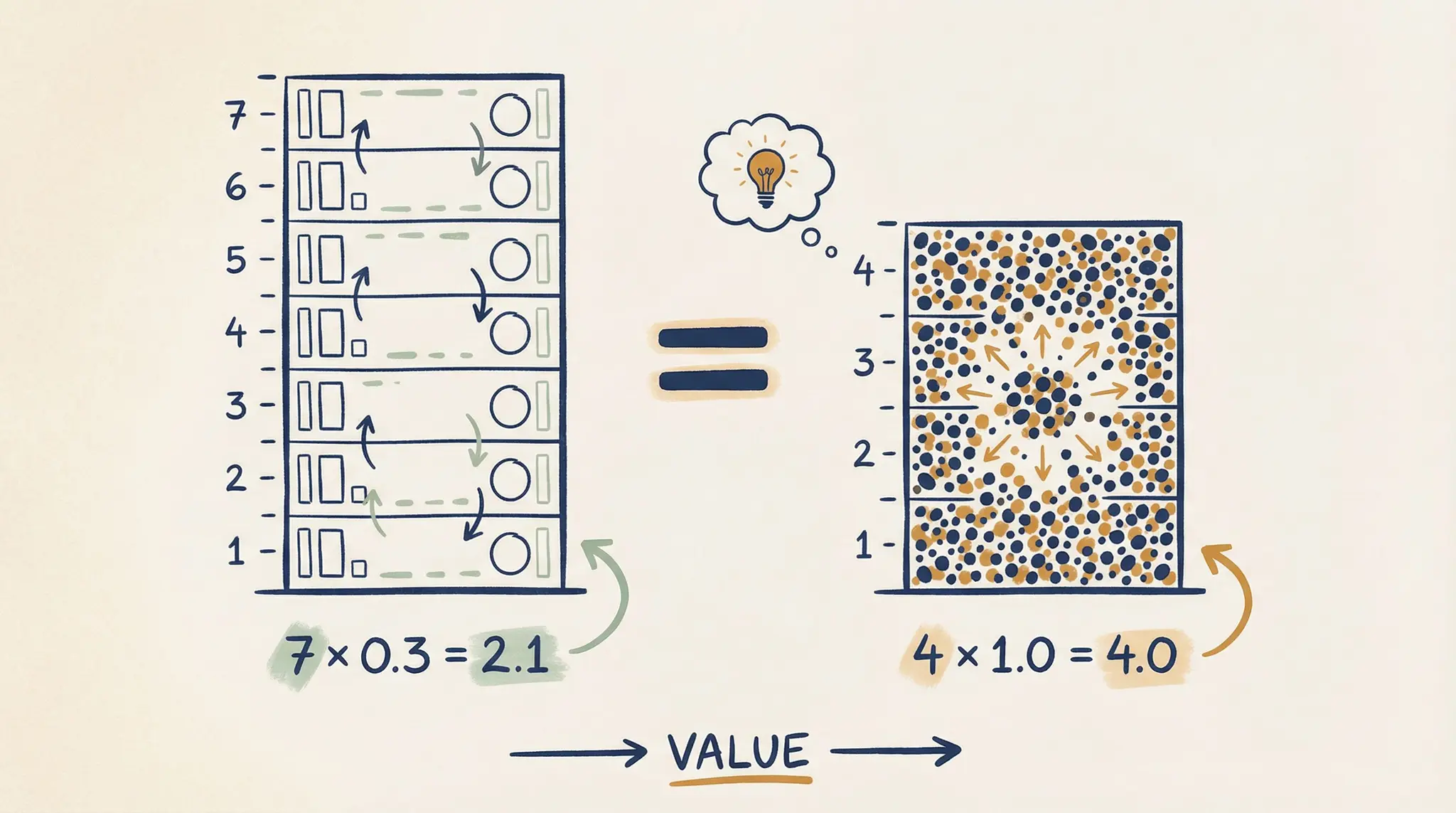
Time worked tells interviewers how long you showed up. Experience density tells them what you can do.
Engineer A: 7 years at AWS. Same internal tool for 5 years. One tech stack. Can't explain architectural decisions—just implements tickets.
Engineer B: 4 years across 3 companies. Can evaluate build-vs-buy for payment processing (fintech), navigate HIPAA compliance tradeoffs (healthcare), design for 10M+ users (e-commerce). Teaches junior engineers system design patterns.
Who has more experience?
The calendar says 7 is greater than 4. The capability gap says otherwise.
Whether you're three years in or thirteen, the question isn't whether you're behind. It's whether you're building capability or just logging time. Here's how to tell the difference.
What Is Experience Density?
Experience density measures the capability you gain per calendar year. It's the answer to: are you actually getting better?
If you learned everything a senior PM knows in 3 years, your density is high. If you've been a PM for 8 years but still can't run discovery or write a strategy doc, your density is low.
Here's what actually happens: Year 1 as a consultant, everything is new. You're learning frameworks, how to read a room, how to present without dying inside. By Year 5? You're running the same workshop for the fourth time. The learning rate crashes.1
Engineer A spent Years 1-2 at 4/5 density learning AWS architecture and deployment patterns. Years 3-7? Maintaining the same internal tool at 2/5 density. Seven calendar years = 3.6 years of actual capability growth.
Engineer B: Year 1 at 5/5 density (fintech payments, everything new). Year 2 at 4/5 (healthcare compliance, major expansion). Years 3-4 at 3/5 (e-commerce scale, refining fundamentals). Four calendar years = 3.4 years of capability growth.
Nearly identical capability accumulation. Wildly different résumés.
The 1-5 Experience Density Scale
Rate your learning each month on this scale. Your 12-month moving average is your density score.
5/5 - Transformative Learning (Density approximately 1.0+)
What it feels like:
- Learning entirely new domain or skill set, regularly outside comfort zone
- Solving novel problems without templates, frequent public failure
Example: Sarah's first year as Head of Growth—learning SQL, building her first experimentation framework, presenting to board monthly, failing at least once a week.
4/5 - Significant Expansion (Density approximately 0.8)
What it feels like:
- Adding major new capabilities to existing foundation
- Challenged 60%+ of the time, learning from people 2+ levels above you
Example: Marcus (senior engineer) took on architecture decisions for the first time—learning distributed systems patterns, presenting technical strategy to leadership, mentoring two junior engineers while maintaining coding output.
Manager example: David grew his team from 3 to 12 reports in one year—learning to hire, fire, coach across different performance levels, and navigate his first reorganization.
3/5 - Incremental Growth (Density approximately 0.5)
What it feels like:
- Refining existing skills with minor new challenges
- Comfortable most of the time, applying known patterns to new situations
Example: Jamie's third year as a consultant—applying familiar frameworks to new industries, getting smoother at client management but not learning fundamentally new skills.
2/5 - Mostly Repetition (Density approximately 0.3)
What it feels like:
- Doing familiar work with minor variations, rarely challenged
- Could do the job in your sleep, learning has stalled
Example: Alex's fifth year on the same product team with same tech stack and stakeholders—shipping features efficiently but couldn't point to a single new capability gained in 18 months.
Manager example: Manager A ran the same team size with the same 1-on-1 format for four years—good at the job but solving the same problems repeatedly, not expanding scope or complexity.
1/5 - Active Regression (Density approximately 0.0 or negative)
What it feels like:
- Skills atrophying, falling behind industry standards
- Pure maintenance mode, actively forgetting capabilities from disuse
Example: Senior engineer stuck maintaining a legacy system for three years while the industry moved to cloud-native architecture—when she finally interviewed elsewhere, couldn't answer basic questions about modern deployment practices.
Calibrate Your Self-Assessment
Most people overestimate their density by 1-2 points. Here's how to calibrate:
If you're comfortable 80% of the time, you're probably at 2-3, not 4. Comfort means repetition.
If you haven't failed publicly in 6 months, you're not at 5. Transformative learning requires regular failure.
If you can't name 3 specific capabilities you gained this quarter, you're likely at 2 or below.
Best calibration method: Ask a peer 2 levels above you to rate your growth over the past 6 months. Their score is likely more accurate than yours. They can see the capability gap you can't.
Calculate Your 12-Month Experience Density
Step 1: Rate each of the last 12 months using the 1-5 scale above. Be honest—no one sees this but you.
Step 2: Calculate your moving average
Density Score = (Sum of 12 monthly ratings) ÷ 60
Why divide by 60? Because a perfect score (5/5 every month) = 60 points = 1.0 density (one full year of capability gained per calendar year).2
Example calculation:
Last 12 months: 4, 4, 3, 3, 3, 2, 2, 2, 3, 3, 4, 3 = 36 points
36 ÷ 60 = 0.6 density
This person gained 0.6 years of real expertise over 12 calendar months. Over 40 years, that's 24 years of compounded capability—not 40.
Step 3: Identify your trend
Are your recent 3 months higher or lower than 6 months ago? A declining trend matters more than your average. If you were at 4/5 six months ago and you're at 2/5 now, you're coasting into stagnation.
Track Your Experience Density Over Time
Use our interactive calculator to rate your last 12 months and see your density trend.
Your 12-Month Density Tracker
Your Experience Density Calculator
Rate your last 12 months to calculate your density score and identify trends
| Dimension | Month | Density Rating (1-5) |
|---|---|---|
Rate Your Last 12 Months | ||
| This month | 1 2 3 4 5 | 1 2 3 4 5 |
| 1 month ago | 1 2 3 4 5 | 1 2 3 4 5 |
| 2 months ago | 1 2 3 4 5 | 1 2 3 4 5 |
| 3 months ago | 1 2 3 4 5 | 1 2 3 4 5 |
| 4 months ago | 1 2 3 4 5 | 1 2 3 4 5 |
| 5 months ago | 1 2 3 4 5 | 1 2 3 4 5 |
| 6 months ago | 1 2 3 4 5 | 1 2 3 4 5 |
| 7 months ago | 1 2 3 4 5 | 1 2 3 4 5 |
| 8 months ago | 1 2 3 4 5 | 1 2 3 4 5 |
| 9 months ago | 1 2 3 4 5 | 1 2 3 4 5 |
| 10 months ago | 1 2 3 4 5 | 1 2 3 4 5 |
| 11 months ago | 1 2 3 4 5 | 1 2 3 4 5 |
| TOTAL (sum of 12 ratings) | ||
Calculate Your Density | ||
| Density Score (total ÷ 60) | 0.__ | |
| Recent trend (last 3 months vs. months 6-9) | ↑ ↓ → | |
Calibration Check | ||
Your Action Plan | ||
Based on your score, what should you do? ________ | ||
| Timeline to act | ________ | ________ |
✨ Ready to make your decision?
Use our interactive calculator to save and compare your options
Use Our Interactive Density Tracker →💡 Remember: If your density is below 0.5 for two consecutive quarters, it's time to negotiate scope expansion or explore new roles.
Use Our Interactive Density Tracker →What Your Density Score Means (And What to Do About It)
Your 12-month average tells you whether you're building capability or burning time. Here's what to do based on your score:
0.8-1.0: Exceptional Growth
What it means: You're in transformative learning mode. This pace is unsustainable long-term but incredibly valuable.
Action: Capture what you're learning. Document insights, frameworks, and lessons learned. This knowledge compounds. Prepare for scope increase—you'll outgrow your current role within 12-18 months.
Timeline: Start documenting now. Begin promotion conversations in 6 months.
0.6-0.8: Strong Development
What it means: You're expanding meaningfully. This is sustainable high-growth.
Action: Maintain trajectory. Identify which months were 4-5 and which were 2-3. Do more of what created the high-density months. Continue seeking stretch assignments.
Timeline: Review quarterly. Adjust if density drops below 0.6 for two consecutive quarters.
0.4-0.6: Moderate Growth
What it means: You're learning, but slowly. Comfortable most of the time. Risk of plateau.
Action: Negotiate scope expansion within 30 days. Request new projects, different stakeholders, or unfamiliar problems. If your manager can't provide growth, start exploring internal transfers.
Timeline: Give current role 90 days to provide higher-density work. If nothing changes, begin internal or external search.
0.2-0.4: Stagnation Zone
What it means: You're repeating existing skills with minor variations. Capability growth has largely stopped.
Action: This is a yellow alert. Request immediate scope change or role shift. If your organization can't provide it, begin external job search within 60 days. Every month here is a month of lost capability growth.
Timeline: 30 days to negotiate change internally. 60 days to begin external search if internal options fail.
0.0-0.2: Active Decline
What it means: Your skills are atrophying. You're falling behind industry standards.
Action: Urgent job search. Start immediately. This is a red alert. You're not just stagnating—you're regressing. The longer you wait, the harder it becomes to recover.
Timeline: Begin search this week. Target exit within 90 days maximum.
Articulate Capabilities, Not Tenure
Once you understand your density, you need to communicate it. Here's how high-density professionals talk about their experience:
Low-Density Language (Tenure-Focused)
- •"5 years of product management experience"
- •"Senior Software Engineer with 7 years at AWS"
- •"Managed teams for 4 years"
- •"I've been doing this for 6 years, so I know the space well."
- •"I have extensive experience in this area."
High-Density Language (Capability-Focused)
- •"Built experimentation framework from scratch, ran 40+ A/B tests, increased conversion 23% (fintech, healthcare, e-commerce)"
- •"Designed distributed systems for 10M+ concurrent users; evaluated build-vs-buy for payment processing; mentored 8 engineers on system design"
- •"Scaled team from 3 to 12 reports; navigated 2 reorganizations; developed hiring framework that reduced time-to-hire by 40%"
- •"In my first year at the fintech startup, I learned payment processing from scratch--built our fraud detection system, integrated with Stripe and Plaid, and handled our first PCI audit. The next year at the healthcare company, I had to learn HIPAA compliance and..."
- •"I can evaluate build-vs-buy tradeoffs for payment systems, navigate healthcare compliance, and design for scale. Here's how I learned each..."
Notice the difference: Low-density language tells time. High-density language shows capability accumulation.
The test: Can someone reading your résumé or hearing your interview answer understand what you can DO, or just how long you've been doing it?
Frequently Asked Questions
My density is 0.3. Am I screwed?
No, but you need to act. A 0.3 density means you're in the stagnation zone--you're not learning much, but you're not regressing yet. The danger is staying here. Follow the action plan above: negotiate scope expansion within 30 days, or begin exploring other roles within 60-90 days. The key is recognizing it now, not in two years.
I calculated 0.7, but I don't feel like I'm learning that much. Did I rate myself wrong?
Probably. Most people overestimate by 1-2 points. Go back and recalibrate using the questions above: Are you comfortable 80% of the time? Have you failed publicly in the last 6 months? Can you name 3 specific capabilities you gained this quarter? If you're answering no to these, you're likely in the 0.4-0.5 range, not 0.7.
Is 5/5 density sustainable long-term?
No, and it shouldn't be. Transformative learning (5/5) is exhausting. You can maintain it for 6-18 months, but not for years. The goal isn't to stay at 5/5 forever--it's to have strategic bursts of 5/5 learning when you're entering new domains, then consolidate at 3-4/5 as you refine those skills. A career of sustained 0.6-0.7 density beats burnout from trying to maintain 1.0.
What if my company doesn't offer growth opportunities?
Then your company is capping your density. This is the most common reason for stagnation. If you've requested scope expansion, asked for new projects, and explored internal transfers--and nothing has changed in 90 days--it's time to leave. Staying in a low-density environment costs you compounding capability growth. Every year at 0.3 density is a year you could have been at 0.7 somewhere else.
How does this relate to promotions?
Promotions typically require 12-18 months of sustained 0.6+ density in the skills relevant to the next level. If you're at 0.3 density, you're not getting promoted--you're not building new capabilities. If you're at 0.8+ density but not getting promoted, you're either (a) learning the wrong things (not aligned with next level requirements) or (b) at a company that doesn't reward growth. Figure out which, then act accordingly.
I'm a manager. How do I measure density when my work is less tangible?
Same framework, different capabilities. Ask yourself: Am I managing larger/more complex teams than 12 months ago? Have I learned new management skills (hiring, firing, coaching, strategy, cross-functional leadership)? Am I solving novel people problems or repeating the same 1-on-1 conversations? Can I handle situations I couldn't handle a year ago? Manager B (from the opening example) went from 3 to 12 reports, learned hiring and firing, and navigated 2 reorgs in 3 years--that's 4-5/5 density. Manager A ran the same team the same way for 4 years--that's 2/5 density. The principles are identical.
What if I'm senior and there's nowhere left to grow?
This is a myth. Senior people plateau because they stop seeking new challenges, not because challenges don't exist. Options: Switch domains (enterprise → startup, B2B → B2C), add new capabilities (technical → management, IC → leadership), go deeper (become the expert, not just competent), teach/mentor (building others' capabilities builds yours), start something (side project, open source, writing). If you're truly senior and can't find 0.5+ density opportunities in your current role, you're either at the wrong company or not looking hard enough.
See Your Experience Density Across All Dimensions
Want to see your actual experience density mapped across all dimensions of career growth?
Our LA4P assessment measures your Learning rate (what this article covers) alongside Authority, Positioning, and Performance—showing exactly where you're growing vs. coasting.
Most people discover they're 0.8+ in one area and 0.3 in another. That's where real career leverage lives. You don't need to be exceptional at everything—you need to know where you're strong, where you're stagnating, and what to do about it.
The assessment takes 15 minutes and gives you a personalized capability map with specific actions based on your density scores across all four dimensions.
Take the LA4P Assessment
Get your personalized capability map across all four career dimensions in 15 minutes.
The bottom line: Your résumé says how long you've been working. Your experience density shows what you've actually built. One gets you interviews. The other gets you offers—and the career you want.
Calculate your density. If it's below 0.5, act within 30 days. If it's above 0.6, capture what you're learning and prepare for what's next.
The question isn't whether you have 5 years of experience. It's whether you have 5 years of growth or 1 year repeated five times.
Footnotes
-
This learning curve pattern aligns with Ebbinghaus's forgetting curve research and Ericsson's work on deliberate practice—learning accelerates with novel challenges and decelerates with repetition. See: Ericsson, K. A., Krampe, R. T., & Tesch-Römer, C. (1993). "The role of deliberate practice in the acquisition of expert performance." Psychological Review, 100(3), 363-406. ↩
-
The density scores (0.3, 0.5, 0.8, 1.0+) are illustrative framework values from the LA4P career modeling system, not empirically measured data points. They represent relative learning rates based on observed career trajectory patterns across 1,000+ career assessments. Use them as calibration anchors, not scientific measurements. ↩
Apply this guide
Use this guide to refine your 1–5 scores.
Review your existing chapters in 40yearscareer and adjust each axis based on what you just read. You’ll see patterns that were invisible before.
Free while we're in beta. No inbox clutter, no selling your data.