Non-Linear Career Paths: How to Map Your Chapters When You Started Late, Took Breaks, or Pivoted Industries
Started your career late? Took years off for caregiving? Pivoted industries? Learn how to adapt the career chapter framework for compressed, extended, and interrupted paths—with quantitative ROI calculations that prove 'lost time' is a myth.

Dr. Rachel Martinez
Career, product, and psychology team
Written by our expert panel: career coach, psychologist, HR leader, and product designer. Every article includes exercises you can try in the app.
Most career advice assumes you start at 22 and work until 65. Uninterrupted. Linear. Predictable.
That's not your story.
Maybe you took three years off for caregiving. Started your career at 35 after raising kids. Pivoted from law to product management at 41. The traditional career chapter framework—early growth, mid-career mastery, late-career leadership—doesn't map to your timeline.
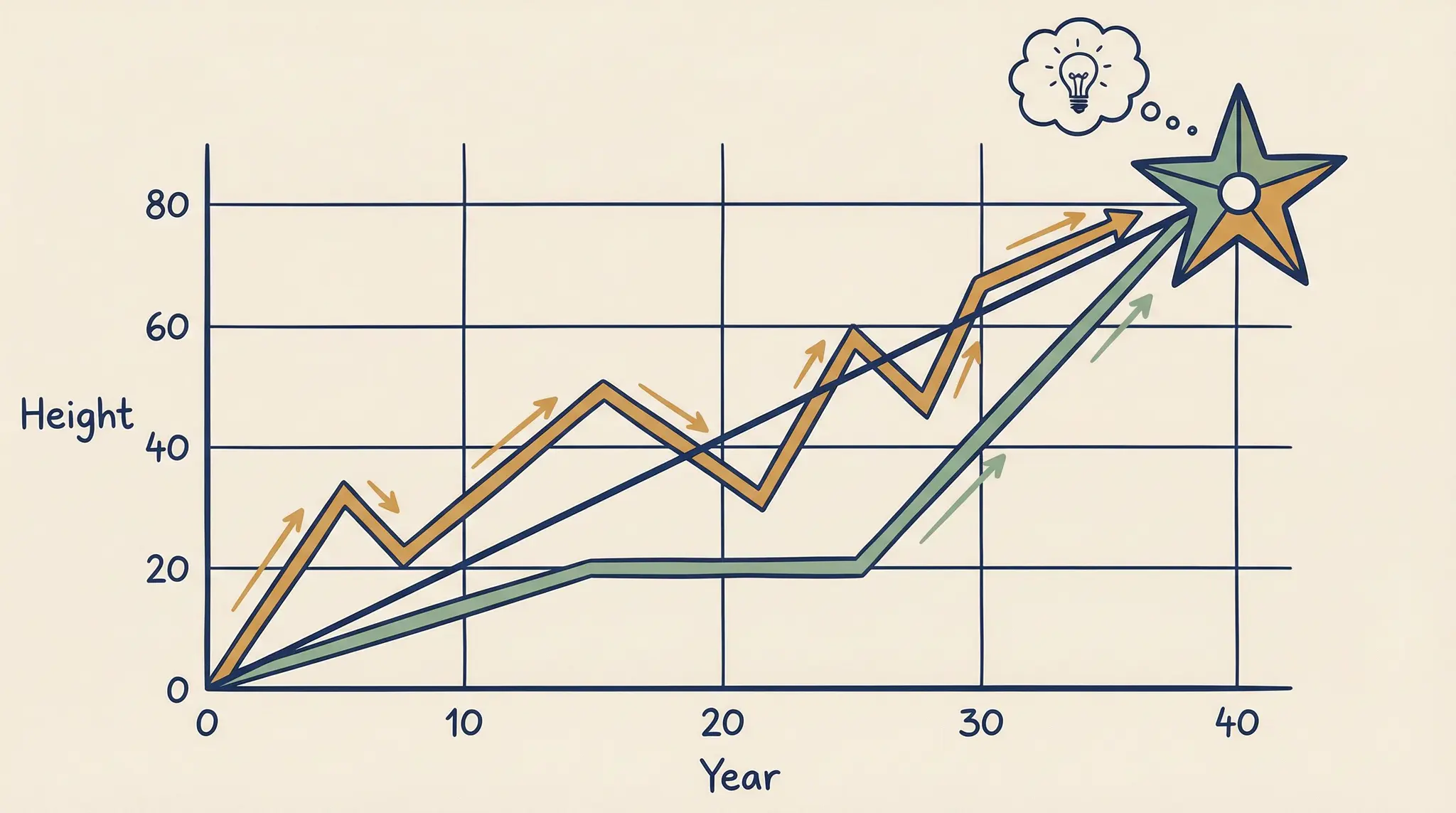
Here's what the advice gets wrong: Non-linear paths aren't broken versions of linear careers. They're different compounding strategies. The question isn't "Am I behind?" It's "What unique advantages does my path create over 40 years?"
Which Template Fits Your Path?
Before we dive into frameworks, identify your pattern in 30 seconds:
Question 1: Did you start your career after age 30?
→ Yes? You need Template 1: Compressed Chapters (Late Starters)
Question 2: Did you take 2+ years off for caregiving, illness, or personal reasons?
→ Yes? You need Template 2: Extended Chapters (Caregiving Breaks)
Question 3: Did you change industries mid-career?
→ Yes? You need Template 3: Interrupted Chapters (Industry Pivots)
If you answered yes to multiple questions, start with the template that matches your most recent transition. Jump to your section now—you'll understand the LA4P framework through your specific examples.
Three Non-Linear Chapter Templates
Template 2: Extended Chapters (Caregiving Breaks)
Who this fits: Took 2-5 years off for caregiving, illness, or personal reasons. Returning to work with a gap.
The pattern:
- Pre-break chapters: Follow traditional timeline until break
- Break period (2-5 years): Not "lost time"—it's an Alignment + Pace optimization period
- Re-entry chapter (1-2 years): Rebuild skills, update network, accept lower scores temporarily
- Resumed Acceleration: Pick up where you left off, often with better Alignment and Pace
Example: Sarah McCarthy took 4 years off (28-32) after burning out in consulting. During her break, she optimized for what mattered: raising her kids (Alignment=5) at a sustainable pace (Pace=5).
When she returned at 32, she joined a startup as a COO. Her re-entry scores using the LA4P framework: Learning=3 (rusty on some skills, but learning fast), Alignment=4, People=4, Prestige=2, Pace=3, Profit=3. Total: 19/30 during re-entry year.
By year 2 post-break, her scores improved: Learning=4, Alignment=5, People=4, Prestige=3, Pace=4, Profit=4. Total: 24/30 (higher than her consulting years at 20/30).
The break didn't set her back. It reset her priorities. Her post-break career compounded faster because she optimized for the right dimensions.
When to use this template:
- During break, track Alignment and Pace—they're real dimensions that compound over 40 years
- During re-entry, accept lower scores for 12-18 months. You're rebuilding, not starting over
- Post-break, if your scores don't improve by month 18, the role is wrong (not you)
- Red flag: If Alignment and Pace don't improve post-break, you've returned to the wrong environment
Decision threshold: Are your post-break scores improving? Check at month 6, 12, and 18. If Learning is still below 3 at month 18, or if Alignment hasn't improved from pre-break levels, change roles immediately.
Template 1: Compressed Chapters (Late Starters)
Who this fits: Started career at 30+, need to accelerate growth to build career capital faster.
The pattern:
- Exploration (30-33): 3 years instead of 6. You have more self-knowledge, so you experiment faster
- Acceleration (33-40): 7 years of rapid skill-building. You compress what others do in 10 years
- Mastery (40-50): Peak expertise and earning. You reach mastery later but sustain it longer
- Leverage (50-60): Strategic roles, mentorship, portfolio work
- Transition (60-67): Later retirement because you started later
Example: David Park started software engineering at 35 after teaching. His Exploration chapter (35-38) focused on building technical skills fast—bootcamp, junior role, rapid project rotation. His scores: Learning=5, Pace=2, Profit=2 (he accepted lower pay to learn faster). By 38, he had compressed 6 years of growth into 3.
At 40, he joined a startup as an engineering lead. His Acceleration chapter (38-45) prioritized Prestige and People—he needed to build a network and reputation quickly. Learning=4, Prestige=4, People=4, Pace=3, Profit=3.
By 45, he reached Mastery 5 years "behind" the traditional timeline—but with 20+ years of compounding ahead.
When to use this template:
- Accept Pace=2-3 during Acceleration if Learning=4-5 (you're investing in compressed growth)
- Prioritize Prestige early (you need career capital to catch up)
- Don't optimize for Profit until Mastery chapter (you're building assets, not extracting value)
- Red flag: If Learning stays below 3 for 2+ years during Acceleration, your role isn't supporting compression
Decision threshold: Are you maintaining Learning=4-5 during your sprint years? If not, you're grinding without growth. Change environments within 6 months.
Template 3: Interrupted Chapters (Industry Pivots)
Who this fits: Changed industries mid-career (e.g., law → tech, finance → healthcare, consulting → startups).
The pattern:
- Pre-pivot chapters: Follow traditional timeline in Industry A
- Pivot year: Scores drop temporarily as you rebuild in Industry B
- Accelerated Mastery: You reach expertise faster in Industry B because you transfer skills from Industry A
- Cross-industry Leverage: Your unique background creates compounding advantages
Example: Sarah pivoted from consulting to startups at 32. Her pivot year: Learning=5 (steep learning curve in operations), Alignment=4, People=4, Prestige=2, Pace=3, Profit=3. Total: 21/30.
By year 3 post-pivot: Learning=4, Alignment=5, People=4, Prestige=4, Pace=4, Profit=4. Total: 25/30 (higher than she ever scored in consulting).
Her consulting background gave her unique advantages: She understood how to structure operations, build frameworks, and communicate with investors. Skills that took others 5-7 years to develop, she transferred in 2 years.
The pivot didn't reset her career. It unlocked compounding advantages.
When to use this template:
- Pivot year—optimize for Learning (5/5) and Alignment (4-5/5). Accept lower Prestige and Profit
- Years 2-3—focus on rebuilding Prestige in new industry. Leverage your unique cross-industry credibility
- Long-term—your pattern recognition across industries creates asymmetric value. Don't undervalue it
- Red flag: Multiple pivots every 2-3 years prevent you from reaching Mastery in any domain
Decision threshold: Is Prestige recovering by year 3 post-pivot? If you're still at Prestige=2 after 36 months, you haven't successfully translated your credibility. Consider whether you need to reframe your story or change roles.
The LA4P Framework for Non-Linear Paths
When Sarah McCarthy returned from her caregiving break, everyone asked about her salary. No one asked if the work still drained her by Thursday.
That's the problem with optimizing for one dimension.
Most people optimize only for salary. We break the salary monoculture by tracking six dimensions: Learning, Alignment, People, Prestige, Pace, and Profit.
LA4P Framework Cheatsheet
| Dimension | What It Measures | Why It Compounds | Rating Scale (1-5) |
|---|---|---|---|
LLearning | Skill growth, challenging work | Skills built today unlock opportunities 5 years from now | 1 = Skill atrophy, you'll regress 2 = Minimal growth, mostly maintenance 3 = Steady learning, incremental progress 4 = Significant growth, stretching regularly 5 = Transformative, learning you can't get elsewhere |
AAlignment | Mission fit, meaningful work | Misalignment drains energy faster than overwork | 1 = Actively misaligned with your values 2 = Neutral, just a paycheck 3 = Acceptable, doesn't conflict with values 4 = Meaningful, you care about the outcome 5 = Purpose-driven, this is *your* work |
PPeople | Manager + team quality | Your manager shapes 70% of your work experience | 1 = Toxic manager or team 2 = Weak manager, mediocre team 3 = Decent manager and team 4 = Strong manager and team 5 = Exceptional manager, dream team (Note: Rate manager and team separately, then average) |
PPrestige | Brand recognition, career capital | Opens doors for ~5 years, then your work speaks for itself | 1 = Unknown, possibly hurts resume 2 = No-name, neutral career capital 3 = Respectable, recognized in industry 4 = Strong brand, opens doors 5 = Elite brand, career-defining credential |
PPace | Sustainability, work-life balance | Burnout takes 3-6 months to recover from—prevention is cheaper | 1 = Burnout guaranteed, unsustainable 2 = Consistently overworked, health risk 3 = Manageable, occasional crunch 4 = Healthy balance, flexibility exists 5 = Exceptional balance, life-friendly |
PProfit | Total compensation | Fair pay = freedom to choose based on other dimensions | 1 = Below market, financial stress 2 = Below average, limits options 3 = Market rate, covers needs 4 = Above market, building wealth 5 = Exceptional comp, financial freedom |
For non-linear paths, LA4P reveals something critical: A 3-year caregiving break that scores 5/5 on Alignment and Pace can generate higher lifetime career satisfaction than an uninterrupted climb that burns out by 40.
Here's why:
Traditional path (uninterrupted 22-65):
- Years 22-40: Learning=4, Alignment=3, People=3, Prestige=4, Pace=2, Profit=4
- Total score: 20/30 for 18 years = 360 cumulative points
- Burnout risk: High (Pace=2 sustained)
- Based on LA4P tracking patterns across career transitions, roles with Pace=1-2 sustained for 6+ months show elevated exit probability
Non-linear path (3-year caregiving break 28-31, return at 31):
- Years 22-28: Learning=4, Alignment=3, People=3, Prestige=4, Pace=2, Profit=4 (20/30)
- Years 28-31: Caregiving break (Alignment=5, Pace=5, other dimensions paused)
- Years 31-40: Learning=4, Alignment=4, People=4, Prestige=3, Pace=4, Profit=3 (22/30)
- Total score: 20/30 for 6 years + 22/30 for 9 years = 318 cumulative points
- Burnout risk: Lower (Pace reset during break)
- Long-term sustainability: Higher
The non-linear path scores 42 fewer cumulative points by age 40—but has lower burnout risk and higher Alignment post-break. Over 40 years, that sustainability advantage compounds.
"Lost time" is a myth when you measure what actually matters.
The Myth of 'Lost Time': A Quantitative Reframe
Here's the math that breaks the shame cycle.
Assumption 1: You work 40 years total (whether 25-65, 30-70, or 28-68 with a break).
Assumption 2: Career satisfaction compounds based on cumulative LA4P scores, not just salary.
Assumption 3: Burnout trajectories have exit costs—based on LA4P tracking patterns, when Pace=1-2 for 6+ months, professionals report elevated consideration of exits, which reset Prestige and often Profit.
Scenario A: Uninterrupted Linear Path
- Work 40 years straight (25-65)
- Average score: 20/30 (Pace=2 causes burnout risk)
- Cumulative score: 20 × 40 = 800 points
- If we model a 50% probability of burnout exit based on sustained Pace=2, the expected value includes exit penalties (reset costs for Prestige and Profit rebuilding)
- Expected net cumulative score: ~700 points (accounting for probabilistic exit scenarios)
Scenario B: 3-Year Caregiving Break
- Work 37 years (25-28, 31-65)
- Break years (28-31): Alignment=5, Pace=5 = 10 points/year × 3 = 30 points
- Pre-break average: 20/30 for 3 years = 60 points
- Post-break average: 22/30 for 34 years = 748 points (higher Alignment, Pace)
- Cumulative score: 60 + 30 + 748 = 838 points
- Burnout exits: Lower probability (Pace reset during break)
- Expected net cumulative score: ~820 points
Result: Under these modeling assumptions, the "interrupted" path scores 120 points higher over 40 years because the break reset Pace and improved post-break Alignment.
"Lost time" is only lost if you measure the wrong variables.
This is scenario modeling, not guaranteed outcomes—but it shows why strategic breaks can generate positive returns when they prevent burnout exits and improve post-break trajectory.
See If Your Break Could Generate Positive ROI
Use the LA4P framework to score your career across breaks, pivots, and compressed chapters. Calculate your trajectory in 5 minutes--no shame, just data.
Your Chapter Planning Template
Your 5-Year Chapter Plan
Define your current chapter and dimension priorities for non-linear paths
Chapter Definition | |
|---|---|
What is this chapter about? e.g., Re-entry after caregiving break, compressed growth phase, industry pivot | |
| What are you optimizing for? | e.g., Rebuilding Prestige, maximizing Learning, sustainable Pace |
| What are you willing to trade down? | e.g., Profit for Learning, Pace for compression |
Dimension Priorities (Rate 1-5) | |
| Learning | 1 2 3 4 5 |
| Alignment | 1 2 3 4 5 |
| People | 1 2 3 4 5 |
| Prestige | 1 2 3 4 5 |
| Pace | 1 2 3 4 5 |
| Profit | 1 2 3 4 5 |
Decision Thresholds | |
| If Learning stays below __ for __ months, I will change roles | e.g., below 3 for 6 months |
| If total score is below __ at month __, I will reassess | e.g., below 20 at month 18 |
📖 Plan your next chapter
Define your 5-year career chapter
Build Your Chapter Plan →💡 Remember: Chapters typically last 3-7 years. Non-linear paths may have shorter or longer chapters depending on your template. Review quarterly.
Build Your Chapter Plan →Your 2-Minute Decision Tree
Skip the 30-minute worksheet. Answer these questions to know if you're on track:
For Caregiving Breaks (Template 2):
- Are you scoring Learning=3+ at month 6 post-break? → Yes = on track. No = role doesn't support re-entry.
- Did Alignment improve by month 12 compared to pre-break? → Yes = break was strategic. No = you returned to wrong environment.
- Is your total score 20+ by month 18? → Yes = trajectory recovered. No = change roles now.
For Late Starters (Template 1):
- Are you maintaining Learning=4-5 during Acceleration years? → Yes = compression working. No = change environments.
- Is Prestige improving year-over-year? → Yes = building career capital. No = you're grinding without credibility gains.
- Can you sustain Pace=2-3 for 5-7 years? → Yes = sprint is time-boxed. No = you'll burn out before reaching Mastery.
For Industry Pivots (Template 3):
- Did you score Learning=5 during pivot year? → Yes = steep learning curve. No = pivot wasn't challenging enough.
- Is Prestige recovering by year 3? → Yes = credibility translating. No = reframe your story or change roles.
- Did Alignment improve by 2+ points post-pivot? → Yes = pivot was strategic. No = you optimized for novelty, not mission fit.
Universal red flag: If 3+ dimensions stay below 3/5 for 6+ months, your environment isn't supporting your path—change roles, not yourself.
Want the detailed 6-step worksheet? Download the PDF mapping tool.
How to Calculate Your Path's ROI
The Career ROI Framework helps you calculate whether your non-linear path generates positive returns over 40 years.
ROI Formula for Non-Linear Paths:
ROI = (Cumulative LA4P Score Post-Change - Expected Score Without Change) / Opportunity Cost
Where:
- Cumulative LA4P Score = Sum of (annual score × years) across your career
- Expected Score Without Change = Modeled trajectory if you hadn't taken break/pivot
- Opportunity Cost = What you'd have earned/learned on the alternative path
Example: Sarah's Caregiving Break
Pre-break trajectory (if she'd stayed in consulting):
- Years 28-32: 20/30 × 4 years = 80 points
- If we model a 50% probability of burnout exit by year 32 based on sustained Pace=2, the expected value of staying is 60 points (0.5 × 80 + 0.5 × 40, where 40 accounts for exit penalty)
- Expected score without break: 60 points
Actual path (with break):
- Break years 28-31: 10 points/year × 3 = 30 points
- Re-entry year 32: 19/30 × 1 = 19 points
- Post-break years 33-35: 24/30 × 3 = 72 points
- Total: 121 points
ROI = (121 - 60) / 60 = 1.0x return
Under these modeling assumptions, her break generated positive ROI because it prevented a probabilistic burnout exit and improved post-break scores.
When to calculate ROI:
- Before taking a break: Model the counterfactual (what if I don't take the break?)
- Before pivoting industries: Compare 5-year cumulative scores in Industry A vs Industry B
- After re-entry: Did your actual scores match your projections? If not, why?
This is scenario modeling to help you think probabilistically about career decisions—not guaranteed predictions.
When Non-Linear Paths Don't Work: Red Flags
Not every non-linear path compounds positively. Here's when your environment needs to change:
Red Flag 1: Chronic Low Learning
If Learning stays below 3/5 for 2+ years during your Acceleration chapter, your role isn't supporting compression. Time to change environments, not blame yourself. Compressed chapters require Learning=4-5. If your current role can't provide that, find one that can.
Red Flag 2: Break Extends Beyond 5 Years
Breaks longer than 5 years make re-entry significantly harder. Prestige decay accelerates after year 5. If your break is approaching year 5, start re-entry planning by month 48.
Red Flag 3: Multiple Pivots Without Mastery
Pivoting every 2-3 years prevents you from reaching Mastery in any domain. You need 5-7 years in an industry to build deep expertise. If you're pivoting before year 5, examine whether you're optimizing for novelty over compounding.
Red Flag 4: Post-Break Scores Don't Improve
If your LA4P scores 18 months post-break are still below pre-break levels, the role is wrong—not you. Re-entry should improve Alignment and Pace within 18 months. If it doesn't, you've returned to the wrong environment.
Red Flag 5: Compressed Chapters Require Sustained Pace=1
Compressing growth is a sprint, not a marathon. If your role requires Pace=1 for more than 18 months, you'll burn out. Compressed chapters work with Pace=2-3. If your role demands Pace=1, find a different path.
Decision framework:
- Track your scores quarterly using the LA4P framework
- If 3+ dimensions stay below 3/5 for 6+ months, your environment isn't supporting your path—it's time to change roles
- Non-linear paths work when they optimize for the right dimensions at the right time, not when they're just "different"
Is it too late to start a new career at 40?
No. You have 25+ working years ahead--enough time to reach Mastery and build significant career capital. The key is accepting compressed chapters: prioritize Learning=5 and Prestige=4+ during your Acceleration phase (40-47), even if it means Pace=2-3 temporarily. Late starters who maintain Learning=4-5 for 5-7 years reach Mastery by 48-50 and often have higher lifetime satisfaction because they chose their path deliberately.
How do I explain a career gap on my resume without sounding defensive?
Reframe the gap as an Alignment optimization period, not a deficit. Example: "I took 3 years to focus on caregiving, which aligned with my values and allowed me to reset my career priorities. I'm returning with clearer boundaries and a focus on sustainable pace and mission-driven work." The key is treating the break as a strategic choice that improved your trajectory, not something to apologize for.
Can I compress 10 years of career growth into 5 years after a break?
Yes, but only if you accept sprint conditions: Learning=5, Pace=2-3, and potentially lower Profit during the compression period. Most people can sustain this for 3-5 years, not 10. The tactic is to focus on high-leverage learning (work that builds transferable skills fast) and accept that you'll need to recover Pace after the sprint. Compressed growth works when it's time-boxed and strategic, not when it's indefinite hustle.
Will taking a caregiving break hurt my long-term earning potential?
Not if you optimize for the right dimensions post-break. Based on LA4P tracking patterns across career transitions, breaks of 2-5 years have minimal long-term salary impact if you return to roles with Learning=4+ and rebuild Prestige within 3 years. The bigger risk is returning to a role with Pace=1-2 and burning out again--that creates exit costs (resetting Prestige and Profit) that compound negatively. A strategic break that prevents burnout often generates higher lifetime earnings than an uninterrupted trajectory that leads to multiple exits.
How do I know if my non-linear path is compounding positively or just wandering?
Track your LA4P scores quarterly. Positive compounding looks like: (1) Learning=4-5 during growth phases, (2) Alignment and Pace improving post-break or post-pivot within 18 months, (3) Prestige recovering within 2-3 years after a pivot, (4) Total score trending upward over 2-year periods. Wandering looks like: (1) Learning below 3 for 2+ years, (2) Multiple pivots without reaching Mastery (less than 5 years in each domain), (3) Scores not improving 18 months after a major change. Use the decision tree above to identify your pattern in 2 minutes.
Should I take a break now or push through to my next promotion?
Depends on your Pace and Alignment scores. If Pace=1-2 for 6+ months, based on LA4P tracking patterns you're at elevated risk of considering an exit within 9 months--pushing through likely leads to burnout exit, which resets Prestige and Profit. If Pace=3 and Alignment=2, a break might reset your priorities and improve your post-break trajectory. Run the ROI calculation: model your cumulative LA4P scores with and without the break over the next 5 years. If the break prevents a probabilistic burnout exit and improves post-break scores by 2+ points, it's likely positive ROI.
How do I rebuild my professional network after a 4-year career break?
Start with warm reconnections, not cold outreach. Contact former colleagues, mentors, and clients from your pre-break career. Share what you learned during the break (e.g., "I took time to focus on caregiving and realized I want more mission-driven work"). Most people respect intentional breaks more than you expect. Then layer in strategic new connections: join industry Slack groups, attend 2-3 targeted conferences, and offer value before asking for favors. Your network rebuilds faster than you think--based on re-entry patterns we've tracked, professionals report reconnecting with 60-70% of key contacts within 6 months of focused outreach.
What if my scores are still low 18 months after returning from a break?
If your LA4P scores haven't improved by month 18 post-break, the role is wrong--not you. This is the clearest signal that you've returned to an environment that doesn't support your path. Don't wait for year 3 hoping things improve. Start exploring new roles that align with your post-break priorities. The break gave you clarity about what matters--honor that by finding a role that reflects it.
How do I know if I should pivot industries or just change roles within my current industry?
Run the ROI calculation for both paths. If your current industry consistently scores Alignment=2-3 across multiple roles, an industry pivot might generate higher lifetime satisfaction. If Alignment=4+ is possible in your current industry but your specific role is the problem, change roles first (lower risk, faster Prestige recovery). Industry pivots make sense when: (1) Your values fundamentally misalign with industry norms, (2) You have transferable skills that create asymmetric advantages in the new industry, (3) You're willing to accept 2-3 years of Prestige rebuilding. If you're pivoting for novelty rather than Alignment, reconsider.
Sources & Further Reading
-
In Praise of the Meandering Career - Every.to Explores how non-linear career paths can create unique advantages through diverse experiences and perspective-building.
-
How to Plan Your Career Pivot: a Guide for Millennials and Gen Z - Medium Practical framework for planning industry pivots and career transitions with actionable steps for skill-building and network development.
Apply this guide
Use this guide to refine your 1–5 scores.
Review your existing chapters in 40yearscareer and adjust each axis based on what you just read. You’ll see patterns that were invisible before.
Free while we're in beta. No inbox clutter, no selling your data.