The Chapter Portfolio: Why Your Career Needs Rest Chapters (Not Just Growth)
Stop treating your 40-year career like a single sprint. Learn why alternating growth chapters with strategic rest chapters gives you 80% more productive years—and how to know which chapter you need next.
-opt-2048.WEBP)
Alex (UX)
Career, product, and psychology team
Written by our expert panel: career coach, psychologist, HR leader, and product designer. Every article includes exercises you can try in the app.
Francisco Alzantara's résumé looked perfect: four companies in four years, each move strategic. Series A to Series C. IC to tech lead. $140K to $220K. By year 4, he was having panic attacks before Monday meetings. He'd wake at 3am mentally rehearsing conversations. His therapist asked him to describe his ideal week. He couldn't. He'd optimized every move perfectly and felt nothing but dread.
Maya Rodriguez took the opposite path. After burning out at a startup at 28, she joined a stable company where she could coast for 18 months. She felt guilty the entire time. "Am I wasting my twenties?" she'd ask friends. She'd scroll LinkedIn seeing former colleagues ship products, raise funding, get promoted—and feel like she was falling behind.
Both made the same mistake: treating their entire 40-year career like a single sprint.
Here's what they didn't know: Your career isn't a single investment—it's a portfolio of 8 chapters spanning 40 years. And just like a financial portfolio, the optimal strategy isn't "all growth stocks, all the time." It's strategic diversification across different chapter types.
The person who alternates between high-intensity growth chapters and strategic rest chapters works sustainably for 40 years. The person who runs at 100% every year burns out by 35, spends 2-3 years recovering, then repeats the cycle. Do the math: the "slower" strategy gives you 8-10 more productive years.
This article will show you the four chapter archetypes every career needs, help you diagnose which chapter you need next, and give you permission to stop feeling guilty about rest.
Chapter Diagnostic Quiz: Which Chapter Do You Need Next?
Before we dive into theory, let's figure out where YOU are right now. Answer these 5 questions:
1. How long has your Pace been 1-2 (maximum intensity)?
- A) Less than 6 months
- B) 6-12 months
- C) 12-24 months
- D) 24+ months or I'm already burned out
2. What's your primary career goal right now?
- A) Learn new skills / figure out what I'm good at
- B) Maximize compensation and build résumé value
- C) Recover energy and work at sustainable intensity
- D) Pivot to a new domain or role type
3. How many high-intensity chapters have you completed without a rest period?
- A) This is my first high-intensity chapter
- B) 1 high-intensity chapter
- C) 2 consecutive high-intensity chapters
- D) 3+ consecutive high-intensity chapters
4. What's your current Learning score (1-5)?
- A) 4-5 (learning constantly, everything is new)
- B) 3 (maintaining skills, occasional new challenges)
- C) 2 (mostly doing what I already know)
- D) 1 (no learning, just executing)
5. What's your current Alignment score (1-5)?
- A) 4-5 (deeply aligned with mission/work)
- B) 3 (acceptable alignment)
- C) 2 (misaligned but tolerable)
- D) 1 (fundamentally misaligned)
Interpreting Your Results:
Mostly A's → You need an EXPLORATION chapter
You're early in your career or new to a domain. Your next move should optimize for Learning=4-5, even if it means accepting Profit=2-3. Look for roles where you'll be challenged daily, work with people better than you, and gain skills that compound.
This was Francisco at 22-24: His first two jobs were exploration chapters (Learning=5, Pace=2). That was correct for chapters 1-2. His mistake was treating chapters 3-4 the same way—by year 4, he needed rest, not more exploration.
Mostly B's → You need a CONSOLIDATION chapter
You've learned enough to leverage your skills for maximum value. Your next move should optimize for Profit=4-5 and Prestige=4-5 while maintaining Learning=3. Look for roles where you can apply existing expertise to high-impact problems.
This was Maya at 30-34: After her rest chapter, she joined a Series D startup as Senior Product Designer. She wasn't learning new tools—she was applying everything she'd learned to ship high-impact work (Learning=3, Profit=5, Prestige=4). She stayed 4 years and left with $180K in equity.
Mostly C's → You need a REST chapter
You're running on empty. Your next move should optimize for Pace=4-5, even if other dimensions drop to 3. Look for roles with sustainable intensity, clear boundaries, and lower stakes. This isn't career suicide—it's strategic recovery that prevents a 2-3 year burnout cycle.
This was Maya at 28: After burning out (Pace=1 for 4 years), her 18-month rest chapter at a stable company felt like "wasting time." But it enabled her $180K consolidation chapter later. That's a 267% ROI on "doing nothing."
Mostly D's → You need a REINVENTION chapter
You've mastered your current domain but feel misaligned or stagnant. Your next move should optimize for Learning=4-5 and Alignment=4-5, even if it means accepting Profit=2-4 temporarily. Look for roles where you're a beginner again, but in a direction that excites you.
This is where many people are at chapters 4-6: Mid-career pivot window when you've mastered one domain and want to shift. You're intentionally taking a step back in seniority to gain new capabilities.
Mixed results? You might be in transition between archetypes. Keep reading to understand the four chapter types in depth.
Stop Wondering If You're Being Lazy
Feeling guilty about wanting to coast? Track your Pace score for 30 days and see if you're actually recovering or just avoiding. Most people in rest chapters see their Pace climb from 1 to 4 within 8 weeks—that's strategic recovery, not laziness. Get data on whether you need rest or an exit.
Permission Slips You Might Need Right Now
Before we dive into the framework, let's address the guilt. If you're reading this article, you're probably asking yourself one of these questions:
"Am I being lazy, or do I actually need rest?"
Maya asked herself this exact question for 18 months. Here's how she finally distinguished between the two:
Lazy = avoiding work that's available and interesting (Learning=4+ opportunities but you're choosing Learning=2)
Rest = recovering from sustained high intensity so you can perform later
Check your previous 2 chapters: if both were Pace=1-2 (working at maximum intensity), you're not lazy—you're preventing a multi-year burnout cycle.
The test: Rest chapters should still hit 3/5 on most dimensions. If you're at 2/5 across the board, you need an exit, not rest. During Maya's 18-month rest chapter, she stopped waking up at 3am. She started cooking again. She saw friends on weeknights. Her Pace score climbed from 1 to 5 over 8 weeks. That's not laziness. That's recovery.
"Is it okay to take a less ambitious job?"
You're asking permission for a rest chapter. If your Pace has been 1-2 for 12+ months, the answer is yes—it's not just okay, it's strategically necessary.
Francisco wishes he'd given himself this permission at 24 instead of 26. Those two years of "pushing through" cost him three years of recovery. By the time he hit his FAANG job at 26 (the one everyone wanted), he was having panic attacks before meetings. The prestigious job felt like a prison.
Maya's friends told her she was "settling" when she took the stable mid-size company role. Two years later, those same friends were asking her how she had so much energy. The answer: she'd given herself permission to rest before her body forced the issue.
"Should every job push me outside my comfort zone?"
No. Exploration chapters should (Learning=5, Pace=2). Consolidation chapters shouldn't (Learning=3, Pace=4). Rest chapters definitely shouldn't (Learning=3, Pace=5).
If you've been uncomfortable for 3+ years straight, you're overdue for consolidation or rest. The person who demands discomfort in every chapter burns out. The person who alternates strategic discomfort with strategic comfort builds a 40-year career.
"Am I wasting my potential by not constantly growing?"
You're confusing chapter strategy with career strategy. A 40-year career needs varied chapters.
Research on occupational burnout shows that professionals who experience chronic work stress without adequate recovery periods face 2-3 year rehabilitation timelines before returning to baseline productivity. Meanwhile, studies on sustainable performance suggest that workers who intentionally design recovery periods between high-intensity roles maintain higher long-term productivity than those who push continuously.
The person who grows at 100% for 5 years, rests for 1, then grows at 100% for 5 more will outperform the person who grows at 60% for 11 years straight—and definitely outperform the person who grows at 100% for 5 years, then spends 3 years recovering from burnout.
"What if I'm in my 30s/40s and haven't done any of this intentionally?"
You can start designing your portfolio at any chapter. Someone who discovers this framework at 40 still has 25 working years to optimize. Better late than never.
Francisco is 29 now, finally feeling human again after three years of recovery. He's starting to design his next chapter intentionally—something he wishes he'd known how to do at 24. The worksheet at the end will help you audit your past chapters and design your next ones with intention.
The Myth of Linear Optimization
Somewhere along the way, we absorbed the idea that every year should be more ambitious than the last. Every job should stretch you. Every chapter should maximize growth.
This is terrible portfolio construction.
Career Planning 101 introduces the 8-chapter framework: roughly 5-year blocks that naturally divide your working life. But here's what that framework doesn't tell you: those chapters shouldn't all look the same.
Your career isn't a single investment—it's a portfolio of 8 chapters spanning 40 years. And just like a financial portfolio, the optimal strategy isn't "all growth stocks, all the time." It's strategic diversification across different risk profiles, time horizons, and objectives.
Francisco optimized every individual move. Series A to Series C. IC to tech lead. $140K to $220K. But he never designed the portfolio. Four consecutive high-intensity chapters with Pace=1-2 created a burnout debt that compounded until his body forced the issue.
What he needed: Exploration → Exploration → Rest → Consolidation.
That "wasted" rest year at age 25 would have prevented the panic attacks at 26, the therapy bills, the damaged relationship with his partner, and the three years of recovery that followed.
The Four Chapter Archetypes
Not every chapter serves the same purpose. Here are the four types you should intentionally design into your career portfolio:
1. Exploration Chapters (High Learning, Variable Everything Else)
These are your "figure out what you're good at" chapters. Usually early career (chapters 1-2), but can happen during reinvention.
You know you need this when: You're refreshing job boards not because you hate your current role, but because you genuinely don't know what you're capable of yet. Everything feels hard because you're learning, not because you're struggling. You're more excited about what you're learning than what you're earning.
Characteristics:
- Learning = 4-5 (primary optimization target)
- Pace = 2-3 (you're working hard to learn)
- Profit = 2-3 (you're investing, not extracting)
- Duration: 2-4 years
Example: Francisco's first two jobs were exploration chapters. Series A startup where he learned product thinking. Series C where he learned scale. Both were Learning=5, Pace=2, Profit=3. That was correct for chapters 1-2.
His mistake was treating chapters 3-4 the same way. By year 4, he needed consolidation, not more exploration. But he didn't have the vocabulary to recognize the pattern—he just knew he felt exhausted and couldn't figure out why his "perfect" career trajectory felt so wrong.
When to choose this: You don't know what you're good at yet, you're in a new domain and everything is hard, or you're optimizing for Learning=4-5 over everything else.
Red flag: Exploration chapters beyond year 6-7 of your career suggest you're avoiding commitment, not exploring.
2. Consolidation Chapters (High Profit + Prestige, Moderate Learning)
These are your "cash in what you learned" chapters. You leverage existing skills for maximum compensation and career capital.
You know you need this when: You're tired of being the beginner. You want to apply what you know to high-impact problems and get paid well for it. You're confident in your abilities and ready to harvest what you've planted. LinkedIn recruiters are messaging you about roles that sound perfect—and you actually have the skills they want.
Characteristics:
- Profit = 4-5 (optimize earnings)
- Prestige = 4-5 (build résumé value)
- Learning = 3 (maintaining, not acquiring)
- Pace = 3-4 (sustainable because you're not learning from scratch)
- Duration: 3-5 years
Example: After Maya's rest chapter, she joined a Series D startup as Senior Product Designer. She wasn't learning new tools—she was applying everything she'd learned in chapters 1-2 to ship high-impact work. Learning=3, Profit=5, Prestige=4, Pace=4. She stayed 4 years and left with $180K in equity and a portfolio that opened doors.
Consolidation chapters aren't "selling out." They're strategic harvesting that funds future exploration. Maya's consolidation chapter gave her the financial security to take risks later—she could afford to pivot to a lower-paying role in chapter 5 because chapter 4 had built her savings.
When to choose this: You've mastered a domain and want to extract value, you're optimizing for Profit + Prestige, or you've completed 1-2 exploration chapters and want to leverage what you learned.
Red flag: Consolidating before you've learned anything meaningful = premature optimization. You'll hit a ceiling fast.
3. Rest Chapters (High Pace, Moderate Everything Else)
These are your "recover and recharge" chapters. You're still working, still contributing—just not at maximum intensity.
You know you need this when: You're refreshing LinkedIn on Sunday night with a pit in your stomach, not because you hate your job, but because you're too exhausted to face Monday. You can't remember the last time you felt excited about work. You're snapping at your partner. You're having trouble sleeping. Your body is sending signals your brain is trying to ignore.
Characteristics:
- Pace = 4-5 (primary optimization target)
- All other dimensions = 3 (acceptable, not exceptional)
- Duration: 1-3 years
- Often follow burnout or major life events (new parent, health issues, family care)
Example: Maya's 18-month "coast" at a stable company was a rest chapter. Learning=3, Alignment=3, People=3, Prestige=3, Pace=5, Profit=3. Total score: 20/30.
She felt guilty because she'd internalized that 20/30 = failure. But after a Pace=1 burnout chapter, a Pace=5 rest chapter is strategic recovery. It's what enabled her to perform at a high level in chapter 3.
During those 18 months, Maya stopped waking up at 3am. She started cooking again. She saw friends on weeknights. She read books that weren't about productivity. And crucially—her Pace score climbed from 1 to 5 over 8 weeks. That's not laziness. That's recovery.
When to choose this: Your Pace has been 1-2 for 12+ months, you're experiencing physical symptoms (insomnia, anxiety, burnout), you've had 2+ consecutive high-intensity chapters, or you need to be present for non-work life.
The guilt trap: Rest chapters feel like you're "wasting time" because they don't look impressive on LinkedIn. But research on employee burnout shows that professionals who take strategic recovery periods return to higher performance levels than those who push through exhaustion.
Red flag: Confusing "I need rest" with "I hate my job." Rest chapters should still hit 3/5 on most dimensions. If you're at 2/5 across the board, you need an exit, not a rest.
4. Reinvention Chapters (High Learning + Alignment, Variable Profit)
These are your "pivot to something new" chapters. Usually mid-career (chapters 4-6) when you've mastered one domain and want to shift.
You know you need this when: You're good at what you do, but you don't care anymore. You're scrolling job boards not for better pay, but for different work. You're jealous of people in adjacent roles. You're daydreaming about "what if I had gone into X instead?" You have the financial cushion to take a step back, and you're willing to be a beginner again if it means doing work that matters.
Characteristics:
- Learning = 4-5 (you're a beginner again)
- Alignment = 4-5 (you're chasing meaning, not just money)
- Profit = 2-4 (depends on how transferable your skills are)
- Pace = 2-3 (learning is hard)
- Duration: 2-4 years
Example: A former consultant moving into startup operations. A software engineer becoming a PM. A designer learning to code. You're intentionally taking a step back in seniority to gain new capabilities.
Reinvention chapters look like career regression on paper. They're actually portfolio rebalancing—trading short-term compensation for long-term optionality.
When to choose this: You've mastered your current domain and want something new, you're optimizing for Alignment + Learning over Profit, you're willing to take a seniority/compensation step back, or you're in chapters 4-6 (mid-career pivot window).
Red flag: Reinventing every 3 years = you're running from problems, not toward opportunities.
What Francisco Got Wrong (And How It Cost Him Three Years)
Let's map Francisco's actual trajectory with the emotional reality behind the scores:
Chapter 1 (Age 22-24): Series A Startup
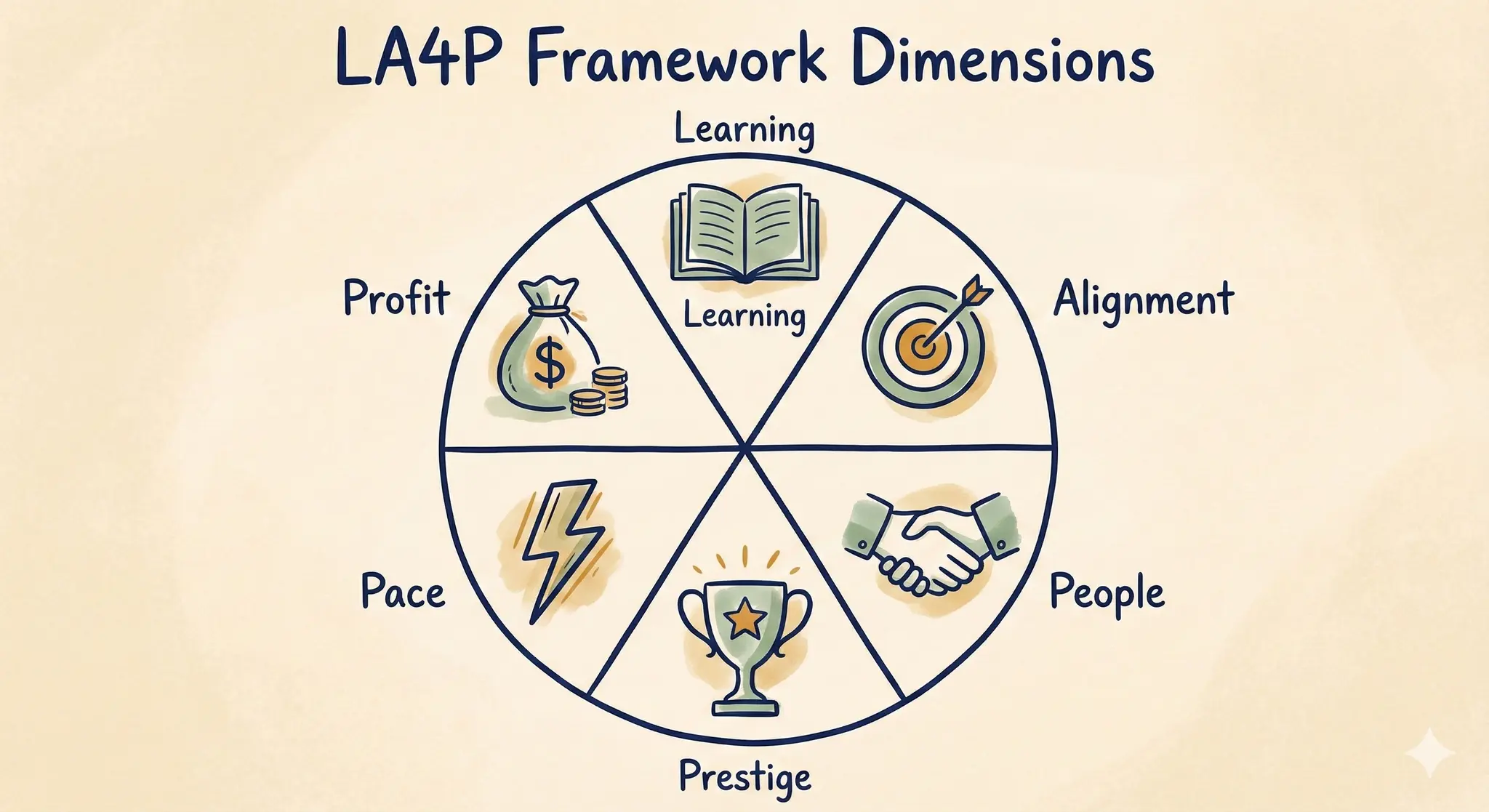
- Learning=5, Alignment=4, People=4, Prestige=2, Pace=2, Profit=2
- Total: 19/30
- Archetype: Exploration (correct)
- Emotional state: Energized, overwhelmed in a good way, learning constantly. He'd go home exhausted but excited. This is what growth is supposed to feel like.
Chapter 2 (Age 24-25): Series C Startup
- Learning=5, Alignment=3, People=3, Prestige=4, Pace=2, Profit=3
- Total: 20/30
- Archetype: Exploration (correct)
- Emotional state: Still learning, but starting to feel tired. Sunday nights got harder. He told himself it was normal. "Everyone feels like this, right?"
Chapter 3 (Age 25-26): Late-Stage Startup
- Learning=4, Alignment=2, People=3, Prestige=4, Pace=1, Profit=4
- Total: 18/30
- Archetype: Attempted Consolidation (wrong—needed Rest first)
- Emotional state: Sunday night dread became Sunday afternoon dread. He started snapping at his partner. He couldn't remember the last time he felt excited about work. But the compensation was great ($180K), so he told himself to push through. "I just need to work harder."
Chapter 4 (Age 26-27): FAANG
- Learning=3, Alignment=2, People=2, Prestige=5, Pace=1, Profit=5
- Total: 18/30
- Archetype: Forced Consolidation (wrong—still running on empty)
- Emotional state: Panic attacks before meetings. Waking up at 3am mentally rehearsing conversations. Therapy appointments. His therapist asked him to describe his ideal week. He couldn't. The prestigious job everyone wanted felt like a prison. He'd optimized every move perfectly and felt nothing but dread.
Francisco optimized every individual move. But he never designed the portfolio. Four consecutive high-intensity chapters with Pace=1-2 created a burnout debt that compounded until his body forced the issue.
What he needed: Exploration → Exploration → Rest → Consolidation.
That "wasted" rest year at age 25 would have prevented the panic attacks at 26, the therapy bills, the damaged relationship with his partner, and the three years of recovery that followed. Instead, he's now 29, finally feeling human again, and has to rebuild momentum he could have maintained.
The Career ROI Framework shows this mathematically: rest chapters aren't "lost time"—they're strategic investments that prevent catastrophic losses later.
What Maya Got Right (Eventually)
Maya's trajectory shows the power of intentional chapter design—and the cost of not having this vocabulary earlier:
Chapter 1 (Age 24-26): Fast-Paced Startup
- Learning=5, Alignment=4, People=3, Prestige=2, Pace=1, Profit=2
- Total: 17/30
- Archetype: Exploration (correct, but unsustainable duration)
- Emotional state: Years 1-2 were thrilling. She was learning constantly, shipping work she was proud of. Year 3, the thrill faded. She started crying in the bathroom at work. She couldn't pinpoint why—the work was the same, but she felt hollow.
Chapter 2 (Age 26-28): Same Startup (Post-Burnout)
- Learning=2, Alignment=2, People=2, Prestige=2, Pace=1, Profit=3
- Total: 12/30
- Archetype: Decay (this is what burnout looks like in LA4P terms)
- Emotional state: Numb. Going through motions. Refreshing LinkedIn but too exhausted to apply. She couldn't quit because she didn't know what else to do. She just knew she couldn't keep doing this.
Chapter 3 (Age 28-30): Stable Mid-Size Company
- Learning=3, Alignment=3, People=3, Prestige=3, Pace=5, Profit=3
- Total: 20/30
- Archetype: Rest (correct—strategic recovery)
- Emotional state: First 6 months: guilty. "Am I wasting my twenties?" Months 7-12: less guilty. She started sleeping through the night. Months 13-18: actually energized again. She started cooking. She saw friends. She read books. She remembered what "sustainable" felt like. Her Pace score climbed from 1 to 5 over 8 weeks.
Chapter 4 (Age 30-34): Series D Startup
- Learning=3, Alignment=4, People=4, Prestige=4, Pace=4, Profit=5
- Total: 24/30
- Archetype: Consolidation (correct—harvesting previous learning)
- Emotional state: Confident. Shipping high-impact work without burning out. Building wealth ($180K in equity). Enjoying her career again. She could work hard because she'd learned how to rest.
Maya's chapter 3 looked unimpressive: all 3s except Pace. But it was the strategic move that enabled chapter 4's performance. She gave herself permission to recover, which compounded into higher output later.
Her 18-month rest chapter generated a 4-year consolidation chapter with $180K in equity. That's a 267% ROI on "doing nothing."
If Maya had discovered this framework at 26, she could have designed a rest chapter intentionally instead of stumbling into one after burnout. She would have saved herself two years of decay (chapter 2) and entered her rest chapter from a position of strength, not desperation.
The 40-Year Math
Here's why chapter portfolio design matters:
Francisco's Path (No Rest Chapters):
- Years 1-4: High intensity (Pace=1-2)
- Years 5-7: Burnout recovery (Pace=1, Learning=1, minimal output)
- Years 8-12: High intensity (Pace=1-2)
- Years 13-15: Burnout recovery
- Years 16-20: High intensity
- Years 21-23: Burnout recovery
- Years 24-40: Diminished capacity, chronic health issues
Productive years: ~20 out of 40 (50%)
Maya's Path (Strategic Rest Chapters):
- Years 1-4: Exploration (Pace=2)
- Years 5-6: Rest (Pace=5)
- Years 7-11: Consolidation (Pace=4)
- Years 12-13: Rest (Pace=5)
- Years 14-18: Consolidation (Pace=4)
- Years 19-22: Reinvention (Pace=3)
- Years 23-24: Rest (Pace=5)
- Years 25-40: Sustainable high performance (Pace=4)
Productive years: ~36 out of 40 (90%)
The "always be growing" strategy gives you 20 productive years. The "strategic rest" strategy gives you 36. That's an 80% increase in total career output.
This isn't theoretical. Francisco is living the left column right now. Maya is living the right column. The difference isn't talent or ambition—it's portfolio construction.
How to Know Which Chapter You Need
Here's the diagnostic:
You Need an Exploration Chapter If:
- You don't know what you're good at yet
- You're in a new domain and everything is hard
- You're optimizing for Learning=4-5 over everything else
- You can sustain Pace=2 for 2-4 years
Red flag: Exploration chapters beyond year 6-7 of your career suggest you're avoiding commitment, not exploring.
You Need a Consolidation Chapter If:
- You've mastered a domain and want to extract value
- You're optimizing for Profit + Prestige
- You want to work hard but not learn from scratch
- You've completed 1-2 exploration chapters
Red flag: Consolidating before you've learned anything meaningful = premature optimization. You'll hit a ceiling fast.
You Need a Rest Chapter If:
- Your Pace has been 1-2 for 12+ months
- You're experiencing physical symptoms (insomnia, anxiety, burnout)
- You've had 2+ consecutive high-intensity chapters
- You need to be present for non-work life (new parent, family care, health)
Red flag: Confusing "I need rest" with "I hate my job." Rest chapters should still hit 3/5 on most dimensions. If you're at 2/5 across the board, you need an exit, not a rest.
You Need a Reinvention Chapter If:
- You've mastered your current domain and want something new
- You're optimizing for Alignment + Learning over Profit
- You're willing to take a seniority/compensation step back
- You're in chapters 4-6 (mid-career pivot window)
Red flag: Reinventing every 3 years = you're running from problems, not toward opportunities.
Your Chapter Design Worksheet
Use this to audit your current trajectory and plan your next 2-3 chapters:
Step 1: Score Your Last 2 Chapters
For each of your last 2 chapters (roughly 5-year blocks), rate 1-5:
Chapter ___ (Age ___ to ___):
- Learning: ___ (1=no growth, 5=constant learning)
- Alignment: ___ (1=misaligned values, 5=deeply meaningful)
- People: ___ (1=toxic team, 5=dream colleagues)
- Prestige: ___ (1=unknown company, 5=résumé gold)
- Pace: ___ (1=burnout intensity, 5=sustainable)
- Profit: ___ (1=underpaid, 5=top of market)
- Total: ___/30
Chapter ___ (Age ___ to ___):
- Learning: ___
- Alignment: ___
- People: ___
- Prestige: ___
- Pace: ___
- Profit: ___
- Total: ___/30
Step 2: Identify Your Current Archetype
Based on your current chapter scores, which archetype are you in?
- Exploration (Learning=4-5, Pace=2-3)
- Consolidation (Profit=4-5, Prestige=4-5, Learning=3)
- Rest (Pace=4-5, everything else=3)
- Reinvention (Learning=4-5, Alignment=4-5)
- Decay (multiple dimensions below 3 = you need an exit)
Step 3: Design Your Next Chapter
Based on your last 2 chapters and current state, what archetype should your NEXT chapter be?
If your last 2 chapters were both high-intensity (Pace=1-2): → You need a REST chapter next
If your last chapter was Rest and you're feeling energized: → You need a CONSOLIDATION chapter next (harvest what you learned before burnout)
If you're early career (chapters 1-2) and still learning: → You need an EXPLORATION chapter next
If you've mastered your domain but feel misaligned: → You need a REINVENTION chapter next
Target scores for your next chapter:
- Learning: ___
- Alignment: ___
- People: ___
- Prestige: ___
- Pace: ___
- Profit: ___
What would a role need to offer to hit these scores?
(Write 3-5 specific criteria. Example: "Pace=5 means max 45 hours/week, clear boundaries, no weekend work")
Portfolio Balance Check
Look at your last 2 chapters and your planned next chapter:
Red flags to watch for:
- 3+ consecutive high-intensity chapters (Pace=1-2) = burnout risk
- 3+ consecutive exploration chapters = avoiding commitment
- Consolidating before you've learned anything = premature optimization
- Rest chapter with scores below 3 on most dimensions = you need an exit, not rest
Green flags (healthy portfolio):
- Alternating intensity levels (Pace varies between chapters)
- Mix of learning and harvesting (some chapters Learning=4-5, others Learning=3)
- Strategic rest after high-intensity periods
- Clear purpose for each chapter archetype
What to Do Next
You now have the vocabulary to design your career portfolio intentionally. Here's what to do:
If you're in a Rest chapter and feeling guilty:
Stop. Track your Pace score weekly for 8 weeks. If it's climbing from 1 toward 4-5, you're recovering, not being lazy. Give yourself permission to finish the recovery cycle. Maya's 18-month rest chapter generated $180K in equity later. That's not wasted time—that's strategic investment.
If you're in back-to-back high-intensity chapters:
You're overdue for rest. Start designing your next chapter now, before your body forces the issue. Francisco wishes he'd done this at 24 instead of 26. Those two years of "pushing through" cost him three years of recovery.
If you're early career and exploring:
Keep exploring, but know that exploration has a shelf life. By chapter 3 (age 30-32), you should be ready to consolidate. If you're still exploring at 35, you're avoiding commitment, not building skills.
If you're mid-career and feeling stuck:
You might need a reinvention chapter. But make sure you've consolidated first—reinvention from a position of strength (with savings, skills, and confidence) is very different from reinvention from burnout.
The person who designs their chapter portfolio at 26 and alternates growth with rest strategically through 40 gains 15+ productive years over the "always be growing" cohort.
Francisco is 29 now, finally feeling human again. He's designing his next chapter intentionally—something he wishes he'd known how to do at 24.
Maya is 34, in the middle of a high-performing consolidation chapter, with $180K in equity and the energy to enjoy it. She knows she'll need another rest chapter in 2-3 years. She's already planning for it.
Which path will you choose?
Frequently Asked Questions
How long should each chapter type last?
Exploration: 2-4 years (long enough to learn, short enough to avoid stagnation)
Consolidation: 3-5 years (long enough to harvest value, short enough to avoid golden handcuffs)
Rest: 1-3 years (long enough to recover, short enough to maintain momentum)
Reinvention: 2-4 years (long enough to gain new skills, short enough to avoid perpetual beginner status)
The key is matching duration to purpose. Francisco's mistake was running two 2-year exploration chapters back-to-back without rest. Maya's success was giving herself 18 months of rest before a 4-year consolidation chapter.
Can I skip rest chapters if I'm young and energetic?
No. This is exactly what Francisco thought at 24. By 26, he was having panic attacks.
Youth gives you higher baseline energy, but it doesn't make you immune to burnout. In fact, early-career professionals often burn out faster because they don't recognize the warning signs.
The research is clear: professionals who experience chronic work stress without adequate recovery periods face 2-3 year rehabilitation timelines before returning to baseline productivity. That's 2-3 years of lost output because you didn't take 1 year of strategic rest.
What if my company doesn't support "rest chapters"?
Rest chapters don't mean doing nothing. They mean optimizing for Pace=4-5 (sustainable intensity) instead of Pace=1-2 (maximum intensity).
You can create a rest chapter within your current company by:
- Saying no to stretch projects for 12 months
- Focusing on execution over innovation
- Setting clear boundaries (no weekend work, no late nights)
- Choosing projects where you can apply existing skills instead of learning new ones
If your company culture makes this impossible (everything is urgent, everyone works weekends, boundaries are seen as lack of commitment), that's a sign you need to change companies, not push through.
Maya's rest chapter was at a stable mid-size company with reasonable hours. She didn't tell them "I'm here to rest"—she just chose a role where Pace=5 was the default, not the exception.
How do I know if I'm in Decay vs. Rest?
Rest chapters: Pace=4-5, other dimensions=3. You're working at sustainable intensity and maintaining acceptable performance. Your Pace score should climb from 1 to 4-5 within 8-12 weeks.
Decay chapters: Multiple dimensions below 3. You're not recovering—you're deteriorating. Your Pace score stays at 1-2 even after months in the role.
Maya's chapter 2 (age 26-28) was decay: Learning=2, Alignment=2, People=2, Prestige=2, Pace=1, Profit=3. Total: 12/30. She wasn't resting—she was dying slowly.
Maya's chapter 3 (age 28-30) was rest: Learning=3, Alignment=3, People=3, Prestige=3, Pace=5, Profit=3. Total: 20/30. She was recovering.
The difference: In rest chapters, you feel better over time. In decay chapters, you feel worse.
What if I need rest but can't afford a pay cut?
Rest chapters don't require pay cuts—they require Pace=4-5. Look for roles that pay well but have sustainable intensity:
- Established companies with mature processes (less chaos)
- Individual contributor roles (less management stress)
- Domains where you already have expertise (less learning curve)
- Companies with strong work-life balance cultures
Maya's rest chapter paid $120K—not a pay cut from her $115K burnout role. The difference wasn't compensation; it was that she worked 45 hours/week instead of 65, and she wasn't learning new tools under pressure.
If you're in a high-cost-of-living area and genuinely can't find sustainable roles at your current compensation, that's a sign your compensation is artificially inflated by burnout-level intensity. You're being paid extra to destroy your health. That's not a good deal.
Can I have multiple chapter types simultaneously?
No. Chapters are defined by what you're optimizing for, and you can't optimize for everything at once.
You can't have an exploration chapter (Learning=5, Pace=2) and a rest chapter (Pace=5, Learning=3) at the same time. High learning requires high intensity.
You can't have a consolidation chapter (Profit=5, Prestige=5) and a reinvention chapter (Learning=5, Alignment=5) at the same time. Reinvention requires taking a step back in seniority and compensation.
The whole point of chapter portfolio design is accepting that different chapters serve different purposes. Trying to do everything at once is how you end up burned out like Francisco.
What if I'm in my 40s and have never designed chapters intentionally?
You can start now. Someone who discovers this framework at 40 still has 25 working years to optimize.
Audit your last 2-3 chapters using the worksheet. Identify patterns (have you been running at Pace=1-2 for 10 years straight?). Design your next chapter based on what your portfolio needs, not what looks good on LinkedIn.
Francisco is 29 and just learning this. Maya learned it at 30. Better late than never.
The key insight: your past chapters are sunk costs. You can't change them. But you can design your next 4-5 chapters intentionally, and that's still 20-25 years of optimized career trajectory.
How does this framework apply to freelancers or entrepreneurs?
The same way. Chapters aren't defined by employment type—they're defined by what you're optimizing for.
Freelancer exploration chapter: Taking diverse projects to learn new skills (Learning=5, Profit=3)
Freelancer consolidation chapter: Specializing in high-value services you've mastered (Profit=5, Learning=3)
Freelancer rest chapter: Reducing client load to sustainable levels (Pace=5, Profit=3)
Entrepreneur exploration chapter: Building your first startup (Learning=5, Pace=1)
Entrepreneur consolidation chapter: Scaling a proven business model (Profit=5, Learning=3)
The archetype framework is about portfolio construction, not employment structure. Whether you're employed, freelance, or entrepreneurial, you still need to alternate between growth and rest, learning and harvesting.
What's the optimal chapter sequence?
There's no single optimal sequence—it depends on your goals and circumstances. But here are common healthy patterns:
Early career (chapters 1-3): Exploration → Exploration → Rest → Consolidation
Mid career (chapters 4-6): Consolidation → Rest → Reinvention → Consolidation
Late career (chapters 7-8): Consolidation → Rest → Consolidation (or Reinvention if you want a final pivot)
Red flag patterns:
- Exploration → Exploration → Exploration → Exploration (avoiding commitment)
- Consolidation → Consolidation → Consolidation (no learning, eventual obsolescence)
- High intensity → High intensity → High intensity → Burnout (Francisco's path)
The key principle: alternate intensity levels. Don't run 3+ consecutive high-intensity chapters without rest.
Apply this guide
Use this guide to refine your 1–5 scores.
Review your existing chapters in 40yearscareer and adjust each axis based on what you just read. You’ll see patterns that were invisible before.
Free while we're in beta. No inbox clutter, no selling your data.