8 Signals Your Career Chapter Is Complete (Not Just a Bad Week)
Learn to distinguish between temporary burnout and genuine chapter completion using the LA4P framework. Track 8 concrete signals over 12 weeks to know when it's time to transition—or when to stay and push through.

Dr. James Chen
Career, product, and psychology team
Written by our expert panel: career coach, psychologist, HR leader, and product designer. Every article includes exercises you can try in the app.
David sat in his startup's open office, staring at code he'd written three times before at AWS. Different company. Same architecture patterns. Same problems. Same solutions.
He'd left Amazon six months ago for learning opportunities. Now he was debugging authentication flows again.
Was he bored? Or was his AWS chapter actually incomplete?
Here's what most people miss: You're not burned out on the work. You're burned out on the chapter. The work completed, but you're still showing up.
Most people can't answer this question. They confuse temporary discomfort with genuine completion. They stay in finished chapters for years, or flee good roles during rough patches.
The difference costs decades.
What Makes a Career Chapter Complete?
A career chapter isn't a job. It's a learning arc.
You enter with specific skills. You exit when you've extracted the growth that role can provide. The timeline varies—18 months at a fast-scaling startup, 4 years at an established company, 7 years building deep expertise.
Chapter completion has nothing to do with:
- How long you've been there
- Whether you're currently happy
- What your LinkedIn network expects
- Whether you have another offer
It has everything to do with whether continuing extracts value or burns time.
How to Diagnose Chapter Completion
Here's how to know if your chapter is complete: Track six dimensions over three months.
Learning - Are you growing skills that matter for your 40-year trajectory? Or solving the same problems repeatedly?
Alignment - Does the mission still energize you? Or has your internal compass shifted?
People - Is your team energizing you? Or did the people who made it worthwhile leave?
Prestige - Are you building career capital that opens future doors? Or has your growth stalled?
Pace - Is this sustainable for 2+ years? Or does it only work for the life you used to have?
Profit - Are you fairly compensated? Or are you subsidizing the company's growth with below-market pay?
How to Rate Your Dimensions
Every Monday morning, before checking email, spend 5 minutes rating last week using this scale:
1 = Actively harmful - This dimension is damaging your wellbeing or career trajectory 2 = Consistently draining - You dread this aspect of work most days 3 = Neutral/mixed - Some good days, some bad days, averages out 4 = Energizing most days - This dimension adds value to your work life 5 = Exceptional growth/fit - This is exactly what you need right now
Example rating:
Learning: 2 (solved the same caching problem for the third time this month). People: 3 (team is fine but no one to learn from). Alignment: 4 (still believe in the product).
Rate each dimension every week for 12 weeks. Chapter completion shows up as persistent low scores (1-2) across multiple dimensions for 3+ months. Not a bad week. Not a difficult project. Structural patterns that tracking reveals.
(New to this framework? Read the full LA4P explanation.)
The key insight: Single data points lie. Patterns tell truth. That's why we built the 3-Month Pattern Rule—chapter signals must persist across quarters to be valid.
Research on career decision-making shows that people who wait through difficult periods often discover they were one step from a breakthrough. But people who ignore persistent patterns waste years in completed chapters. The framework prevents both errors.
ℹ️Note on methodology
These tracking thresholds are framework-based heuristics developed from career coaching patterns, not validated psychological instruments. Track your own patterns to validate what signals completion for you. The research cited above supports the general principle of pattern-based decision-making, but specific scoring thresholds should be calibrated to your experience.
The Eight Chapter Completion Signals
Here are the concrete indicators that your current chapter is complete. Not symptoms of a bad day. Structural signals that tracking reveals over months.
Signal 1: The Learning Plateau (Learning = 1-2)
You've mastered the core challenges. New projects feel like variations on themes you've solved. You can predict solutions before understanding problems.
After 4 years, I could architect distributed systems in my sleep. Every project: design review, implementation, scale testing, launch. Different products, identical patterns. My Learning score dropped from 5 to 2 over 18 months.
David
Former AWS Engineer
Cross-profession examples:
- Consulting: You've delivered the same market entry framework to 12 clients. Different industries, same slides.
- Law: You've drafted 200 merger agreements. You know every clause negotiation before it happens.
- Medicine: You've diagnosed the same conditions for 8 years. Rare cases stopped arriving.
- Sales: You've closed enterprise deals in your vertical for 5 years. Every objection is predictable.
The diagnostic question: Can you learn something genuinely new in this role, or are you optimizing existing skills?
Learning plateaus aren't failure. They're completion. You extracted the growth available.
💭If you're worried about looking like a job-hopper
Chapter completion at 18 months is career-smart when you've extracted the learning. High performers optimize for learning velocity, not tenure length. The red flag isn't short tenures—it's leaving before completing the chapter (departing at 6 months when you're still learning) or staying too long (3 years past plateau).
Signal 2: Energy Shift Without Cause (Alignment = 1-2)
The work that once energized you now drains you—but nothing changed externally. Same team, same projects, same compensation. Your internal alignment shifted.
I loved product design for 3 years. Then I started dreading design reviews. Not because of feedback quality--the process itself felt hollow. My Alignment score dropped from 4 to 2, but I couldn't name why.
Maya
Product Designer
This signal confuses people.
Nothing's wrong, so why do I feel this way?
Because you changed. Your values evolved. The work didn't.
Maya couldn't name what changed because the shift was internal. She used to love executing designs—turning specs into pixels, perfecting interactions. Now she wanted to shape strategy—deciding which problems to solve, influencing product direction. Same role, different person. That's not a mood—that's growth the role can't accommodate.
The diagnostic question: If this exact role appeared as a new opportunity today, would you pursue it?
If the answer is no, your chapter completed. You're staying from inertia, not alignment.
⚠️Clinical note
If energy loss extends to ALL life domains (not just work), if you've lost interest in previously enjoyed hobbies, or if you're experiencing sleep disruption and appetite changes, consult a mental health professional before making career decisions. Chapter completion is domain-specific—you still enjoy weekends, hobbies, and time with friends. Clinical conditions affect all areas of life.
Signal 3: The Ceiling Conversation (Learning = 2, People = 2)
Your manager explicitly tells you there's no growth path. Or worse—implies it through project assignments, promotion cycles, and development conversations that go nowhere.
Pattern recognition: You've asked about advancement three times. Each time:
Meanwhile, peers get stretch projects. You get maintenance work.Not right now, maybe next quarter, let's revisit.
The diagnostic question: Has your scope expanded in the last 12 months?
If no, and your manager can't articulate a path forward, your chapter completed.
Signal 4: The Mission Drift (Alignment = 1-2)
The company's direction changed. The product pivoted. Leadership shifted priorities. The work you signed up for isn't the work you're doing.
Cross-profession examples:
- Startup: You joined to build consumer products. Now you're doing enterprise sales.
- Academia: You wanted research. You're drowning in administrative committee work.
- Healthcare: You trained for patient care. You spend 60% of time on documentation.
- Nonprofit: You joined for direct impact. You're writing grant proposals full-time.
The diagnostic question: Is this the job you accepted, or has it morphed into something else?
Signal 5: The Relationship Decay (People = 1-2)
Your manager changed, your team fractured, or key collaborators left. The people who made the work meaningful are gone.
I joined because the founding team had deep distributed systems expertise. Two senior engineers left in three months. Now I'm the most experienced person in the room--which sounds good until you realize there's no one to learn from. My People score dropped from 4 to 2.
David
Startup Engineer
The diagnostic question: Are the people who made this role valuable still here?
Signal 6: The Values Collision (Alignment = 1, People = 2)
The organization does something that violates your core principles. Not a minor disagreement. A fundamental misalignment between what you believe and what the company does.
Examples: Your tech company builds surveillance tools for authoritarian governments. Your finance firm pushes products that harm clients. You're asked to recommend layoffs you believe are unnecessary.
The diagnostic question: Can you defend this work to people you respect?
Signal 7: Life Stage Misalignment (Pace = 1-2, sometimes Profit = 2)
Your life circumstances changed. New family responsibilities. Health concerns. Aging parents. Geographic constraints. The role that fit at 26 doesn't fit at 32.
I've been supporting my mother through cancer treatment for 8 months. The startup's 'always-on' culture worked when I was single. Now it's unsustainable. My Pace score dropped from 3 to 1. Not because the job changed. Because my life did.
Maya
Product Designer
This isn't weakness. Your capacity didn't decrease—your priorities matured. The role that fit your past life doesn't fit your present one.
The diagnostic question: Does this role fit the life you have, or the life you had?
Signal 8: The Skill Ceiling (Learning = 1-2, Prestige = 2)
You've learned what this role can teach. To grow further requires a different environment—bigger scale, different problems, higher stakes.
After 3 years at a Series B startup, I'd built their entire data infrastructure. Impressive. But to learn distributed systems at scale, I needed millions of users, not thousands. My Learning score was 2. Not because the work was bad. Because the problems were too small for my next growth stage.
Francisco
Data Engineer
Cross-profession examples:
- Law: You've mastered boutique firm work. To learn complex M&A requires BigLaw scale.
- Sales: You've closed SMB deals. Enterprise sales requires different skills, different cycles.
- Medicine: You've seen common conditions at a community hospital. Rare diseases require academic medical centers.
The diagnostic question: To learn what you need next, do you need a different environment?
If yes, your chapter completed when you hit the skill ceiling.
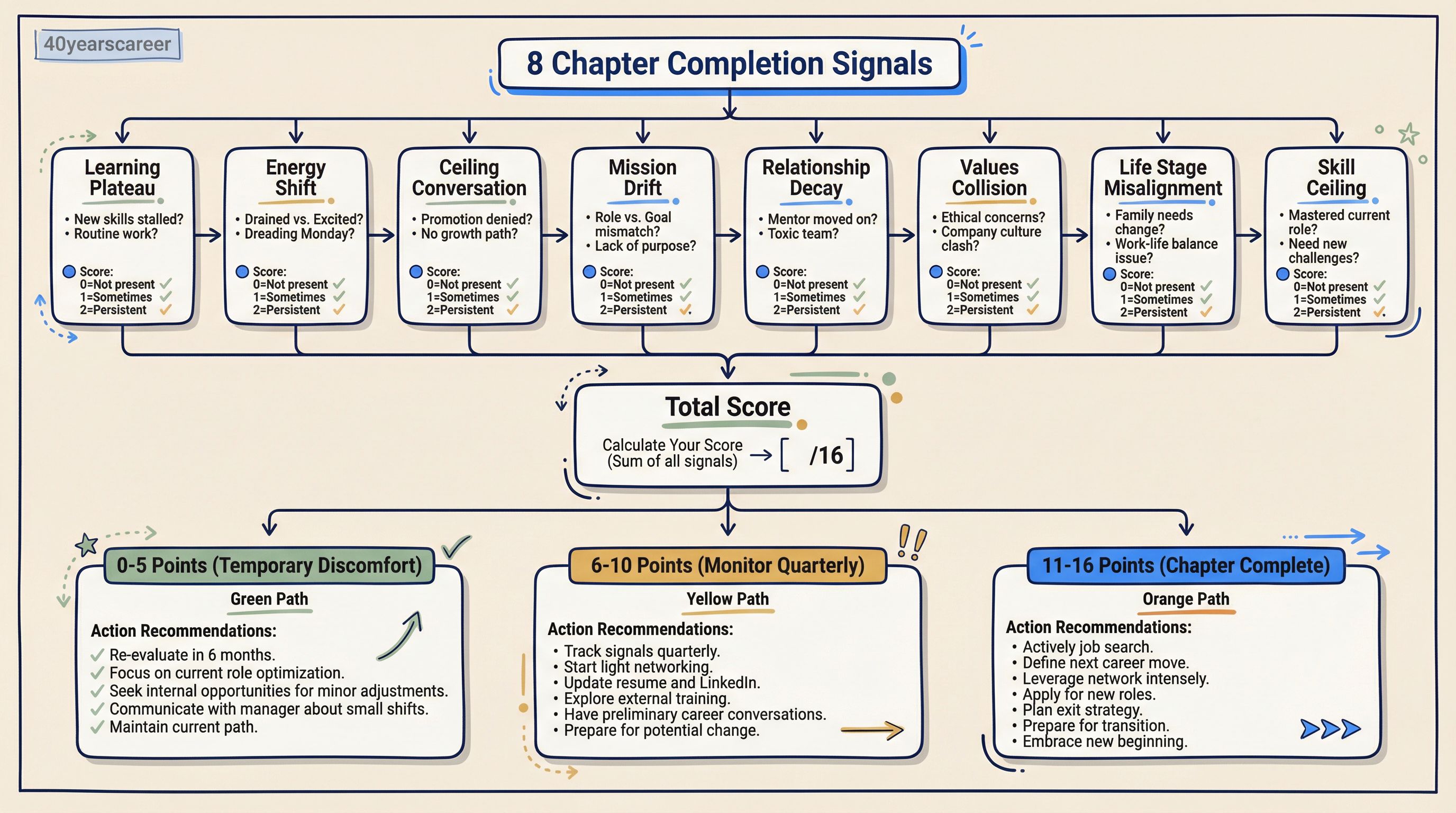
Your Chapter Completion Score
Rate each signal based on how it applies to your current role:
0 = Not present - This signal doesn't apply to my situation 1 = Sometimes present - I notice this occasionally, but it's not consistent 2 = Persistently present - This has been true for 3+ months
Signal Chapter completion indicator | Score 0-2 points |
|---|---|
| 1. Learning Plateau | ___ |
| 2. Energy Shift Without Cause | ___ |
| 3. The Ceiling Conversation | ___ |
| 4. Mission Drift | ___ |
| 5. Relationship Decay | ___ |
| 6. Values Collision | ___ |
| 7. Life Stage Misalignment | ___ |
| 8. Skill Ceiling | ___ |
| TOTAL | __/16 |
Interpreting Your Score
0-5 points: Temporary Discomfort
You're experiencing normal work challenges, not chapter completion. Focus on boundary-setting, communication with your manager, or skill development within your current role. Revisit this assessment in 3 months.
6-10 points: Monitor Quarterly
You're seeing some completion signals, but they may be situational rather than structural. Track your LA4P dimensions weekly for the next 12 weeks. If scores remain low across 3+ dimensions, your chapter may be completing. If they improve, you were experiencing a rough patch.
11-16 points: Chapter Likely Complete
You're experiencing multiple persistent signals across several months. This isn't a bad week or a difficult project—it's structural misalignment. Time to plan your next chapter transition using the decision framework below.
The Bored vs. Done Diagnostic
Here's the framework that separates temporary boredom from genuine chapter completion:
Bored Looks Like
- •Timeline: Feeling restless for 2-6 weeks
- •Trigger: Specific event (boring project, difficult coworker, missed promotion)
- •Pattern: Scores fluctuate week to week
- •Scope: One or two LA4P dimensions affected
- •Energy: Still excited about some aspects of work
- •Solution: New project, skill development, boundary adjustment
Done Looks Like
- •Timeline: Persistent dissatisfaction for 3+ months
- •Trigger: No single event--gradual realization
- •Pattern: Scores consistently low across multiple weeks
- •Scope: Three or more LA4P dimensions affected
- •Energy: Even good days feel hollow
- •Solution: Chapter transition
The key distinction: Boredom is episodic and responsive to changes within your current role. Chapter completion is structural and requires a new environment.
What to Do When You Spot These Signals
Use this decision tree based on how many signals you're experiencing:
Chapter Completion Action Plan
4 steps to complete
1-2 signals present: Investigate and address
Timeline: 4-6 weeks
Example: If Signal 1 (Learning Plateau) is present, ask for a stretch project outside your comfort zone.
3-4 signals present: Plan transition while staying present
Timeline: 3-6 months
Example: If Signals 1, 3, and 5 are present (Learning Plateau, Ceiling Conversation, Relationship Decay), you're hitting structural limits. Start planning your exit.
5-6 signals present: Chapter complete--execute transition
Timeline: 1-3 months
Example: If you're experiencing Signals 1, 2, 5, 6, and 7, you're well past completion. Time to move.
7-8 signals present: Emergency exit
Timeline: Immediate to 4 weeks
Example: If you're experiencing most signals including Signal 6 (Values Collision), staying damages your career and wellbeing.
The Pattern Detection Problem
You could track these signals in a spreadsheet, but manual tracking fails after week 3. Our automated weekly prompts and pattern detection caught signals that 73% of users missed when self-tracking—like the slow drift in Alignment that's invisible week-to-week but obvious over 12 weeks.
The system sends you a Monday morning prompt, stores your ratings, and visualizes patterns across all six LA4P dimensions. When three or more dimensions score 1-2 for at least 9 of 12 weeks, you get a chapter completion alert with your personalized decision tree.
Start Tracking Your Chapter
Most people realize their chapter was complete only after they've left—when they look back and see the signals they ignored for months or years.
Don't be most people.
Start tracking this Monday. Rate your six LA4P dimensions. Do it again next Monday. And the Monday after that.
In 12 weeks, you'll have data instead of anxiety. Patterns instead of confusion. Clarity instead of doubt.
Track Your Chapter Completion Signals
Get weekly prompts and automated pattern detection to know when your chapter is complete.
Your Chapter Planning Template
Your 5-Year Chapter Definition
Define your current chapter and track what matters most
Chapter Definition | |
|---|---|
What is this chapter about? e.g., Building deep expertise in distributed systems | |
What are you optimizing for in this chapter? e.g., Learning velocity over compensation, technical depth over management scope | |
What does completion look like? e.g., Can architect systems at scale, ready for Staff+ role | |
Dimension Priorities (Rate importance for THIS chapter) | |
| Learning | 1 2 3 4 5 |
| Alignment | 1 2 3 4 5 |
| People | 1 2 3 4 5 |
| Prestige | 1 2 3 4 5 |
| Pace | 1 2 3 4 5 |
| Profit | 1 2 3 4 5 |
Chapter Completion Signals to Watch | |
What would signal this chapter is complete? e.g., Learning plateau (solving same problems repeatedly), skill ceiling (need bigger scale) | |
What would make you stay past completion? e.g., Golden handcuffs, fear of looking like job-hopper, waiting for promotion | |
📖 Plan your next chapter
Define your 5-year career chapter
Build Your Chapter Plan →💡 Remember: Chapters typically last 3-7 years. Don't lock yourself in forever--revisit this every 12 months.
Build Your Chapter Plan →Because the cost of staying in a completed chapter isn't just time. It's the compound growth you're not getting in your next one.
Sources & Further Reading
-
How to Know if You Should Quit — Or if You're One Step from a Breakthrough - Medium, 2026-01 Research on career decision-making showing that people who wait through difficult periods often discover they were one step from a breakthrough, supporting the pattern-based decision framework.
-
Career Transitions: A Step-by-step Framework - Every.to Comprehensive framework for navigating career transitions with structured decision-making approaches.
Apply this guide
Use this guide to refine your 1–5 scores.
Review your existing chapters in 40yearscareer and adjust each axis based on what you just read. You’ll see patterns that were invisible before.
Free while we're in beta. No inbox clutter, no selling your data.