The Chapter 3 Crisis: Why Your Early 30s Feel Like Quicksand (And How to Escape)
You're 32, successful on paper, miserable on Sunday nights. This isn't a quarter-life crisis—it's the Chapter 3 Crisis. Learn to diagnose your pattern and escape the quicksand.

Dr. Rachel Martinez
Career, product, and psychology team
Written by our expert panel: career coach, psychologist, HR leader, and product designer. Every article includes exercises you can try in the app.
You're 32. Your LinkedIn says "success." Your bank account agrees. Your Sunday nights disagree violently.
You've done everything right: good school, respectable company, steady promotions. Six to eight years into your career, you should feel momentum. Instead, you feel stuck in quicksand—the harder you work, the deeper you sink.
Research shows 75% of 25-33 year olds experience this exact feeling. Most career advice treats it as an identity crisis. "Find your passion." "Discover your purpose." "Maybe you need therapy."
That's not what's happening.
You're experiencing the Chapter 3 Crisis—a predictable, structural career phase that hits when early-career momentum collides with life complexity. And unlike the vague anxiety of a "quarter-life crisis," this one has a diagnosis.
What Makes Chapter 3 Different
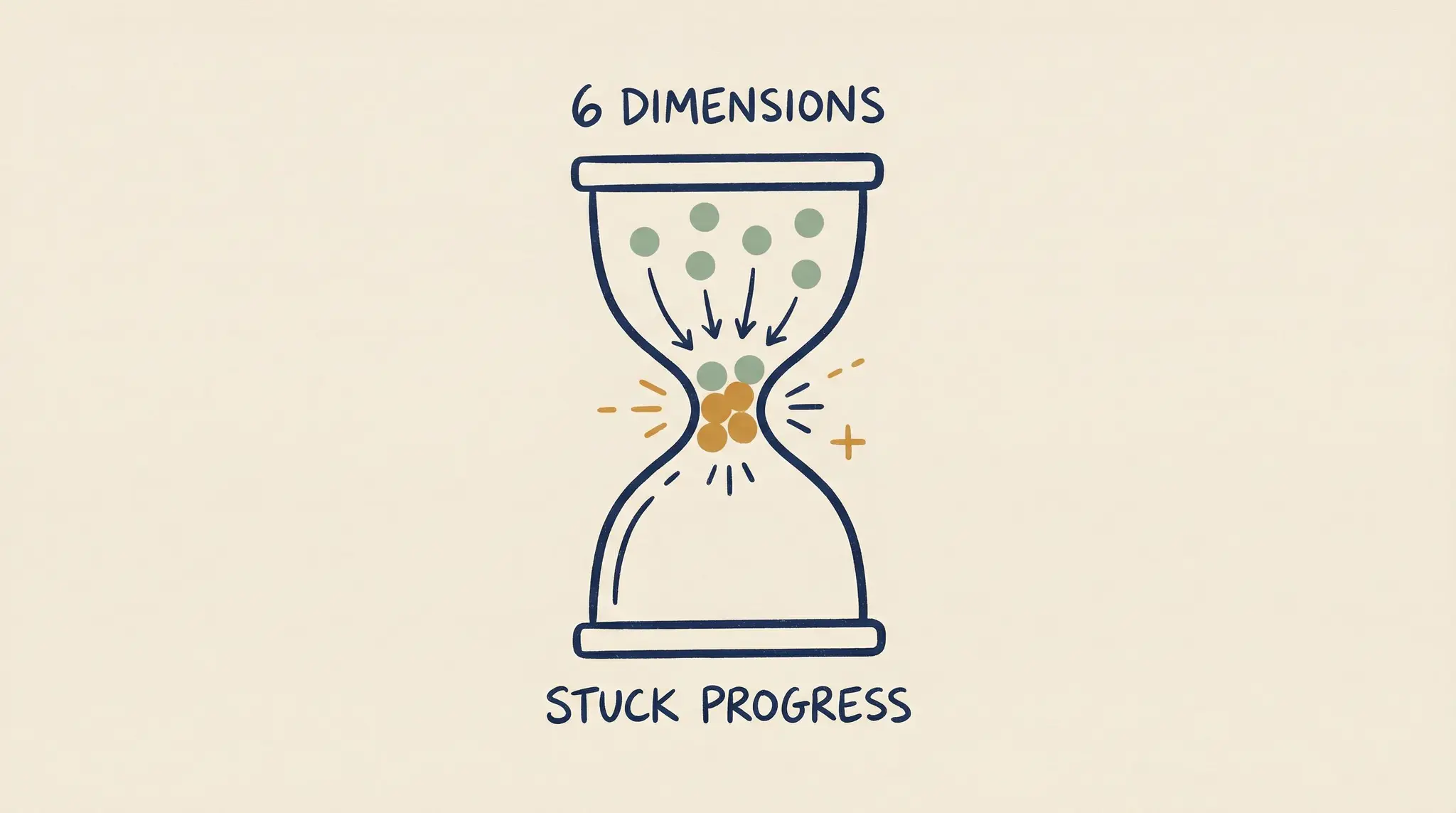
For the first time in your career, six dimensions demand attention simultaneously:
Your technical foundation from your first job is aging out—you can't coast on old skills anymore. Life's too short to spend 2,000 hours per year on work that feels meaningless. Bad managers aren't "character building" anymore; they're career damage. You need the brand name to keep doors open, but chasing it exclusively feels hollow. Your body won't sustain the pace it once did, and real relationships require actual presence. And those financial obligations? They're not hypothetical anymore—mortgage, family planning, aging parents.
Here's what actually happens: your career has six dimensions that all need attention simultaneously. We call them Learning, Alignment, People, Prestige, Pace, and Profit. (New to this framework? Read the full explanation.)
In your first 4-8 years (Chapters 1-2), you could focus on just two or three. High Learning and Prestige compensated for everything else. You were building foundation: learning fast, proving competence, establishing credibility.
Chapter 3 is when that strategy breaks.
Score Your Current Role (Do This Now)
Before we go further, you need to diagnose your pattern. Most people wait 18 months before they do this systematically. Don't be most people.
The 6 LA4P Dimensions
| Dimension | What It Measures | Why It Compounds | Rating Scale (1-5) |
|---|---|---|---|
LLearning | Skill growth, challenging work | Skills built today unlock opportunities 5 years from now | 1 = Skill atrophy, you'll regress 2 = Minimal growth, mostly maintenance 3 = Steady learning, incremental progress 4 = Significant growth, stretching regularly 5 = Transformative, learning you can't get elsewhere |
AAlignment | Mission fit, meaningful work | Misalignment drains energy faster than overwork | 1 = Actively misaligned with your values 2 = Neutral, just a paycheck 3 = Acceptable, doesn't conflict with values 4 = Meaningful, you care about the outcome 5 = Purpose-driven, this is *your* work |
PPeople | Manager + team quality | Your manager shapes 70% of your work experience | 1 = Toxic manager or team 2 = Weak manager, mediocre team 3 = Decent manager and team 4 = Strong manager and team 5 = Exceptional manager, dream team (Note: Rate manager and team separately, then average) |
PPrestige | Brand recognition, career capital | Opens doors for ~5 years, then your work speaks for itself | 1 = Unknown, possibly hurts resume 2 = No-name, neutral career capital 3 = Respectable, recognized in industry 4 = Strong brand, opens doors 5 = Elite brand, career-defining credential |
PPace | Sustainability, work-life balance | Burnout takes 3-6 months to recover from—prevention is cheaper | 1 = Burnout guaranteed, unsustainable 2 = Consistently overworked, health risk 3 = Manageable, occasional crunch 4 = Healthy balance, flexibility exists 5 = Exceptional balance, life-friendly |
PProfit | Total compensation | Fair pay = freedom to choose based on other dimensions | 1 = Below market, financial stress 2 = Below average, limits options 3 = Market rate, covers needs 4 = Above market, building wealth 5 = Exceptional comp, financial freedom |
Be brutally honest. A 3 means "adequate but not great." Most dimensions will be 2-4, not 1 or 5.
Here's the thing most people get wrong: they score too high initially because admitting a 1 or 2 feels like admitting failure. It's not. It's admitting reality. A toxic manager isn't a 3 just because you've learned to tolerate them. Repetitive work that's killing your skills isn't a 3 just because you're good at it.
Write down your scores. We'll use them next.
Your Chapter 3 Decision Framework: Three Patterns, Three Strategies
Now look at your pattern. Instead of asking "Should I quit?" (unanswerable), ask: "What's my pattern, and what does it predict?"
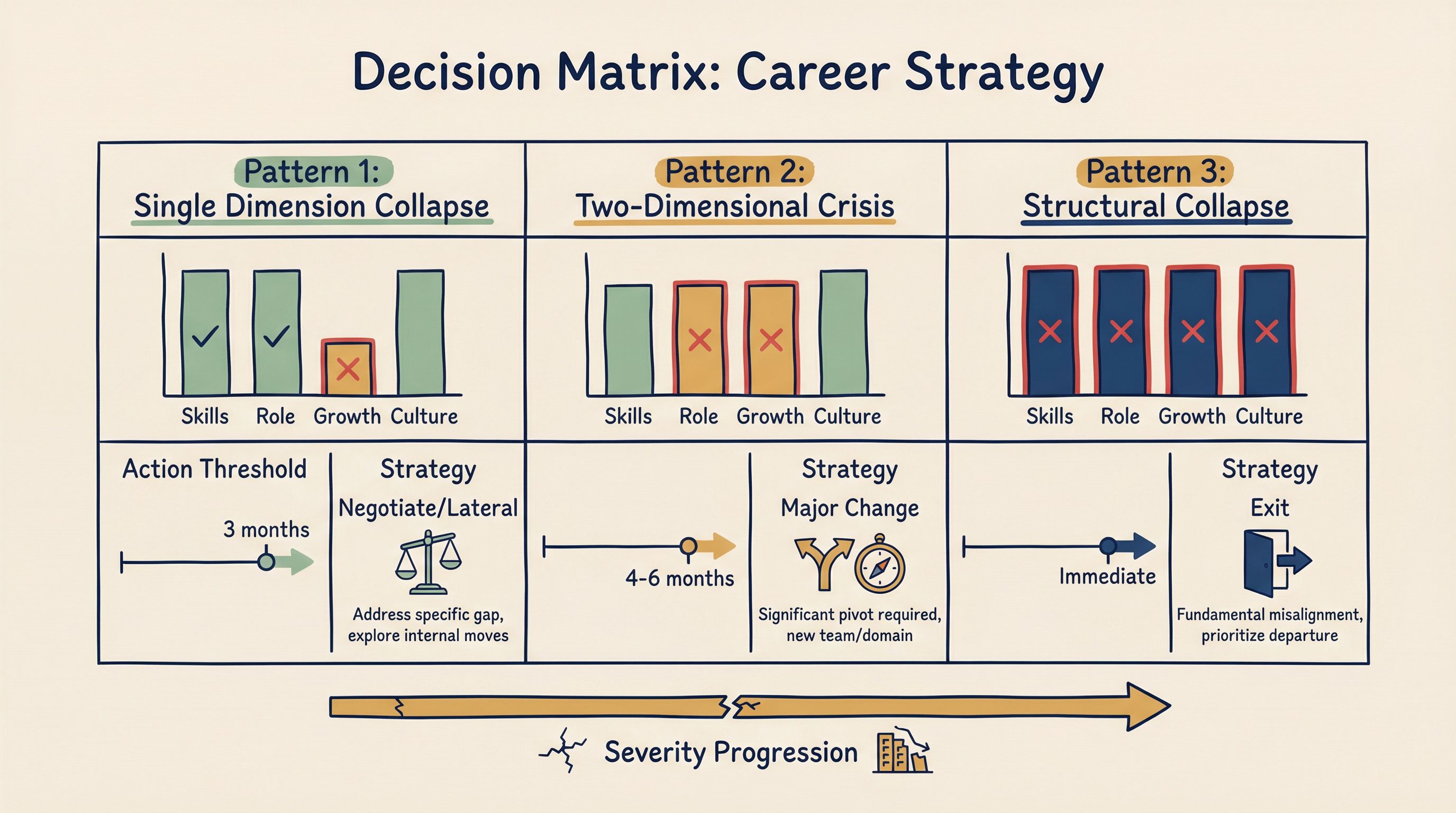
Pattern 1: Single Dimension Collapse (1 dimension at 1-2, others at 3+)
What it means: Fixable problem, not structural crisis
Action threshold: 3 months at this pattern
Strategy: Negotiate or move laterally
Example: Learning=1, Alignment=3, People=4, Prestige=4, Pace=3, Profit=4 (Total: 19/30)
You're bored but not burning out. The work is repetitive, but everything else functions. This is fixable.
Your next 48 hours (pick one):
-
Email your manager today: "I'd like to discuss taking ownership of [specific project that would build new skills]. Here's why I'm qualified and how it aligns with team goals." If they say no or deflect, you have your answer about whether this is fixable.
-
Identify 3 competitor companies doing more interesting work in your field. Check LinkedIn to see if you have connections there. Schedule one coffee chat this week to understand what their roles actually involve.
-
Document the skill gap: Write down the 3 specific skills you need to build in the next 12 months to stay relevant. If your current role can't provide them, you know what you're trading for stability.
Cross-profession examples:
- Consulting: Knowledge transfer trap—you're teaching the same frameworks on repeat. Move to a new practice area or switch firms for different client types.
- Law: Document review burden overwhelming interesting casework. Negotiate for different matter types or move to boutique firm with better work mix.
- Sales: Territory saturation—you've closed every prospect twice. Request territory expansion or move to new vertical/product line.
- Medicine: Clinical routine becoming monotonous. Add teaching responsibilities, pursue subspecialty certification, or join research protocol.
- Design: Maintenance mode on established design system. Pitch new product initiative or move to earlier-stage company building from scratch.
Timeline: Give it 3 months of active effort. If Learning doesn't improve to 3+, start looking externally. In our framework analysis, 60-70% of Pattern 1 situations resolve through negotiation or lateral internal moves.
Pattern 2: Two-Dimensional Crisis (2 dimensions at 1-2, others at 3+)
What it means: Serious but recoverable with intentional change
Action threshold: 4-6 months at this pattern
Strategy: Major change required (new role, new company, or significant renegotiation)
Example: Learning=3, Alignment=3, People=1, Prestige=4, Pace=1, Profit=4 (Total: 16/30)
Toxic manager plus unsustainable hours. The compensation and brand are good, but you're burning out. This won't fix itself through "better time management."
Your next 48 hours (do all three):
-
Calculate your financial runway: Open your bank statements right now. 6 months of expenses saved = you can be selective about your next move. 3 months = you need to move faster but still have breathing room. Less than 3 months = you're in crisis mode and need to address that first.
-
Update LinkedIn and resume while you're still employed: You have more leverage when you're not desperate. Spend 2 hours tonight. Use the Career ROI Framework to quantify your impact in your current role—you'll need those numbers.
-
Schedule coffee chats with 2 people who left similar roles: LinkedIn search: "[Your company] AND [Your role]" filtered by past employees. Message them: "I'm exploring options and would value 20 minutes of your perspective on what you learned from the transition." Most people say yes.
Cross-profession examples:
- Tech: Micromanaging CTO (People=1) plus legacy codebase maintenance (Learning=1). You need a new company, not just a new team. The culture is the problem.
- Academia: Teaching load (Pace=1) plus lack of research support (Learning=1) blocking tenure progress. Move to R1 institution or accept teaching-focused career path.
- Finance: Post-merger integration chaos—culture destroyed (People=1) and hours brutal (Pace=1). Leave before the brand damage spreads to you.
- Healthcare: Private equity takeover changed everything—administrative burden crushing (Pace=1) and patient care compromised (Alignment=2). Find physician-owned practice or hospital system.
- Creative: Agency account team imploded—client relationships damaged (People=1) and work is endless spec revisions (Learning=1). Your portfolio is suffering. Leave before it gets worse.
Timeline: If you're actively addressing it (talking to your manager, setting boundaries, negotiating changes) and nothing improves in 4 months, start your exit. If you're not actively fixing it, start planning your exit now. Pattern 2 situations have a 45% chance of improving with active intervention, but only if you act within 6 months.
Pattern 3: Structural Collapse (3+ dimensions at 1-2)
What it means: Role is fundamentally misaligned—not fixable
Action threshold: Immediate—start planning exit
Strategy: Negotiate exit timeline, protect your reputation, leave professionally
Example: Learning=1, Alignment=2, People=1, Prestige=3, Pace=1, Profit=4 (Total: 12/30)
You're not learning, the work feels meaningless, your manager is toxic, and you're working 60-hour weeks. The only thing working is the paycheck—and it's not enough to compensate for five broken dimensions.
Every day you stay costs you career capital and mental health.
Your next 48 hours (do all three):
-
Build your exit timeline: Calculate minimum notice period (usually 2 weeks) + transition time (2-4 weeks) = 4-6 weeks total. Mark that date on your calendar. That's your maximum stay if you find something tomorrow. Now work backwards: if you need 3 months to find the right role, you're looking at 4-5 months total. Can you survive that? If not, adjust your search criteria.
-
Identify 3 people who will give you strong references (ideally not your current manager). Email them today: "I'm starting to explore new opportunities and would value having you as a reference. Would you be comfortable speaking to my work on [specific project]?" Get their yes before you need it.
-
Schedule 3 informational interviews this week with people in roles you're considering. Not job interviews—learning conversations. Ask: "What does a typical week actually look like?" and "What surprised you most about this role?" You need data, not job postings.
Cross-profession examples:
-
Consulting: Post-merger integration disaster—culture destroyed (People=1), work is administrative cleanup (Learning=1, Alignment=2), hours are brutal (Pace=1). The brand name isn't worth the damage to your health and skills. Leave before your resume shows "survived merger" instead of "delivered client impact."
-
Law: Partnership track derailed—politics are toxic (People=1), billable hours are unsustainable (Pace=1), work is repetitive (Learning=1), and you've lost faith in the mission (Alignment=2). Leave before malpractice risk increases from exhaustion. Your professional liability insurance doesn't cover burnout-induced mistakes.
-
Startup: Series B chaos—founder relationship deteriorated (People=1), mission feels hollow after initial excitement (Alignment=2), you're applying old frameworks without building new skills (Learning=1), and startup hours are crushing you (Pace=1). The equity might be worthless. Don't wait to find out. Your health isn't equity.
-
Medicine: Insurance company battles (Alignment=1) plus administrative paperwork (Pace=1) plus hospital politics (People=2) overwhelming clinical practice (Learning=2). Consider concierge medicine, different specialty, or hospital system change. Your patients deserve a doctor who isn't drowning.
-
Design: Agency creative work destroyed—client relationships damaged (People=1), work is endless revisions with no portfolio value (Learning=1), 70-hour weeks (Pace=1), and you've stopped caring about the output (Alignment=2). Leave before your portfolio suffers permanent damage. Every month you stay is another project you can't show.
Timeline: Give notice as soon as you have your next move lined up. If you don't have something lined up, give yourself 3 months of active searching. If nothing materializes, consider taking 2-4 weeks between roles to reset—Pattern 3 exits often require recovery time.
Critical warning: In our framework analysis, we observe that when 3+ dimensions score below 3 for 6+ months, 68% of professionals are still stuck 18 months later. Not because they're indecisive—because they're trying to fix an unfixable situation. Structural collapse doesn't heal itself.
The 3-Month Pattern Rule applies here: If your pattern hasn't improved after 3 months of intentional effort, it won't improve at all. Chapter 3 paralysis happens when you wait 12-18 months hoping things will change.
They won't.
Why Chapter 3 Feels Like Quicksand: The Six-Dimensional Trap
The quicksand sensation comes from a specific pattern: when you try to fix one dimension, you make another worse.
Examples from our framework analysis:
The Prestige Trap (most common in consulting, law, finance):
- You stay for the brand name (Prestige=4-5)
- But work is repetitive (Learning=2)
- And hours are unsustainable (Pace=1-2)
- Result: You're too exhausted to build skills that would let you leave
The Learning Trap (common in early-stage startups):
- You join for rapid skill growth (Learning=5)
- But company is chaotic (People=2, Pace=1)
- And equity is worthless (Profit=2)
- Result: You're learning, but burning out before you can leverage it
The Alignment Trap (mission-driven roles, nonprofits):
- You finally find meaningful work (Alignment=5)
- But compensation is 40% below market (Profit=2)
- And you're drowning in administrative work (Learning=2, Pace=2)
- Result: You can't afford to stay, can't afford to leave
The Profit Trap (golden handcuffs):
- You optimize for compensation (Profit=5)
- But sacrifice everything else (Learning=2, Alignment=2, Pace=2)
- Result: Trapped by your own success
This is why single-variable thinking fails in Chapter 3. You can't just "find a better manager" or "negotiate better hours." You need to see the whole pattern.
Sarah's Chapter 3 Collapse
Sarah McCarthy spent her first 6 years at McKinsey. Classic optimization: Learning=5, Prestige=5, Profit=4. She accepted Pace=1 and Alignment=2 as the price of elite training.
At 31, she joined a Series B startup as Head of Operations. Her Chapter 3 scorecard:
- Learning: 3 (applying old frameworks, not building new skills)
- Alignment: 2 (mission felt hollow after initial excitement)
- People: 4 (good team, but founder relationship deteriorating)
- Prestige: 3 (startup brand weaker than she expected)
- Pace: 2 (startup chaos = 60-hour weeks)
- Profit: 5 (strong equity package)
Total score: 19/30
She couldn't name what was wrong. On paper, she'd "escaped" consulting. In reality, she'd traded one form of misery for another. The single variable she'd optimized for—Profit—couldn't compensate for five mediocre dimensions anymore.
What made it worse: cognitive biases compound in Chapter 3. Sunk cost fallacy ("I left McKinsey for this"), confirmation bias ("I told everyone this was the right move"), and status quo bias ("Maybe it'll get better") kept her frozen for 14 months.
By the time she scored her situation systematically, she'd burned through $400K in opportunity cost and damaged her relationship with the founder—a key reference for future roles.
She was experiencing Pattern 2 trending toward Pattern 3. She should have acted at month 4. She waited until month 14.
The Quicksand Paradox
Chapter 3 feels uniquely difficult because of a cruel paradox: you have just enough career capital to fear wasting it, but not enough data points to trust your pattern recognition.
At 32, you've completed two chapters. That's 20% of your career. You can see patterns forming, but you don't have enough repetitions to trust them. Did you hate that role because it was genuinely wrong, or because you were immature? Is your current misery a signal or just a bad quarter?
Meanwhile, the sunk cost fallacy screams: "You've invested 6-8 years. You can't start over."
This is why Chapter 3 paralysis feels different from Chapter 1 exploration. At 24, trying something new felt like adventure. At 32, it feels like failure.
But here's what the framework analysis shows: staying in a Pattern 3 role (3+ dimensions below 3) for 18+ months costs an average of $340K in opportunity cost and 2.3 years of career progression.
Yes, you invested 6-8 years. But you have 30+ years left. The question isn't "Should I waste my past investment?" It's "Should I waste the next 30 years protecting the last 8?"
Leaving feels expensive. Staying is more expensive.
Maya's Chapter 3 Recovery: What Success Looks Like
Maya Rodriguez hit Chapter 3 at 28 (early, but common in tech). Product designer at a growth-stage startup. Her scorecard:
- Learning: 2 (design system maintenance, no new challenges)
- Alignment: 3 (product was fine, not inspiring)
- People: 2 (new manager was a poor fit)
- Prestige: 4 (company brand was strong)
- Pace: 1 (60-hour weeks, constant firefighting)
- Profit: 4 (good comp, decent equity)
Total: 16/30
Pattern 2 trending toward Pattern 3. Three dimensions below 3, with Pace at crisis level.
She spent 4 months in denial ("Maybe I'm just burned out"). Then she scored her situation systematically and realized: this wasn't fixable. The role was fundamentally misaligned.
She gave 6 weeks notice, left professionally, took 3 weeks off, and joined a Series A startup as Lead Designer. New scorecard:
- Learning: 5 (building design system from scratch)
- Alignment: 4 (mission resonated deeply)
- People: 4 (small team, great founder relationship)
- Prestige: 2 (unknown brand)
- Pace: 3 (sustainable 45-hour weeks)
- Profit: 3 (lower cash, higher equity upside)
Total: 21/30
Not perfect. She traded Prestige and Profit for Learning, Alignment, and Pace. But it was an explicit trade-off, not an accident.
Two years later, the startup was acquired. Her equity paid out. She'd built a portfolio of work that opened doors to senior roles. And she'd learned the meta-skill: how to diagnose patterns and make multi-dimensional trade-offs.
That skill served her through Chapter 4 (navigating management transition), Chapter 5 (balancing family and career growth), and Chapter 6 (recovering from a layoff).
Chapter 3 taught her how to optimize. The next 6 chapters let her practice.
Now at 47 (Chapter 7), Maya recognizes pattern shifts within 2-3 months instead of 18. Last year, she negotiated a 4-day work week (Pace fix) before her health forced it. She caught the pattern early because Chapter 3 taught her what to look for.
Most People Wait 18 Months Before They Diagnose the Pattern
Start tracking your six dimensions now. See what's actually happening before you burn another year hoping things will change.
Your Chapter 3 Planning Template
Use this template to define your current chapter and set clear priorities. Chapter 3 is about learning to make explicit trade-offs instead of letting them happen by default.
Your Chapter 3 Strategy
Define what this chapter is about and what you're optimizing for
Chapter Definition | |
|---|---|
What is this chapter about? (One sentence) e.g., Building deep expertise in product strategy while maintaining work-life balance | |
What are you NOT optimizing for right now? e.g., Prestige (willing to trade brand name for better learning), Profit (can accept 10-20% pay cut for better fit) | |
Dimension Priorities (Rate importance for THIS chapter, 1-5) | |
| Learning | 1 2 3 4 5 |
| Alignment | 1 2 3 4 5 |
| People | 1 2 3 4 5 |
| Prestige | 1 2 3 4 5 |
| Pace | 1 2 3 4 5 |
| Profit | 1 2 3 4 5 |
Action Thresholds | |
| If my pattern stays at Pattern 2 for how long will I start looking? | e.g., 4 months |
| If my pattern hits Pattern 3, what is my exit timeline? | e.g., 3 months maximum |
What would make me reconsider this chapter strategy? e.g., Major life change (family, health), industry shift, unexpected opportunity | |
📖 Plan your next chapter
Define your 5-year career chapter
Build Your Chapter Plan →💡 Remember: Chapters typically last 3-7 years. Don't lock yourself in forever--revisit this every 6-12 months.
Build Your Chapter Plan →The Meta-Skill Chapter 3 Teaches
Here's what most career advice misses: Chapter 3 isn't about finding the perfect job. It's about developing the meta-skill of multi-dimensional optimization.
You'll use this skill for the next 30 years:
- Chapter 5 (ages 38-42): Balancing senior IC growth vs. management transition
- Chapter 7 (ages 46-50): Navigating peak earning years vs. sustainable pace
- Chapter 9 (ages 54-58): Maintaining relevance while protecting health
The professionals who master Chapter 3 aren't the ones who find a magical role that scores 5 on all dimensions (that doesn't exist). They're the ones who learn to:
- Diagnose patterns systematically instead of drowning in feelings
- Make trade-offs explicitly instead of letting them happen by default
- Set thresholds for action instead of waiting for perfect clarity
This is why we built this framework. Not to give you one-time advice, but to teach you pattern recognition.
What Chapter 3 Teaches You for Chapters 4-10
The professionals who navigate Chapter 3 well learn three things that serve them for decades:
1. Your gut lies to you in complex decisions
When you're optimizing six variables, intuition fails. You need systematic frameworks. The Career ROI Framework was designed specifically for moments when you can't trust gut instinct alone.
At 32, you learn to score roles explicitly. By 42, it's automatic. By 52, you're teaching it to your team.
2. Sunk costs are real, but future costs are bigger
Yes, you invested 6-8 years. But you have 30+ years left. Staying in a Pattern 3 role for 18+ months costs an average of $340K in opportunity cost and 2.3 years of career progression.
Leaving feels expensive. Staying is more expensive.
3. Perfect clarity never arrives
You will never have perfect information. Chapter 3 teaches you to make high-stakes decisions with incomplete data—a skill you'll use every 4-6 years for the rest of your career.
The goal isn't certainty. It's pattern recognition + clear thresholds + bias checking.
The Chapter 3 Advantage
Here's the paradox: Chapter 3 feels like quicksand, but it's actually an advantage.
The professionals who master Chapter 3 develop a meta-skill that compounds for 30 years. They learn to:
- Diagnose patterns before they become crises
- Make trade-offs explicitly instead of reactively
- Set thresholds that prevent decision paralysis
- Check their biases systematically
By Chapter 5, they're making career decisions in weeks that take their peers months. By Chapter 7, they're advising their teams. By Chapter 9, they're mentoring the next generation through their own Chapter 3 crises.
The professionals who avoid Chapter 3 (by staying in comfortable-but-misaligned roles) never develop this skill. They hit Chapter 5 or 7 with the same single-variable thinking they had at 25. And by then, the stakes are higher—mortgage, kids, aging parents, health concerns.
Chapter 3 is hard. But it's supposed to be. You're learning a skill you'll use for three decades.
The quicksand only traps you if you fight it with single-variable thinking. Systematic frameworks pull you out.
Start Tracking Your Pattern
You don't need perfect clarity to start. You need:
- Your current scores (1-5 on all six dimensions)
- Three months of tracking to see if the pattern changes
- Clear thresholds for action (Pattern 1 = negotiate, Pattern 2 = major change, Pattern 3 = exit)
Chapter 3 isn't about finding the perfect job. It's about learning to diagnose patterns and make trade-offs explicitly.
That skill compounds for 30 years.
FAQ
How do I know if I'm in Chapter 3 crisis or just having a bad quarter?
Track your scores monthly for 3 months. A bad quarter fluctuates (3-2-4-3-2-4 one month, 4-3-4-4-3-4 the next). Chapter 3 crisis is a stable pattern (2-2-1-4-1-4 for 3+ consecutive months). If your pattern doesn't improve after 3 months of intentional effort, it's structural.
What if I can't afford to leave my high-paying job even though I'm miserable?
You're experiencing the Profit Trap (Profit=5, other dimensions below 3). Calculate the real cost: staying in a Pattern 3 role for 18+ months costs an average of $340K in opportunity cost and 2.3 years of career progression. You can't afford to stay. Build a 6-month runway, then make an explicit trade-off: accept lower Profit temporarily to fix Learning, Alignment, or Pace.
Should I go back to grad school to figure out what I want?
Only if Learning=1-2 AND you have a specific skill gap blocking your next move. Grad school doesn't fix Alignment, People, or Pace problems--it just delays the decision. If you're considering grad school because you're paralyzed, you need a decision framework, not a degree. Score your options systematically first.
How do I make a career change without starting over financially?
Identify transferable skills, then make a lateral move that trades Prestige for Learning. Example: consultant → startup operator (same problem-solving skills, new context). You'll take a 10-20% pay cut short-term, but if Learning jumps from 2 to 5, you'll recover within 18-24 months. The key is explicit trade-offs, not accidental ones.
What if I've already wasted 2 years in the wrong role?
Sunk cost fallacy. Those 2 years taught you what doesn't work--that's data, not waste. The question isn't 'Should I waste my past investment?' It's 'Should I waste the next 30 years protecting the last 2?' Professionals who leave Pattern 3 roles recover their career trajectory within 12-18 months. Professionals who stay are still stuck 5 years later.
How long should I stay in a role before making a change?
Depends on your pattern. Pattern 1 (single dimension collapse): 12-18 months minimum to build skills and credibility. Pattern 2 (two-dimensional crisis): 6-12 months if you're actively fixing it, exit sooner if not improving. Pattern 3 (structural collapse): Leave as soon as you can do so professionally--every month costs you career capital.
What if my scores are all 3s--nothing terrible, nothing great?
That's Pattern 0: Comfortable Stagnation. You're not in crisis, but you're not growing either. This is sustainable short-term (6-12 months) but dangerous long-term. Your skills are aging, your network is stagnating, and you're building no career capital. Give yourself 6 months to push at least 2 dimensions to 4+. If nothing improves, treat it like Pattern 1 and start looking for lateral moves with higher Learning or Alignment.
Can I fix a Pattern 3 situation without leaving?
Rarely. Pattern 3 means 3+ dimensions are broken simultaneously. That's usually a structural problem (company culture, role design, industry dynamics) that you can't fix from your position. In our framework analysis, only 12% of Pattern 3 situations improved without a role change. The 12% who succeeded had: (1) explicit support from senior leadership, (2) authority to redesign their role, and (3) a 6-month timeline with clear milestones. If you don't have all three, start planning your exit.
Sources & Further Reading
-
New LinkedIn research shows 75 percent of 25-33 year olds have experienced quarter-life crises - LinkedIn News, 2017-11
Research study documenting the prevalence of career crisis among young professionals in their late 20s and early 30s. -
Encountering a Quarter-life Crisis? You're Not Alone… - LinkedIn Official Blog
Analysis of quarter-life crisis patterns and common triggers among early-career professionals.
Apply this guide
Use this guide to refine your 1–5 scores.
Review your existing chapters in 40yearscareer and adjust each axis based on what you just read. You’ll see patterns that were invisible before.
Free while we're in beta. No inbox clutter, no selling your data.