The Regret Matrix: Why the Chances You Don't Take Haunt You More Than the Ones That Fail
Research shows we regret inaction more than failed action—and the gap compounds over 20 years. Use the Regret Matrix to make career decisions you won't second-guess decades later.

Dr. James Chen
Career, product, and psychology team
Written by our expert panel: career coach, psychologist, HR leader, and product designer. Every article includes exercises you can try in the app.
David's been a Senior Engineering Manager for three years. His technical skills are atrophying while his director peers get VP offers. He knows he should either go deep on leadership or return to IC work, but he's paralyzed—not by fear of failure, but by fear of regret. What if he picks wrong and spends 20 years wondering about the other path?
Wrong question.
The real question: Which version of wrong will I regret more in 20 years?
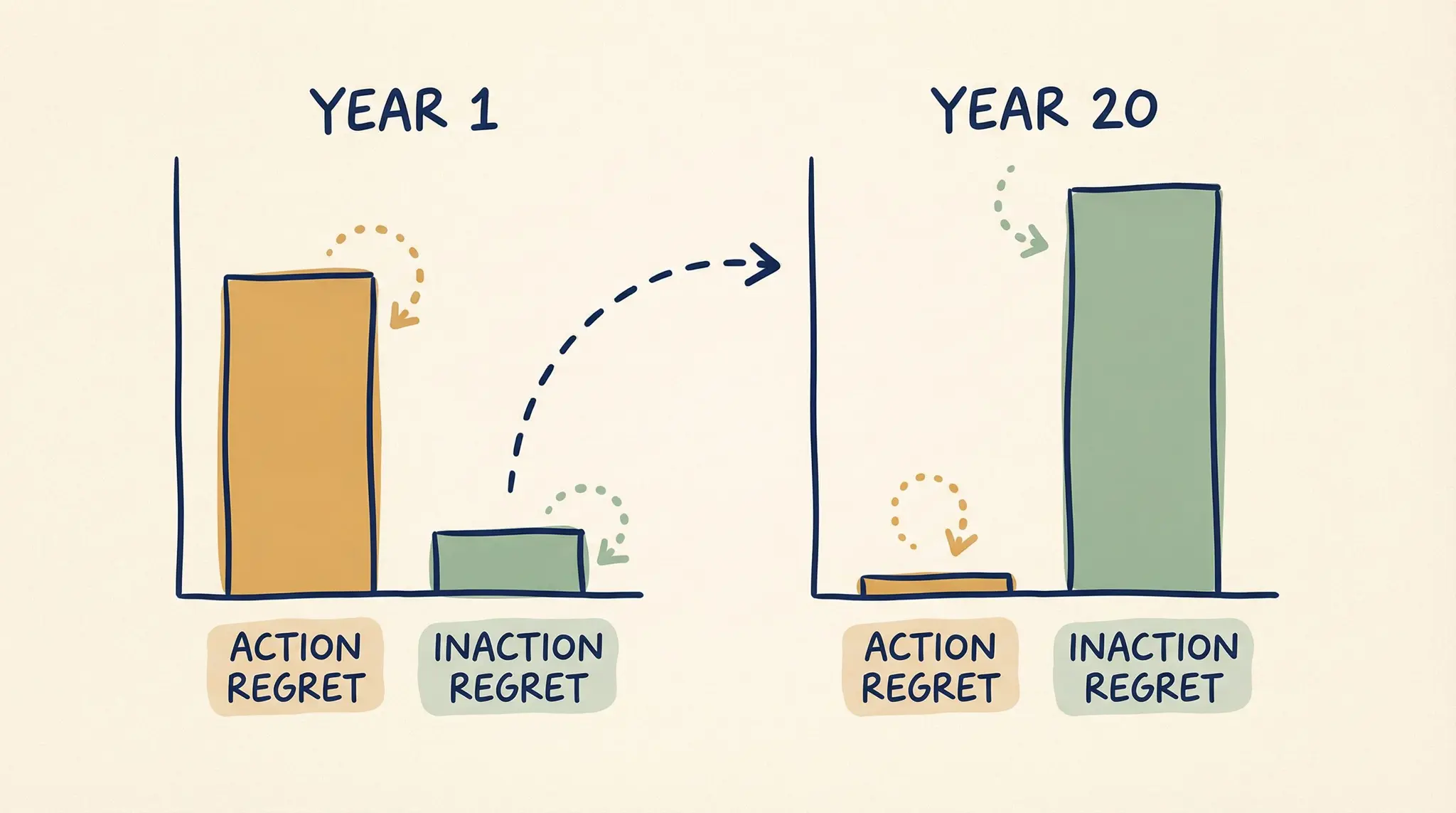
Because here's what two decades of research shows: we regret the chances we didn't take far more than the ones that didn't work out. And that gap compounds over time.
The Two Types of Regret (And Why One Haunts You Forever)
Commission regret: You did something, and it went wrong. You took the startup job, it failed, you lost equity. You moved cities for a relationship that ended. You pivoted to product management and hated it.
Omission regret: You didn't do something, and you'll never know what would have happened. You didn't take the startup offer. You didn't move. You stayed in engineering when you wanted to try PM.
In the short term, commission regret stings more. You have concrete evidence of failure. Your LinkedIn shows the 11-month stint. Your bank account shows the pay cut that didn't pan out.
But the path not taken? The counterfactual becomes more vivid than reality. You've spent years imagining every promotion you missed, every skill you didn't build.
Commission regret teaches. Omission regret haunts.
The Timeline: How Regret Changes Over 20 Years
Year 1: Commission regret dominates.
You took the risky job, it's not working out. You're stressed. Your friends who stayed at Google are crushing it. You feel stupid.
Meanwhile, the safe choice you didn't take barely registers. "I could have stayed at my old job" isn't a compelling counterfactual yet.
Year 5: The balance shifts.
You've recovered from the failed experiment. You learned what you don't want. You found a better fit. The pain has context now.
But the path not taken is getting more interesting. "If I'd taken that startup offer in 2021, I'd be VP Eng by now. The company just raised a Series C."
Year 20: Omission regret dominates completely.
The failed experiment is a story you tell at dinner parties. "I tried consulting for a year, hated it, went back to building products. Best mistake I ever made."
But the unlived career? That's the one that keeps you up at night. You've spent two decades constructing what could have been. Every time you see someone doing the work you didn't try, you add another detail to the alternate timeline.
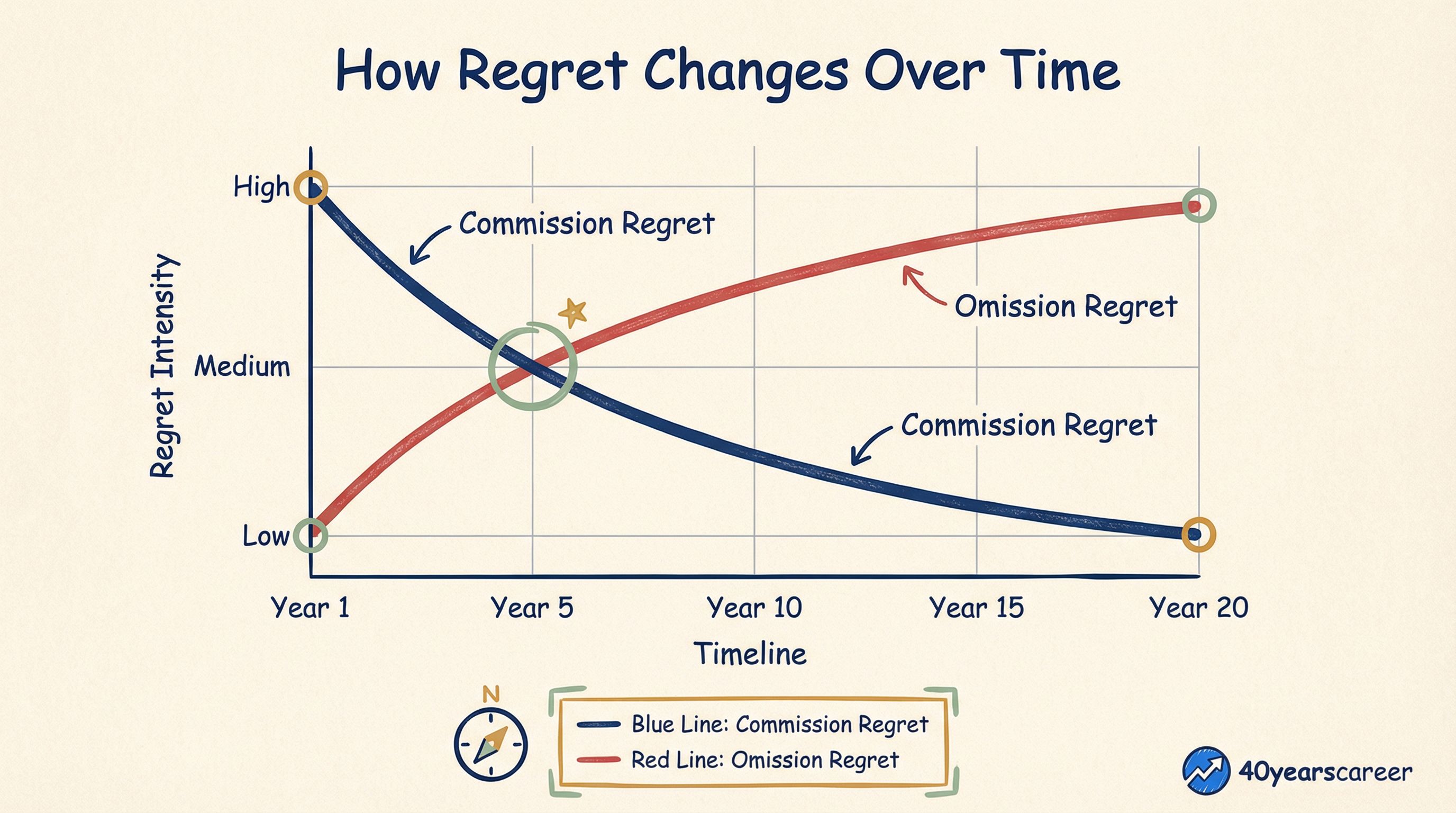
This pattern isn't anecdotal. When Cornell psychologists asked people to describe their single biggest regret, 84% described things they didn't do, not things they tried and failed at (Gilovich & Medvec, 1995). A meta-analysis examining regret across 11 different life domains found the same pattern: in the long term, inaction generates more intense and enduring regret than action (Roese & Summerville, 2005).
Why Your Brain Makes Omission Regret Worse Over Time
Three psychological mechanisms explain why the path not taken haunts you more than the path that failed:
1. Counterfactual Inflation
Your brain fills uncertainty with idealized outcomes. When you try something and it fails, reality constrains the counterfactual: "I tried, it sucked, I know exactly what would have happened."
But when you don't try, your brain has infinite degrees of freedom. It constructs the best possible version of what could have been. The startup you didn't join? In your mind, it definitely would have succeeded. The city you didn't move to? Perfect weather, amazing friends, your dream life.
Research on affective forecasting shows we're terrible at predicting how we'll feel about outcomes (Kahneman & Tversky). But we're even worse at predicting counterfactuals because there's no reality check. The unlived path gets better every time you imagine it.
2. The Closure Gap
Commission regrets have endpoints. You tried, it failed, the story is complete. Your brain can file it away.
Omission regrets remain open loops. The Zeigarnik effect shows our brains obsess over incomplete tasks. The path not taken is the ultimate incomplete task—it can never be completed because it was never started. Your brain keeps it active, keeps adding to it, keeps wondering.
3. Upward Counterfactual Bias
We imagine the best version of the path not taken while ignoring where it could have failed. The startup you didn't join? You imagine yourself as VP Eng, not as employee #47 who got laid off in the Series B crunch.
Meanwhile, the path you took gets compared to this idealized alternative. No wonder your actual career feels disappointing.
How This Maps to Your Career Architecture
Omission regret often stems from misaligned Persona (taking the "should" path instead of the "want" path) and poor Allocation (not investing in skills you care about). When David looks back at his three years as an EM, his omission regret isn't about the management work he did—it's about the technical depth he didn't build.
Commission regret clusters around Pay (equity that tanked, pay cuts that didn't pan out) and Place (cities that didn't work, companies that failed). These are concrete, reversible outcomes. You can make more money. You can move again.
But Persona and Allocation regrets compound. Every year David stays in management while his skills atrophy, the gap between who he is and who he wanted to become widens. That's the regret that will haunt him at 60.
Track which dimension drives your counterfactuals—that's where you're underinvesting. Learn more about how to read your career patterns before they cost you years of compounding regret.
The Regret Matrix: A Decision Framework
Not all decisions carry equal regret risk. The Regret Matrix helps you identify which choices deserve bias toward action.
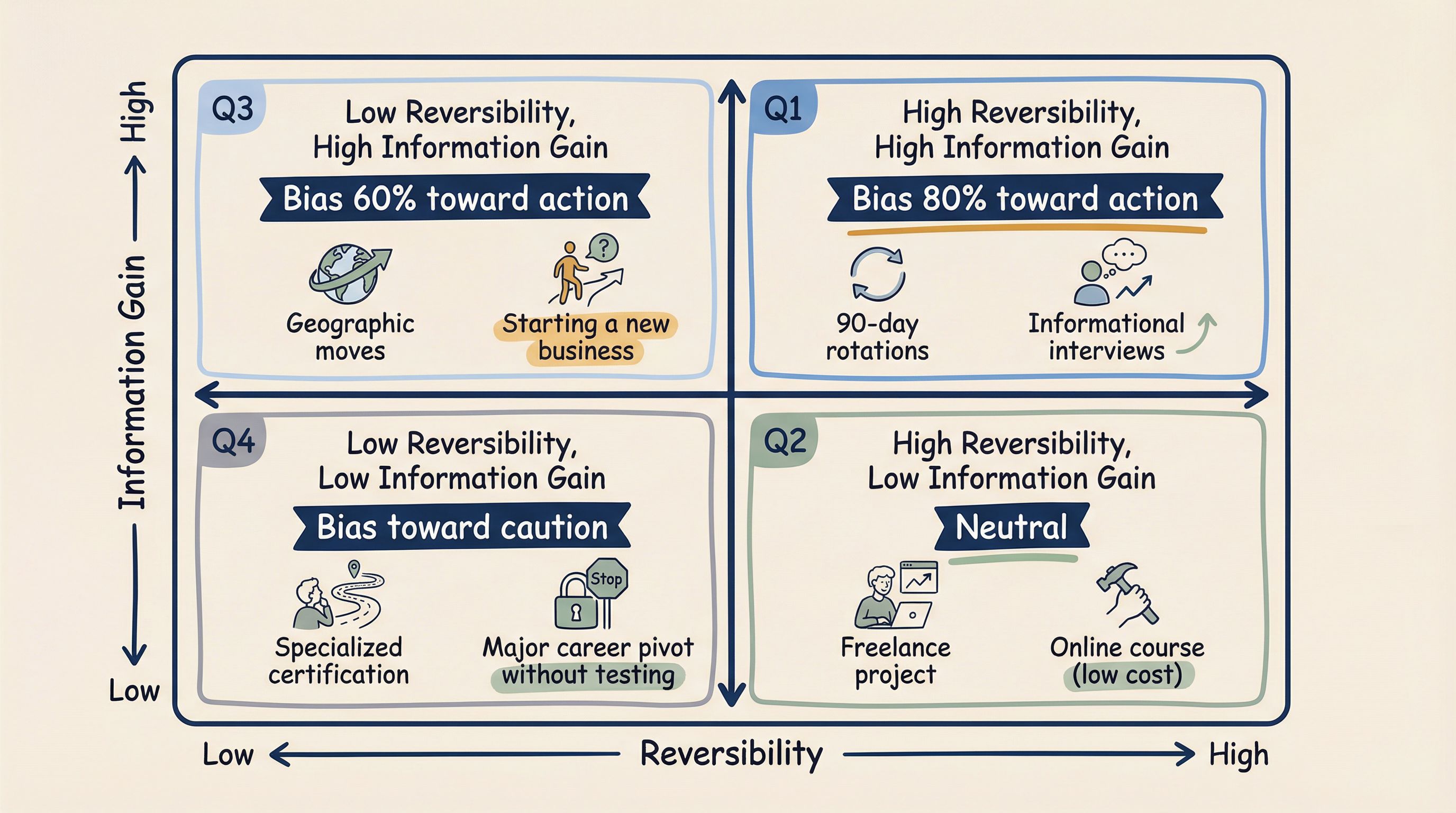
High Reversibility Easy to undo | Low Reversibility Hard to reverse | |
|---|---|---|
| High Information Gain | Quadrant 1: Bias 80% toward action (90-day rotations, sabbaticals) | Quadrant 3: Bias 60% toward action (relocations, pivots) |
| Low Information Gain | Quadrant 2: Neutral (lateral moves, title changes) | Quadrant 4: Bias toward caution (burning bridges, risky equity) |
Quadrant 1: High Reversibility, High Information Gain
Examples: 90-day IC rotation, 6-month sabbatical, contract role, geographic trial
Decision rule: Bias 80% toward action. Low downside, high learning. Commission regret fades fast; omission regret compounds.
David's case: Take a 3-month IC architect rotation while keeping his EM role. If he hates hands-on work, he's learned something valuable. If he loves it, he has data for a permanent switch.
Quadrant 2: High Reversibility, Low Information Gain
Examples: Lateral moves within same company, title changes without scope change, minor comp adjustments
Decision rule: Neutral. These won't haunt you either way. Make the call based on immediate preferences.
Quadrant 3: Low Reversibility, High Information Gain
Examples: Geographic relocations, major industry pivots, founder → employee transitions
Decision rule: Bias 60% toward action if the unlived path aligns with your Persona. The information gain justifies the risk. You'll regret not knowing more than you'll regret trying and failing.
Sarah's case: Taking the 50% pay cut to leave consulting taught her she values building over advising. That's worth knowing, even if the specific role didn't work out. She's now a product leader at a growth-stage company—a path she wouldn't have found without the experiment.
Quadrant 4: Low Reversibility, Low Information Gain
Examples: Burning bridges, equity-heavy comp in uncertain startups, moves that don't build transferable skills
Decision rule: Bias toward caution. High risk, low learning. These are the decisions that can generate lasting commission regret.
Using the Regret Matrix: Three Decision Scenarios
Scenario 1: The Startup Offer
You're a senior engineer at a FAANG company. A Series A startup offers you a principal role with meaningful equity but 30% less cash comp.
Matrix placement: Quadrant 3 (Low Reversibility, High Information Gain)
Analysis:
- Reversibility: Low. Leaving FAANG resets your comp baseline and career trajectory.
- Information Gain: High. You'll learn if you can operate in ambiguity, build from scratch, and thrive without infrastructure.
- LA4P dimension at stake: Allocation (building breadth vs. depth) and Persona (specialist vs. generalist identity)
Regret projection:
- Commission regret if it fails: "I tried startups, learned I need more structure, went back to big tech with new appreciation." Fades to dinner party story within 3 years.
- Omission regret if you don't try: "I spent 20 years wondering if I could have been a founding engineer. I'll never know." Compounds every time you see a startup success story.
Decision: Bias 60% toward taking it, especially if you're under 35 and have financial runway.
Scenario 2: The Management Track
You're a senior IC. Your manager is pushing you toward EM. You're ambivalent—you like mentoring but love building.
Matrix placement: Quadrant 1 (High Reversibility, High Information Gain)
Analysis:
- Reversibility: High. IC ↔ EM transitions are common and accepted. You can switch back within 18 months without stigma.
- Information Gain: High. You'll learn if you're energized by people problems or drained by them.
- LA4P dimension at stake: Persona (maker vs. multiplier identity)
Regret projection:
- Commission regret if you hate it: "I tried management for a year, learned I'm an IC at heart, went back to building." Minimal long-term regret.
- Omission regret if you don't try: "I spent my career wondering if I should have led a team. I'll never know if I could have been great at it." Compounds as you watch peers become VPs.
Decision: Bias 80% toward trying it. Run a 12-month experiment with explicit checkpoints. For more on evaluating management transitions, see which dimensions actually trigger career changes.
Scenario 3: The Geographic Move
You're considering relocating from Austin to San Francisco for better career opportunities, but you love your Austin life.
Matrix placement: Quadrant 3 (Low Reversibility, High Information Gain)
Analysis:
- Reversibility: Medium-Low. Moving is expensive and disruptive. Social networks take years to rebuild.
- Information Gain: High. You'll learn if you thrive in high-density tech ecosystems or if you're optimized for quality of life.
- LA4P dimension at stake: Place (geography) and Persona (career ambition vs. lifestyle optimization)
Regret projection:
- Commission regret if you hate SF: "I tried the SF thing, learned I value space and nature, moved back." Fades within 2-3 years.
- Omission regret if you don't try: "I spent my career wondering if I limited my ceiling by staying in Austin. I'll never know what network I could have built." Compounds every time you see SF-based peers advance faster.
Decision: Depends on age and life stage. If you're under 30 with no dependents, bias 70% toward trying it. If you're 40 with kids in school, bias toward staying—the information gain doesn't justify the family disruption.
The Regret-Minimization Protocol
When facing a major career decision:
Regret-Minimization Protocol
5 steps to complete
Write your Year 20 omission regret letter
Imagine yourself at 60, looking back. Write the letter that starts: "I wish I had..."
David's letter: "I wish I had returned to IC work when I still had the skills to be great at it. I spent 20 years as a mediocre manager when I could have been an exceptional architect. I let my technical identity die because I was afraid of the title downgrade."
Identify which LA4P dimensions you're sacrificing by staying
The dimensions that show up in your Year 20 letter are the ones driving omission regret.
Map the decision to the Regret Matrix
Determine reversibility and information gain to guide your bias.
Create decision thresholds
Set clear rules for when to act vs. when to wait.
Run 90-day experiments instead of permanent leaps
Small experiments generate information without triggering irreversible commission regret.
Map Your Decision to the Regret Matrix
Use our interactive worksheet to identify which choices deserve bias toward action.
Your Regret Matrix Worksheet
Your Regret Matrix Decision Template
Compare the two paths and project which regret you can live with
| Dimension | Path A (Current/Safe) | Path B (Alternative/Risky) |
|---|---|---|
Decision Context | ||
| What is the decision? | Stay in current role | Take startup offer |
What's at stake? ________ | ||
Regret Matrix Placement | ||
| Reversibility (1=Hard to undo, 5=Easy to reverse) | 1 2 3 4 5 | 1 2 3 4 5 |
| Information Gain (1=Low learning, 5=High learning) | 1 2 3 4 5 | 1 2 3 4 5 |
| Which quadrant? (1=Q1, 2=Q2, 3=Q3, 4=Q4) | __ | __ |
LA4P Dimensions at Stake | ||
| Learning | 1 2 3 4 5 | 1 2 3 4 5 |
| Alignment | 1 2 3 4 5 | 1 2 3 4 5 |
| People | 1 2 3 4 5 | 1 2 3 4 5 |
| Prestige | 1 2 3 4 5 | 1 2 3 4 5 |
| Pace | 1 2 3 4 5 | 1 2 3 4 5 |
| Profit | 1 2 3 4 5 | 1 2 3 4 5 |
| TOTAL LA4P | ||
Year 20 Regret Projection | ||
Commission regret (if I try Path B and it fails) ________ | ||
Omission regret (if I don't try Path B) ________ | ||
| Which regret will compound more over 20 years? | ________ | ________ |
Debiasing Checks | ||
Decision Threshold | ||
| Based on the matrix, what's my bias? (e.g., 70% toward action) | ________ | ________ |
| Can I run a 90-day experiment instead of a permanent leap? | ________ | ________ |
Final Decision | ||
Decision ________ | ||
Why (which regret can I live with?) ________ | ||
✨ Ready to make your decision?
Use our interactive calculator to save and compare your options
Use Our Interactive Calculator →💡 Remember: The goal isn\'t to eliminate regret--that\'s impossible. Choose the version of regret you can live with. Commission regret teaches. Omission regret haunts.
Use Our Interactive Calculator →Back to David
David mapped his decision to the Regret Matrix: High reversibility (IC ↔ EM transitions are common), High information gain (he'll learn if he still loves building).
He wrote his Year 20 letter. It wasn't about the VP title he might miss. It was about the technical depth he'd never build, the systems he'd never design, the craft he'd let atrophy.
He realized his omission regret (not building technical depth) would compound for 20 years, while commission regret (leaving the management track) would fade in 2.
He took a 6-month IC architect rotation. Three months in, he's building again. The work energizes him in a way management never did. He's not sure if he'll stay IC forever, but he knows he won't spend the next 20 years wondering.
That's the point. Not to eliminate regret—that's impossible. But to choose the version of regret you can live with.
Commission regret teaches. Omission regret haunts.
Choose the teacher over the ghost.
Sources & Further Reading
-
The Best Strategy for Avoiding Regret? Take a Chance - Medium, Wise & Well Research on how action-based regrets fade while inaction regrets compound over time.
-
Explorations of Regret - LinkedIn, Dan Ariely Behavioral economist Dan Ariely's analysis of regret patterns and decision-making under uncertainty.
Apply this guide
Use this guide to refine your 1–5 scores.
Review your existing chapters in 40yearscareer and adjust each axis based on what you just read. You’ll see patterns that were invisible before.
Free while we're in beta. No inbox clutter, no selling your data.