Phil Knight's 40-Year Career: The LA4P Pattern That Built Nike
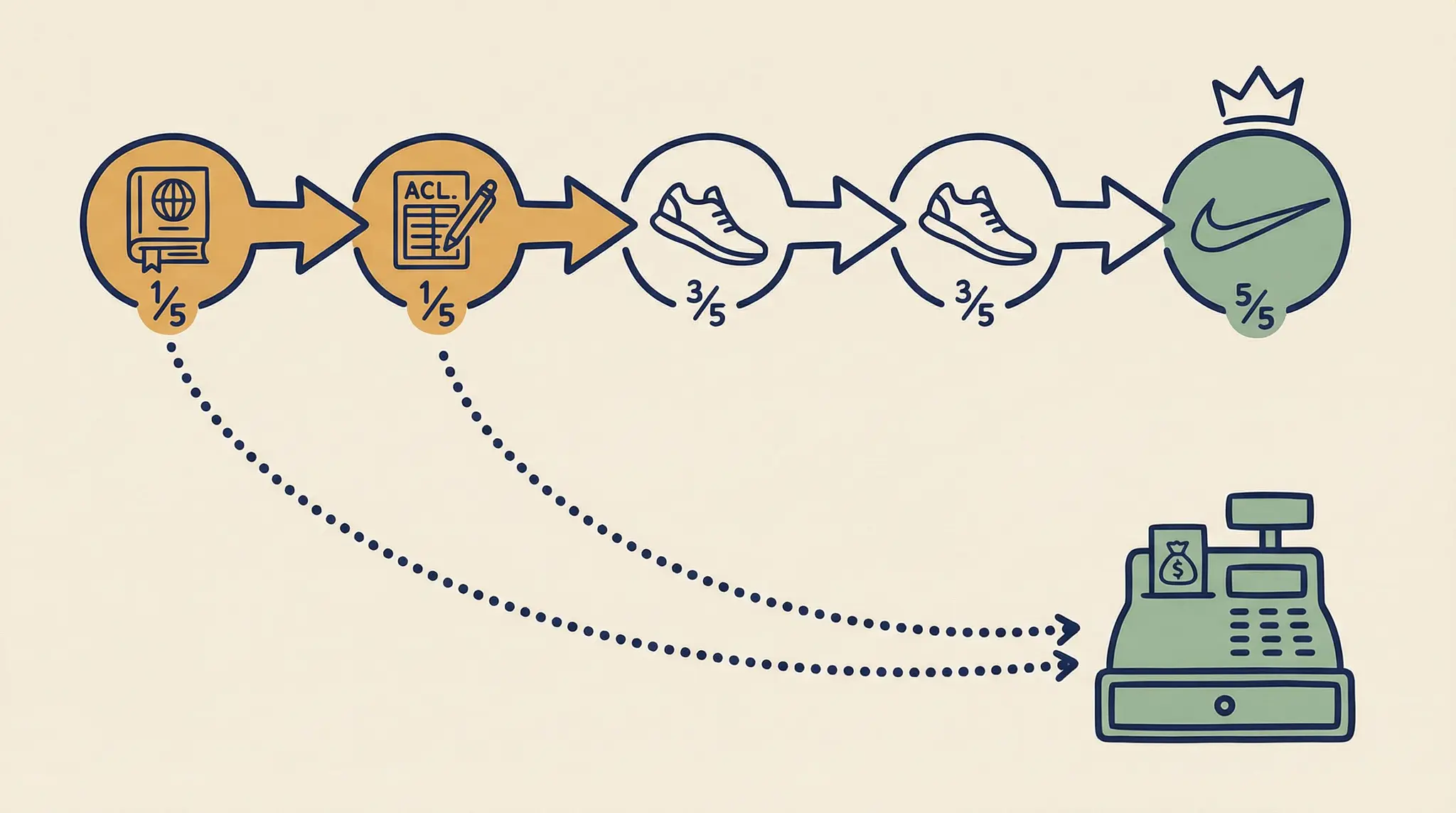
How Phil Knight went from encyclopedia salesman (Alignment: 1/5) to Nike founder (all 5s). A complete LA4P analysis of every experience across 40 years reveals the pattern behind a $35 billion empire.

40yearscareer Research Team
Career Pattern Analysis
Written by our expert panel: career coach, psychologist, HR leader, and product designer. Every article includes exercises you can try in the app.
Phil Knight's 40-Year Career: The LA4P Pattern That Built Nike
TL;DR: Phil Knight's career proves the LA4P framework. His lowest-rated experiences (encyclopedia sales: Alignment 1/5, accounting "prison": Alignment 1/5) built skills that saved Nike. His highest-rated period (1972-80 IPO: all 5/5s) lasted only 8 years. The People dimension compounded more than any other (Bowerman, Johnson, Jordan = billions). Success at work destroyed relationships at home (Matthew never wore Nike). This is what 40 years of strategic career decisions actually looks like.
Why Phil Knight?
You've probably heard the Nike origin story: Stanford MBA writes paper about Japanese shoes, travels to Japan, starts company in car trunk, builds $35 billion empire.
That's the Hollywood version.
The reality? Knight spent 2.5 months selling encyclopedias door-to-door in Hawaii and "despised it to boot." He worked 4 years as a CPA at Price Waterhouse, calling it a "prison" where he'd "stand before travel agency posters like Walter Mitty." His son Matthew "never wore Nike" in protest of his father's obsession—and died at 34.
This isn't a success story. It's a complete 40-year career mapped across six dimensions, revealing the uncomfortable truth about what it actually takes to build something legendary.
💡What Makes This Analysis Different
We rated ALL 27 major experiences in Phil Knight's career across all 6 LA4P dimensions (Learning, Alignment, People, Prestige, Pace, Profit). Both his subjective view at the time and the objective long-term value. The patterns that emerge predict career success better than any advice.
Quick LA4P Refresher
If you're new to the LA4P framework, here's the 60-second version:
Your career has six dimensions, not just salary:
- Learning – Skills, knowledge, growth velocity
- Alignment – Values match, purpose, calling
- People – Manager quality, team, network, doors opened
- Prestige – Brand, reputation, career capital
- Pace – Sustainability, work-life balance, intensity
- Profit – Compensation, wealth creation
Rate each 1-5. Plot on hexagon. Track over time. Patterns predict your future better than any single decision.
New to LA4P? Read Career Planning 101 first, then come back. This article assumes you understand the framework.
Start Tracking Your Career Like Knight Did
Use the same 6-dimension framework Phil Knight would have used. Rate your current role, track patterns over time, and see which experiences are actually building your future.
Knight's Career in Three Hexagons
Before we dive into the full 40-year analysis, here's the pattern that matters:
Encyclopedia Sales (1962):
The Bottom
Total score: 9/30
Knight's reflection:
"I felt dead inside."
What he learned:
You can't sell what you don't believe in. This became Nike's foundation—Knight never sold shoes, he sold belief in running.
The pattern:
Knight's lowest-rated experience. But it taught him a career-defining lesson: belief is the only sales technique that matters.
Nike IPO Journey (1972-1980):
The Peak
Total score: 30/30 — Perfect hexagon
Knight's IPO reaction:
"If I felt anything, it was regret. I wished I could do it all over again."
The pattern:
Perfect hexagon. Revenue $1.96M → $269.8M. 50% market share. IPO at $22/share. Knight's net worth: $178M. But perfect hexagons are rare and temporary—this alignment lasted only 8 years of Knight's 40-year career.
Philanthropy Era (2016-Present):
The Legacy
Total score: 21/30 — Different priorities
The shift:
Profit dimension drops to minimal (giving $7.8B+, not accumulating). Alignment and People peak. Learning moderate. Pace deliberately slow.
The pattern:
Different chapter, different priorities. America's most generous philanthropist (2023). This hexagon looks nothing like his IPO era—and that's intentional.
The pattern: Three completely different hexagon shapes across 40 years. The collapsed shape (encyclopedia sales) taught belief. The perfect shape (IPO era) was temporary. The asymmetric shape (philanthropy) is intentional.
The Complete 40-Year Analysis
Knight's career divides into 7 chapters, each with distinct LA4P priorities. Let's map the full journey.
Chapter 1: Formation & Foundation (1938-1962)
The experiences that built the foundation—often invisible at the time.
Childhood & Family
Born Portland, Oregon. Father William ran Oregon Journal. Cut from baseball team, found running. Father refused to give him job at his paper, forcing self-reliance. Learning 3/5 (discipline through running), Alignment 3/5 (found running but no clear direction), People 3/5 (supportive family, father's lessons proved formative).
Newspaper Job at The Oregonian
Father refused to give Phil job at his paper (Oregon Journal). Phil got job at rival Oregonian tabulating sports scores. Ran 7 miles home each morning. First paycheck, daily running habit, lesson that competition motivates him.
Cleveland High School
Cut from baseball team freshman year. Found track instead. Ran mile. Graduated without distinction. Basic education, discovered running after baseball rejection, typical high school friendships.
U.S. Army Service
Commissioned as Second Lieutenant after ROTC. Served one year active duty. Military discipline. Knight wrote almost nothing about this period. Obligation, not calling.
University of Oregon Track
Ran under Bill Bowerman. Learning 5/5 (genius coach), Alignment 4/5 (loved running but no career clarity), People 5/5 (LIFE-CHANGING: Bowerman became co-founder). Knight: 'If there is no Bill Bowerman, there is no me.'
Stanford MBA
TRANSFORMATIVE awakening. Learning 5/5 ('For the first time, school wasn't drudgery'), Alignment 5/5 (wrote 'Crazy Idea' thesis on Japanese shoes). Professor Shallenberger taught: 'The only time you must not fail is the last time you try.'
Encyclopedia Sales (Hawaii)
HATED IT. Alignment 1/5 ('felt dead inside'), People 1/5 (no mentors, lost travel partner), Profit 1/5 (slept on ironing board). CRITICAL LESSON: Can't sell what you don't believe in.
Securities Sales (Hawaii)
After encyclopedia failure, took job at Investors Overseas Services selling securities. Stanford finance training helped but still felt empty. Made enough money to continue traveling. Boss: "Too bad, you had real future." Knight: Still "felt dead inside."
Pattern: High-alignment experiences (Oregon, Stanford) provided mentors and clarity. Low-alignment experiences (encyclopedia, securities) taught what to avoid. Both essential. Knight tried two different sales jobs in Hawaii - both confirmed sales was not his path, but the experience taught him he could only sell what he believed in.
Chapter 2: The Experiment (1962-1969)
World Travel & Onitsuka Meeting
Solo backpacking. Met Onitsuka execs in Kobe, Japan. Learning 5/5 (Japanese business culture, how to improvise), Alignment 5/5 (took action on crazy idea), Pace 5/5 (turned thesis into reality in one meeting). Secured Tiger distribution deal for $50.
Waiting Period / Limbo
Returned to Portland after world trip. Waited 10 months for Tiger samples to arrive. Lived with parents at 25 years old. Studied for CPA exam. Depressed, powerless waiting. Pace 1/5 (frustratingly slow), Prestige 1/5 (living in parents house), Profit 1/5 (no income, dependent). Limbo state between adventure and career.
Price Waterhouse CPA
The 'PRISON.' Alignment 1/5 ('Each day I'd stand before travel agency posters like Walter Mitty'), but Learning 3/5 objectively (4/5 in hindsight—cash flow skills saved Nike). Profit 3/5 funded Blue Ribbon side project. Knight: 'Are the best moments of my life behind me?'
Portland State Teaching
Assistant Professor, Accounting 101. Alignment 3/5 (better than accounting firm), People 5/5 (MET PENNY PARKS: life partner, 55+ year marriage). Flexible schedule enabled Blue Ribbon growth. Pace 3/5 → 4/5. Worked here WHILE running Blue Ribbon.
Blue Ribbon Sports (Nights & Weekends)
Founded with Bowerman (50/50, $500 each). Sold Tigers from car trunk at track meets. Nights and weekends while working full-time. Learning 4/5 → 5/5 (full entrepreneurial education), Alignment 4/5 → 5/5 (DISCOVERED BELIEF: 'It wasn't selling. I believed in running.'), People 5/5 (Bowerman, Jeff Johnson, Penny). Revenue doubled every year: $8K → $300K.
💡The Parallel Track Pattern
Knight started at Price Waterhouse (1963-67) while launching Blue Ribbon nights and weekends. As the side project grew, he needed more time. His former teacher helped him get the Portland State position (1967-69), same money, fewer hours. This gave him the time Blue Ribbon needed to scale. The day jobs provided income and stability to fund the side project. The side project became Nike.
People Dimension Deep Dive:
💡The Power of the People Dimension
During this chapter, Knight assembled the core relationships that built Nike:
- Bill Bowerman (Oregon coach) → Co-founder, gave Knight 51% control
- Jeff Johnson (first employee) → Sold 3,250 pairs in 10 months, dreamed the name 'Nike'
- Penny Parks (student) → Bookkeeper, life partner, philanthropic partner
Knight's People 5/5 rating during side-project phase compounded into billions. These relationships mattered more than his Stanford MBA or accounting skills.
Pattern: Knight endured low-alignment day job (accounting 1/5) to fund high-alignment side project (Blue Ribbon 5/5). The "prison" built essential skills. The side project built the empire.
Chapter 3: The Pivot (1969-1972)
Going all-in, surviving betrayal, creating Nike brand.
Blue Ribbon Full-Time
Quit teaching, took $18K salary from BRS. Discovered Onitsuka betrayal (meeting with 18 replacement distributors). Learning 5/5 (crisis management, legal strategy), Alignment 5/5 (finally all-in), People 4/5 (team stress but strong), Prestige 3/5 (still small), Pace 5/5 (constant crisis), Profit 3-4/5 (growing revenue).
Nike Brand Launch
Carolyn Davidson designed Swoosh for $35 (later got 500 shares = $3M). Jeff Johnson dreamed 'Nike' name night before deadline. Knight: 'I don't love it, but maybe it'll grow on me.' Debuted at 1972 Olympic Trials. Learning 5/5 (brand building), Alignment 5/5 ('our own terms'), People 5/5 (team unity), Prestige 4/5 (new brand), Pace 5/5 (rapid execution), Profit 4/5 (revenue growing).
Betrayal: Onitsuka's Kitami tried hostile takeover. Knight stole folder from Kitami's briefcase to discover betrayal. Nissho Iwai (Japanese trading company) saved Nike by assuming all debt.
Lesson: Never depend on single supplier. Maintain control.
Chapter 4: Building the Machine (1972-1980)
The perfect hexagon period. Revenue exploded on American running boom.
Revenue growth
137x in 8 years
Market share
Industry dominance
Knight's net worth
IPO Dec 2, 1980
All dimensions 5/5:
- Learning 5/5 – Public markets, mass manufacturing, athlete marketing
- Alignment 5/5 – "Building something to point to and say 'I made that'"
- People 5/5 – Steve Prefontaine (soul), expanded team, athlete network
- Prestige 5/5 – Industry leader, public company CEO
- Pace 5/5 – Revenue doubled nearly every year
- Profit 5/5 – From survival to $178M net worth
Steve Prefontaine: Nike's first athlete ($5,000/year, 1973). Died May 30, 1975 (car crash). Knight: "Pre's spirit is the cornerstone of this company's soul."
Knight's IPO emotion: "If I felt anything, it was regret. I wished I could do it all over again."
If I felt anything, it was regret. I wished I could do it all over again.
Phil Knight
On Nike's IPO, December 2, 1980
Pattern: Perfect hexagons don't feel perfect. Even at 5/5 across all dimensions, Knight felt regret. Success is bittersweet.
Chapter 5: Transformation & Crisis (1980-1990)
Complacency, crisis, comeback.
Post-IPO Struggle (1980-84)
Jordan Signing (1984-90)
The Jordan Decision:
Sonny Vaccaro convinced Knight to bet entire athlete budget on Michael Jordan. Knight initially opposed—wanted multiple athletes, not one rookie.
The deal: $2.5M over 5 years. Deloris Jordan (Michael's mother) was key decision-maker—without her OK, no deal.
Year 1 result: Air Jordan generated $126M.
"Just Do It" (1988): Dan Wieden created the tagline. Knight "trusted me" despite hating it initially. Became Nike's identity.
We could finish each other's sentences.
Phil Knight
On his relationship with Michael Jordan
People Dimension Compounding:
- Sonny Vaccaro – Convinced Knight to go all-in on Jordan
- Deloris Jordan – Approved the deal that saved Nike
- Michael Jordan – Relationship became family (Jordan invited Knight to father's funeral, front row)
- Dan Wieden – Created "Just Do It" for 40-year partnership
- Tinker Hatfield – Air Jordan III design saved Nike-Jordan relationship
Pattern: People dimension compounded more than any other. Strategic relationships (Jordan, Wieden) created more value than all product innovation combined.
Chapter 6: Global Dominance & Reckoning (1990-2004)
Empire building, labor crisis, personal tragedy.
Empire Building
NikeTown stores. Tiger Woods $40M signing. Acquisitions (Cole Haan, Bauer). Global expansion. Revenue $2B → $9B. All dimensions 4-5/5 except temporary dips.
Labor Crisis
Sweatshop allegations. Boycotts. Knight's 1998 speech: Nike 'synonymous with slave wages.' Learning 4/5 → 5/5 (supply chain ethics), Alignment 3/5 (most uncomfortable public moment), Prestige 2/5 → 3/5 (severely damaged, slowly rebuilt).
CEO Transition & Matthew's Death
Son Matthew died May 23, 2004 (scuba diving, heart defect, age 34). People 2/5 (Knight's deepest regret). Matthew 'never wore Nike' in protest. Knight: 'I had three sons: Matthew, Travis, and Nike.' Stepped down as CEO November 2004.
Matthew Knight Deep Dive:
⚠️The Cost of Success: People Dimension at Home
Matthew Knight rebelled against Nike consuming his father's time. He 'declared he would never wear Nike' in protest.
Phil Knight's regret: 'I had three sons: Matthew, Travis, and Nike.'
Matthew's death: Heart attack at 150 feet depth during scuba diving. Knight 'took six months to function.'
Tiger Woods: First athlete to call (7:30 AM) after Matthew's death—Knight never forgot.
Memorial: Matthew Knight Arena at University of Oregon ($100M donation).
The pattern: Knight's work People dimension (5/5 with Jordan, Wieden, team) came at the cost of home People dimension (2/5 with Matthew). Success optimizes one dimension by sacrificing another.
Rob Strasser Betrayal:
Knight NEVER FORGAVE Strasser's 1987 defection to Adidas. Strasser died 1993. Knight didn't attend funeral.
Pattern: People dimension cuts both ways. Life-changing relationships (Bowerman, Jordan) vs. devastating losses (Matthew) and betrayals (Strasser).
Chapter 7: Legacy (2004-Present)
Chairman years, storytelling, massive philanthropy.
Chairman Years
Executive Chairman. Mark Parker succeeded as CEO. Shoe Dog memoir (2016) became bestseller. Learning 3/5 → 4/5 (succession, storytelling), Alignment 5/5 (finally told his story), People 4/5 → 5/5 (Parker partnership, reconciliation with Travis, Shoe Dog connected with millions).
Philanthropy Era
$7.8B+ lifetime giving. $2B OHSU Knight Cancer Institute (2025), $1B+ Oregon, $580M+ Stanford, $400M Albina Community. Alignment 5/5 (living values), People 5/5 (Penny partnership), Prestige 5/5 (America's most generous philanthropist 2023), Profit N/A (giving phase).
Chapter shift: Different priorities entirely. Profit becomes N/A (giving, not accumulating). Alignment and People peak. Learning moderate (philanthropy strategy). Pace deliberately slow (2-3/5).
Shoe Dog (2016): Memoir became bestseller. Knight finally told his story. Alignment 5/5—legacy building through narrative.
Travis Knight: Relationship healed after Matthew's death. Travis now runs Laika Animation (successful in his own right).
Master Patterns: What Knight's 40 Years Teach Us
Pattern 1: Crucibles Shape You - But Exit Fast When Misaligned
Experience | Duration | What Knight Extracted |
|---|---|---|
| Encyclopedia Sales | 2.5 months (QUIT FAST) | Discovery: 'I could only sell what I believed in' - Nike's entire sales philosophy |
| Securities Sales | 2 months (QUIT FAST) | Confirmed: Sales without belief = death. Needed running + business fusion. |
| Price Waterhouse CPA | 4 years (ENDURED strategically) | Cash flow skills that saved Nike during every crisis (Learning 3/5 to 4/5) |
Lesson: Knight did not endure bad experiences - he extracted learning fast, then quit. Encyclopedia + securities = 4.5 months total, but taught him belief drives sales. Price Waterhouse = 4 years, but funded Blue Ribbon and built crisis survival skills. Crucibles shape you only if you learn the lesson and move on.
Pattern 2: People Dimension Compounds Exponentially
Knight's key relationships:
- Bill Bowerman (Oregon, 1955) - Co-founder, 49% stake (gave Knight control)
- Former teacher (1967) - Helped Knight get Portland State position with same pay, fewer hours - unlocked time for Blue Ribbon to scale
- Jeff Johnson (First employee, 1965) - Named Nike, sold 3,250 pairs in 10 months
- Penny Parks (Portland State, 1967) - Life partner, bookkeeper, philanthropic partner
- Steve Prefontaine (First athlete, 1973) - Nike's soul, cultural identity
- Michael Jordan (1984) - Cultural transformation, $126M year 1, family-level relationship
- Dan Wieden (1988) - "Just Do It," 40-year creative partnership
These relationships created billions in value. More than all product innovation, strategic planning, or marketing combined. The compounding took years: Bowerman met Knight in 1955, Nike founded 1964. Johnson hired 1965, named Nike 1971. Jordan signed 1984, became cultural icon by the 1990s.
If there is no Bill Bowerman, there is no me.
Phil Knight
On his University of Oregon coach and Nike co-founder
Pattern 3: Perfect Hexagons Are Rare and Temporary
Perfect hexagon period
1972-80 only
Total experiences
1 perfect period
Balance duration
Then crisis hit
The myth: Successful careers maintain 5/5 across all dimensions.
The reality: Knight's perfect hexagon (1972-80) lasted only 8 years. Before: building. After: crisis, transformation, different priorities.
Implication: Don't optimize for permanent balance. Optimize for the right imbalance at the right time.
Pattern 4: Success at Work Can Destroy People Dimension at Home
Knight's work People dimension: 5/5 throughout (Bowerman, Johnson, Jordan, Wieden, team)
Knight's home People dimension: 2/5 during peak years (Matthew "never wore Nike," Knight "had three sons: Matthew, Travis, and Nike")
The trade-off: You can't optimize all People relationships simultaneously. Knight's obsession with Nike team came at the cost of Matthew relationship.
Strasser: Knight never forgave the betrayal. Didn't attend funeral. Some People relationships end badly despite initial 5/5 ratings.
Pattern 5: Chapters Require Different LA4P Priorities
Formation
Optimize: Learning 5/5 + People 5/5 (Bowerman, Stanford awakening). Accept: Profit 1-2/5 (student, army, low-paying jobs).
Building
Optimize: Pace 5/5 + Alignment 5/5 (side project → full-time). Accept: Prestige 2-3/5 (unknown brand), some Profit sacrifice.
Explosion
Optimize: All 5/5 (IPO period). Then crisis: Prestige 3/5, Pace 2/5 (Reebok challenge).
Transformation
Optimize: Profit 5/5 + Prestige 5/5 (Jordan, empire). Accept: Some Alignment dip (labor crisis).
Legacy
Optimize: Alignment 5/5 + People 5/5 (philanthropy, relationships). Profit becomes N/A (giving phase).
Pattern: You can't optimize all 6 dimensions simultaneously. Each chapter requires different priorities. Knight optimized Learning + People early, Pace + Profit mid-career, Alignment + legacy late.
Which Chapter Are You In?
Knight's career had 5 distinct chapters, each with different LA4P priorities. Identify your current chapter, define your priorities, and plan your next move with the same framework Knight would have used.
The Complete Rating Table
Here are all 27 experiences rated across 6 dimensions (Phil's view / Objective):
💡How to Read This Table
Each experience shows two ratings: Phil's subjective view at the time / Objective long-term value.
For example: Price Waterhouse shows Learning 3/5 (Phil's view) → 4/5 (objective) because Knight hated the job but the skills saved Nike.
Pay attention to the gaps—they reveal which experiences you should endure vs. exit.
| Experience | Years | Learning | Alignment | People | Profit | Prestige | Pace |
|---|---|---|---|---|---|---|---|
| Childhood | 1938-55 | 3/3 | 3/3 | 3/4 | 1/1 | 2/2 | 3/3 |
| Newspaper Job | 1952-54 | 2/3 | 2/2 | 1/2 | 2/2 | 1/1 | 3/3 |
| High School | 1951-55 | 2/3 | 3/3 | 2/2 | 1/1 | 2/2 | 3/3 |
| Oregon/Bowerman | 1955-59 | 5/5 | 4/4 | 5/5 | 1/1 | 3/3 | 4/4 |
| Army Service | 1959-60 | 2/3 | 2/2 | 2/2 | 2/2 | 3/3 | 2/2 |
| Stanford MBA | 1960-62 | 5/5 | 5/5 | 4/5 | 1/1 | 4/4 | 4/4 |
| Encyclopedia Sales | Sep-Nov 62 | 2/3 | 1/1 | 1/2 | 1/1 | 1/1 | 3/2 |
| Securities Sales | Oct-Nov 62 | 2/2 | 1/2 | 1/2 | 2/2 | 2/2 | 2/2 |
| World Travel/Onitsuka | 1962-63 | 5/5 | 5/5 | 4/4 | 2/3 | 2/2 | 5/5 |
| Waiting Period | 1963 | 3/3 | 2/2 | 2/3 | 1/1 | 1/1 | 1/2 |
| Price Waterhouse CPA | 1963-67 | 3/4 | 1/2 | 2/2 | 3/3 | 3/3 | 2/3 |
| BRS Side Project | 1964-69 | 4/5 | 4/5 | 5/5 | 2/3 | 2/3 | 5/5 |
| Portland State Teaching | 1967-69 | 2/3 | 3/3 | 5/5 | 3/3 | 3/3 | 3/4 |
| BRS Full-Time | 1969-71 | 5/5 | 5/5 | 4/5 | 3/4 | 3/3 | 5/5 |
| Nike Launch | 1971-72 | 5/5 | 5/5 | 5/5 | 3/4 | 4/4 | 5/5 |
| Nike IPO Journey | 1972-80 | 5/5 | 5/5 | 5/5 | 5/5 | 5/5 | 5/5 |
| Post-IPO Struggle | 1980-84 | 4/5 | 3/4 | 3/4 | 3/3 | 3/3 | 2/3 |
| Jordan/Just Do It | 1984-90 | 5/5 | 4/5 | 5/5 | 5/5 | 5/5 | 5/5 |
| Empire Building | 1990-96 | 4/5 | 4/5 | 5/5 | 5/5 | 5/5 | 5/5 |
| Labor Crisis | 1996-00 | 4/5 | 3/4 | 3/4 | 4/4 | 2/3 | 3/3 |
| CEO Exit/Matthew | 2000-04 | 3/4 | 3/4 | 2/3 | 5/5 | 5/5 | 2/3 |
| Chairman | 2004-16 | 3/4 | 5/5 | 4/5 | 5/5 | 5/5 | 2/3 |
| Philanthropy | 2016-Now | 3/4 | 5/5 | 5/5 | N/A | 5/5 | 2/3 |
Key observations:
- Lowest-rated: Encyclopedia sales (1/1/1/1/1/3) and Price Waterhouse Alignment (1/5)
- Highest-rated: Nike IPO period (5/5/5/5/5/5) for 8 years only
- Biggest gaps: Price Waterhouse Learning (3 → 4), Matthew period People (2 → 3)
- People 5/5 periods: Oregon, BRS side project, Portland State, Nike launch, IPO, Jordan, Empire, Philanthropy
- Alignment 5/5 periods: Stanford, World Travel, BRS full-time, Nike launch, IPO, Chairman, Philanthropy
See Your Career Patterns Like This
Knight tracked 27 experiences across 6 dimensions over 40 years. Start mapping your own patterns today—rate past roles, identify your People 5/5 moments, and spot the gaps between subjective feelings and objective value.
Apply Knight's Patterns to Your Career
Exercise 1: Rate Your Current Role
Your Career vs. Knight's Pattern
Rate your current role. Compare to Knight at similar career stage.
💡How to Use This Tool
| Dimension |
|---|
Pattern Recognition |
What dimensions are consistently low (1-2)?________ |
What patterns do you notice?________ |
What one dimension would you change in your next role?________ |
📊 Track your dimensions
Spot patterns over 4-6 weeks
Start Tracking Your Dimensions →Compare to Knight:
- Years 1-10: Are you optimizing Learning + People like Knight's Oregon/Stanford period?
- Years 11-20: Are you building your "side project" like Blue Ribbon while working day job?
- Years 21+: Have you gone full-time on your purpose like Knight's 1969 pivot?
Exercise 2: Identify Your "Price Waterhouse"
Knight's accounting "prison" (Alignment 1/5) built cash flow skills that saved Nike.
Your version:
- What current or past job did you hate (Alignment 1-2/5)?
- What skills did it actually build (Learning dimension)?
- How might those skills compound in 5-10 years?
Example: Knight rated Price Waterhouse Learning 3/5 subjectively, but 4/5 objectively because cash flow skills proved essential during Nike's crises.
Exercise 3: Map Your People Dimension
Knight's career was defined by 6 key relationships (Bowerman, Johnson, Penny, Pre, Jordan, Wieden).
Your version:
- Who are your 3-5 most important career relationships?
- Which opened doors? Which taught you? Which betrayed you?
- Are you investing in future Bowermans and Johnsons?
Exercise 4: Predict Your Next Chapter
Your Next 5-Year Chapter
Define your LA4P priorities like Knight did for each chapter
Current Chapter Assessment | |
|---|---|
| Which Knight chapter are you in? | e.g., Formation (Years 1-10), Building (Years 11-20), Explosion (Years 21-30) |
What are your current LA4P priorities? e.g., Optimizing Learning + People, accepting lower Profit | |
What trade-offs are you making? e.g., Low Prestige for high Learning, moderate Pace for skill growth | |
Next Chapter Priorities | |
| Learning | 1 2 3 4 5 |
| Alignment | 1 2 3 4 5 |
| People | 1 2 3 4 5 |
| Prestige | 1 2 3 4 5 |
| Pace | 1 2 3 4 5 |
| Profit | 1 2 3 4 5 |
Your Version of Key Knight Moves | |
| Your Stanford MBA moment (Learning 5/5 awakening) | What experience gave you clarity on your direction? |
| Your Bill Bowerman (People 5/5 mentor) | Who is your co-founder/mentor relationship? |
| Your Blue Ribbon side project | What are you building nights/weekends while working day job? |
| Your 1969 full-time pivot moment | When will you (or did you) go all-in on your purpose? |
📖 Plan your next chapter
Define your 5-year career chapter
Build Your Chapter Plan →The Ultimate Lesson
Phil Knight's career proves the LA4P framework:
There is no $35 billion Nike without:
- The encyclopedia rejection (taught belief matters)
- The accounting "prison" (taught cash flow)
- The Stanford awakening (Learning 5/5, Alignment 5/5)
- The Bowerman relationship (People 5/5 compounding)
- The side-project hustle (1964-69 building while working)
- The full-time commitment (1969 pivot)
- The perfect hexagon period (1972-80, then crisis)
- The Jordan bet (People dimension transformed brand)
And it came with costs:
- Matthew "never wore Nike" (People 2/5 at home)
- Strasser betrayal (People relationships cut both ways)
- Labor crisis (Prestige 2/5, forced values confrontation)
- IPO regret ("I wished I could do it all over again")
The pattern:
- Your lowest-alignment experiences build essential skills
- People dimension compounds more than any other
- Perfect hexagons are temporary, not permanent
- Success at work can destroy relationships at home
- Each chapter requires different LA4P priorities
Knight's 40-year career isn't a success story. It's a complete map of trade-offs, compounding, and costs.
The professionals who reach 45 and think "I built exactly the career I wanted" aren't luckier or smarter.
They just had a framework to read the patterns.
Map Your 40-Year Career
Rate your experiences across 6 dimensions. Track patterns over time. See which chapter you're in and what comes next.
Further Reading
Want to go deeper on specific patterns?
- Career Planning 101 – Full LA4P framework introduction
- The 3-Month Pattern Rule – When to endure vs. exit (Knight stayed in accounting "prison" 4 years strategically)
- From Annual Goals to 40-Year Chapters – Why 5-year chapters beat annual planning
- How to Evaluate Manager Quality – Knight's Bowerman relationship shows the People dimension matters most
Primary source: Phil Knight's memoir Shoe Dog (2016) provides the subjective ratings. Business analysis and objective ratings based on Nike's documented history.
Next 5 minutes
Don’t just nod at this article—turn it into a chapter in your 40-year career map.
Open 40yearscareer, add your current role or offer as a chapter, and score it 1–5 on Learning, People, Alignment, Pace, Profit, and Prestige. You’ll see immediately where the tension really is.
Free while we're in beta. No inbox clutter, no selling your data.