Why Your Career Predictions Are Always Wrong (And How to Fix Them)
Your brain makes predictable mistakes when imagining future job satisfaction. Learn to calibrate your career intuition through structured tracking and stop repeating the same forecasting errors across 40 years.

Dr. James Chen
Career Psychology Researcher
Written by our expert panel: career coach, psychologist, HR leader, and product designer. Every article includes exercises you can try in the app.
The Pattern You Keep Repeating
Sarah McCarthy thought the McKinsey offer would feel prestigious every day. It felt good for three weeks. Then it became Tuesday.
Francisco Alzantara predicted the startup equity would motivate him through 60-hour weeks. It did—for four months. Then he burned out anyway.
Both made the same mistake: they trusted their gut about future job satisfaction. Their gut was systematically miscalibrated.
This isn't about bad intuition. It's about a specific quirk in how brains predict feelings. Your brain makes predictable mistakes when imagining how future experiences will feel (we all do). You don't just make one bad prediction. You make the same type of error repeatedly across your entire career, optimizing for dimensions that matter less than you think and underweighting factors that determine actual satisfaction.
The cost compounds over 40 years. Chase prestige at 26 because you overestimate its emotional impact. Realize at 31 it doesn't feel how you predicted. Overcorrect to alignment, underweighting learning. Plateau at 35. Repeat.
What Affective Forecasting Actually Means
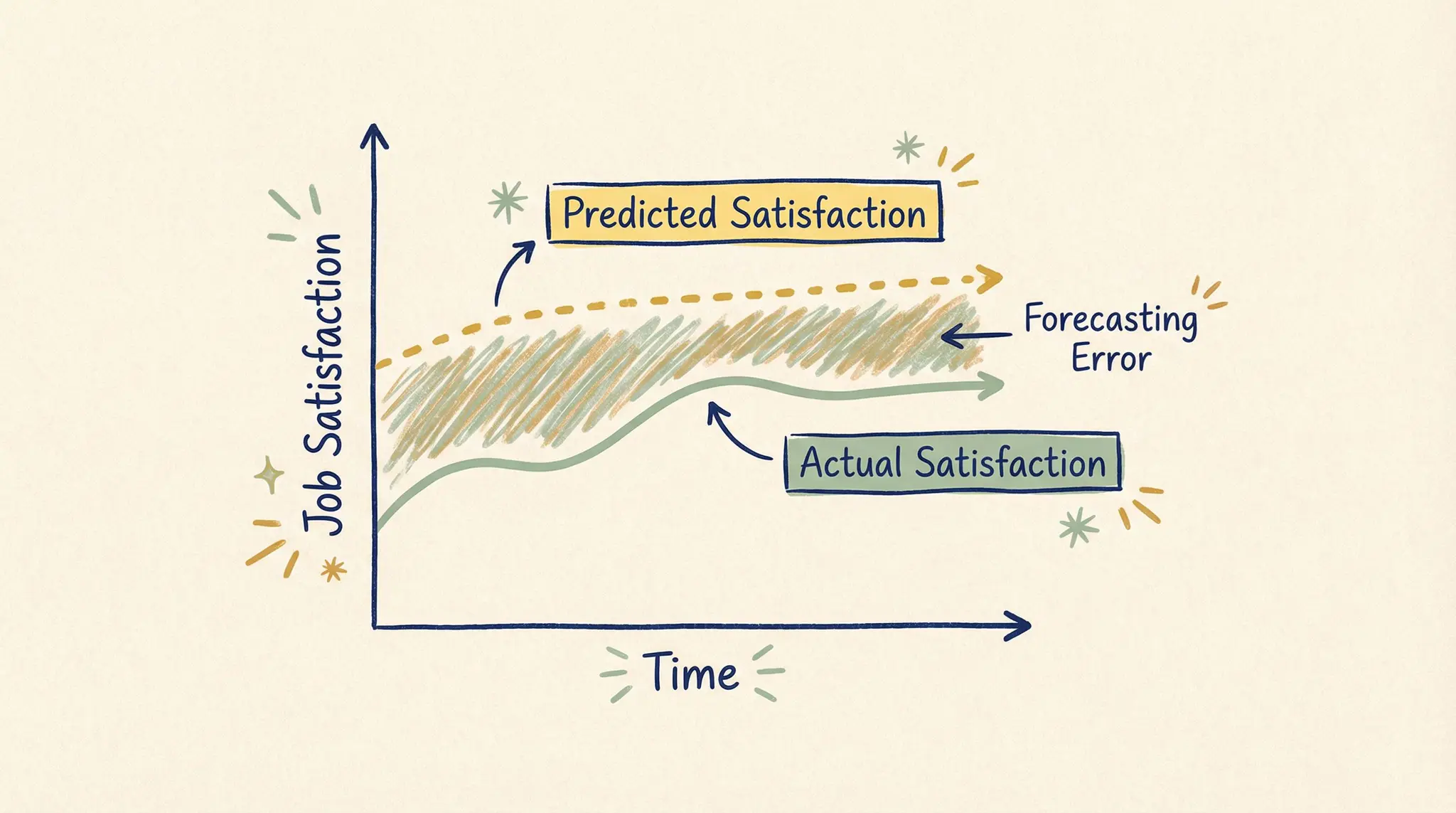
Researchers call this affective forecasting—your brain's systematic failure to predict how experiences will feel. You overestimate intensity (the $180K offer won't feel 40% better daily) and duration (salary satisfaction fades in 3-6 months).1 The pattern repeats because you never track your prediction errors.
Your brain's attempt to predict how future events will make you feel fails in two predictable ways:
Impact bias: You overestimate intensity—thinking a prestigious role will feel amazing daily when it actually just feels nice occasionally. In career terms: You predict a $180K offer will feel substantially better than your current $130K role. Research on hedonic adaptation suggests it feels moderately better for two months, then you adapt.2
Durability bias: You overestimate duration—thinking salary satisfaction lasts when you actually adapt in 3-6 months. Your brain's reference point resets—the new salary becomes your baseline, not your reward. This is why compensation satisfaction drops even when the actual compensation remains unchanged.
Note: Effect sizes mentioned are illustrative framework estimates based on hedonic adaptation research; individual variation is substantial.3
Why This Happens: The Focalism Problem
Your brain uses focalism—it zooms in on salient features (prestige, salary) and ignores baseline factors (commute, manager quality, daily task composition). When predicting Big Tech satisfaction, you simulate the moment of accepting the offer, not the 1,847th day of work.
You don't simulate Tuesday afternoon in month 7 when prestige is invisible but the 70-hour week is crushing you. You imagine telling friends about your new title, not the daily reality of back-to-back meetings with stakeholders who don't read your memos.
This is why tracking actual experience in consistent dimensions matters—it forces attention to the ignored baseline. The exciting features fade. The baseline determines your actual satisfaction.
How to Calibrate Your Career Intuition
Your intuition isn't broken. It's uncalibrated. Here's how to fix it.
Intuition is a skill that requires calibration through structured feedback.
This is why we built 40yearscareer—not to tell you what to optimize for, but to help you discover your personal forecasting biases through structured tracking. Without consistent dimensions across jobs, you can't identify systematic patterns.
The 6 LA4P Dimensions
| Dimension | What It Measures | Why It Compounds | Rating Scale (1-5) |
|---|---|---|---|
LLearning | Skill growth, challenging work | Skills built today unlock opportunities 5 years from now | 1 = Skill atrophy, you'll regress 2 = Minimal growth, mostly maintenance 3 = Steady learning, incremental progress 4 = Significant growth, stretching regularly 5 = Transformative, learning you can't get elsewhere |
AAlignment | Mission fit, meaningful work | Misalignment drains energy faster than overwork | 1 = Actively misaligned with your values 2 = Neutral, just a paycheck 3 = Acceptable, doesn't conflict with values 4 = Meaningful, you care about the outcome 5 = Purpose-driven, this is *your* work |
PPeople | Manager + team quality | Your manager shapes 70% of your work experience | 1 = Toxic manager or team 2 = Weak manager, mediocre team 3 = Decent manager and team 4 = Strong manager and team 5 = Exceptional manager, dream team (Note: Rate manager and team separately, then average) |
PPrestige | Brand recognition, career capital | Opens doors for ~5 years, then your work speaks for itself | 1 = Unknown, possibly hurts resume 2 = No-name, neutral career capital 3 = Respectable, recognized in industry 4 = Strong brand, opens doors 5 = Elite brand, career-defining credential |
PPace | Sustainability, work-life balance | Burnout takes 3-6 months to recover from—prevention is cheaper | 1 = Burnout guaranteed, unsustainable 2 = Consistently overworked, health risk 3 = Manageable, occasional crunch 4 = Healthy balance, flexibility exists 5 = Exceptional balance, life-friendly |
PProfit | Total compensation | Fair pay = freedom to choose based on other dimensions | 1 = Below market, financial stress 2 = Below average, limits options 3 = Market rate, covers needs 4 = Above market, building wealth 5 = Exceptional comp, financial freedom |
These six capture the trade-offs you actually face: learning vs earnings, pace vs prestige, mission vs market value. Rate each dimension 1-5 for any role you're considering or currently in. Rate them honestly and patterns emerge.
You could track this in a spreadsheet, but you won't—we tried for two years and kept abandoning it. 40yearscareer makes calibration automatic by prompting ratings at decision points and 3-month intervals.
Real Calibration: Maya's Pattern
Maya Chen (designer, 28) predicted her agency's Prestige=4 would sustain her through Pace=2 (60-hour weeks). After 18 months, actual experience: Prestige=3 (clients care less about agency name than she thought), Pace=1 (unsustainable), Alignment=2 (making rich people richer felt hollow). Her prediction error: she overweighted Prestige's durability by 12+ months and completely missed how Alignment would become non-negotiable once financial stability was achieved.
This pattern shows up whether you're choosing between McKinsey and a startup, or between a stable corporate role and a mission-driven nonprofit. Learn more about how to compare job offers using the LA4P framework.
Francisco's Calibration Journey
Here's how Francisco learned to calibrate his predictions:
Before accepting his Big Tech role at 26, Francisco predicted scores for two competing offers:
Startup A Predicted | Big Tech B Predicted | |
|---|---|---|
| Learning | 5 | 3 |
| Alignment | 4 | 3 |
| People | 4 | 4 |
| Prestige | 3 | 5 |
| Pace | 3 | 4 |
| Profit | 3 | 5 |
| Total | 22 | 24 |
He chose Big Tech B, predicting the Prestige=5 would feel significant daily and Profit=5 would sustain motivation.
Three months in, he re-rated his actual experience:
Predicted Before accepting | Actual (3mo) Reality check | Error Prediction gap | |
|---|---|---|---|
| Learning | 3 | 4 | +1 |
| Alignment | 3 | 3 | 0 |
| People | 4 | 4 | 0 |
| Prestige | 5 | 3 | -2 |
| Pace | 4 | 2 | -2 |
| Profit | 5 | 3 | -2 |
| Total | 24 | 19 | -5 |
Francisco discovered his personal forecasting biases:
Prestige felt good when telling friends about the offer. Felt neutral by month 2. He'd overestimated intensity—the daily experience of working at a prestigious company felt nothing like the excitement of accepting the offer. The brand name mattered to his LinkedIn profile, not to his Tuesday afternoon.
Profit adapted faster than predicted. $185K felt great versus his previous $130K role. By month 3, it was just his salary. His lifestyle inflated to match (nicer apartment, eating out more), and the emotional boost disappeared. The equity package that seemed so motivating became an abstract number on Carta he checked monthly.
Pace crashed harder than expected. He predicted sustainable 45-hour weeks. Reality: 55 hours by month two, with weekend Slack messages becoming the norm. The "work-life balance" mentioned in interviews evaporated under project deadlines.
Learning exceeded expectations. Working with senior engineers taught him more than predicted. This was the one positive surprise—and the dimension he'd underweighted in his decision.
Francisco overestimated Prestige by 2 points (felt significant for 3 weeks, not daily) and underestimated Pace impact by 2 points (sustainable 45-hour weeks crept to 55 by month two). This revealed his systematic bias: he overweights visible status markers and underweights daily sustainability factors.
At six months, the pattern solidified:
Predicted Before accepting | Actual (6mo) Pattern confirmed | Error Persistent bias | |
|---|---|---|---|
| Learning | 3 | 4 | +1 |
| Alignment | 3 | 3 | 0 |
| People | 4 | 4 | 0 |
| Prestige | 5 | 3.5 | -1.5 |
| Pace | 4 | 2 | -2 |
| Profit | 5 | 3 | -2 |
| Total | 24 | 19.5 | -4.5 |
The Prestige score ticked up slightly as he adjusted expectations, but Pace continued declining as project intensity increased. Profit satisfaction continued its downward trajectory as lifestyle inflation completed.
What Calibration Looks Like
By his third job decision at 32, Francisco had data. He knew he systematically overestimated Prestige by 1.8 points on average and underweighted Pace by 1.5 points. He knew Profit satisfaction lasted less than 3 months regardless of the absolute number.
When the VP role appeared—high prestige, brutal hours, significant equity—his gut screamed yes. His spreadsheet said: You will predict this feels like a 4.8. It will actually feel like a 3.1 after the honeymoon phase ends in 8 weeks.
He passed. Took the senior role instead (lower title, better pace, strong learning). Still happy two years later.
💭Francisco's Calibration Rule
After tracking 3 jobs, he discovered he overestimates Prestige impact by 2 points and Profit duration (adapted in 2 months vs predicted sustained motivation). He underestimates Pace importance by 1.5 points. His adjustment formula: Prestige predictions -2, Pace predictions +1.5, Profit emotional impact lasts under 3 months. When evaluating his next offer, he applies these corrections before deciding.
This is what calibrated intuition looks like: You still use your gut, but you correct for its known biases. Learn more about reading your career patterns before they cost you years.
Start Calibrating Your Career Predictions
Use our interactive comparison tool to track your predictions vs reality and discover your personal forecasting biases.
Your Calibration Exercise (5 Minutes)
Here's how to start discovering your personal forecasting biases:
Your Affective Forecasting Calibration
Compare what you predicted vs what you actually experienced to identify your systematic biases
| Dimension | What I Predicted | What I Actually Experienced |
|---|---|---|
Rate a Role from 6+ Months Ago (1-5) | ||
| Learning | 1 2 3 4 5 | 1 2 3 4 5 |
| Alignment | 1 2 3 4 5 | 1 2 3 4 5 |
| People | 1 2 3 4 5 | 1 2 3 4 5 |
| Prestige | 1 2 3 4 5 | 1 2 3 4 5 |
| Pace | 1 2 3 4 5 | 1 2 3 4 5 |
| Profit | 1 2 3 4 5 | 1 2 3 4 5 |
| TOTAL | ||
Calculate Your Prediction Errors | ||
| Which dimension did you overestimate most? | e.g., Prestige by 2 points | ________ |
| Which dimension did you underestimate? | e.g., Pace by 1.5 points | ________ |
| How long did Profit satisfaction actually last? | e.g., 2-3 months before adapting | ________ |
Identify Your Bias Pattern | ||
My systematic bias e.g., I consistently overweight visible status markers (Prestige, Profit) and underweight daily sustainability factors (Pace, People) | ||
My adjustment formula for next decision e.g., Prestige predictions -2, Pace predictions +1.5, Profit emotional boost lasts under 3 months | ||
✨ Ready to make your decision?
Use our interactive calculator to save and compare your options
Track Your Patterns Over Time →💡 Remember: Most people make the same 2-3 prediction errors across every job. Once you see your pattern, you can correct for it.
Track Your Patterns Over Time →Most people make the same 2-3 prediction errors across every job. Once you see your pattern, you can correct for it.
40yearscareer helps you do this systematically by prompting ratings at decision points and 3-month intervals, then revealing your personal forecasting biases over time. You can't fix what you don't measure. Start measuring.
Your next career decision is coming. Will you make it with the same miscalibrated intuition, or with data on how your predictions actually perform?
For more on avoiding common decision-making traps, read about the two biases that keep you stuck in the wrong job.
Footnotes
-
Gilbert, D. T., & Wilson, T. D. (2007). Prospection: Experiencing the future. Science, 317(5843), 1351-1354. https://scholar.harvard.edu/files/danielgilbert/files/prospection.pdf ↩
-
Brickman, P., Coates, D., & Janoff-Bulman, R. (1978). Lottery winners and accident victims: Is happiness relative? Journal of Personality and Social Psychology, 36(8), 917-927. ↩
-
Wilson, T. D., & Gilbert, D. T. (2003). Affective forecasting. Advances in Experimental Social Psychology, 35, 345-411. https://www.sciencedirect.com/science/article/abs/pii/S0065260108602146 ↩
Apply this guide
Use this guide to refine your 1–5 scores.
Review your existing chapters in 40yearscareer and adjust each axis based on what you just read. You’ll see patterns that were invisible before.
Free while we're in beta. No inbox clutter, no selling your data.