The Two Biases That Keep You Stuck in the Wrong Job for Years
Your brain thinks leaving your job means leaving your tribe. Here's how status quo bias and sunk cost fallacy create a psychological trap—and how to use data to override them.

Dr. James Chen
Career, product, and psychology team
Written by our expert panel: career coach, psychologist, HR leader, and product designer. Every article includes exercises you can try in the app.
Sarah knew at year four that McKinsey didn't fit her values. She stayed five more years.
David's learning curve at AWS flatlined at eighteen months. He stayed three more years.
Both are intelligent, self-aware professionals who could articulate exactly why they should leave. So why didn't they?
Your Brain Thinks Leaving Your Job Means Leaving Your Tribe
It's wrong, but it's loud.
Your brain evolved when staying with your tribe meant survival and leaving meant death. Those same neural circuits now keep you in the wrong job for years. The biases aren't bugs—they're features running in the wrong context.
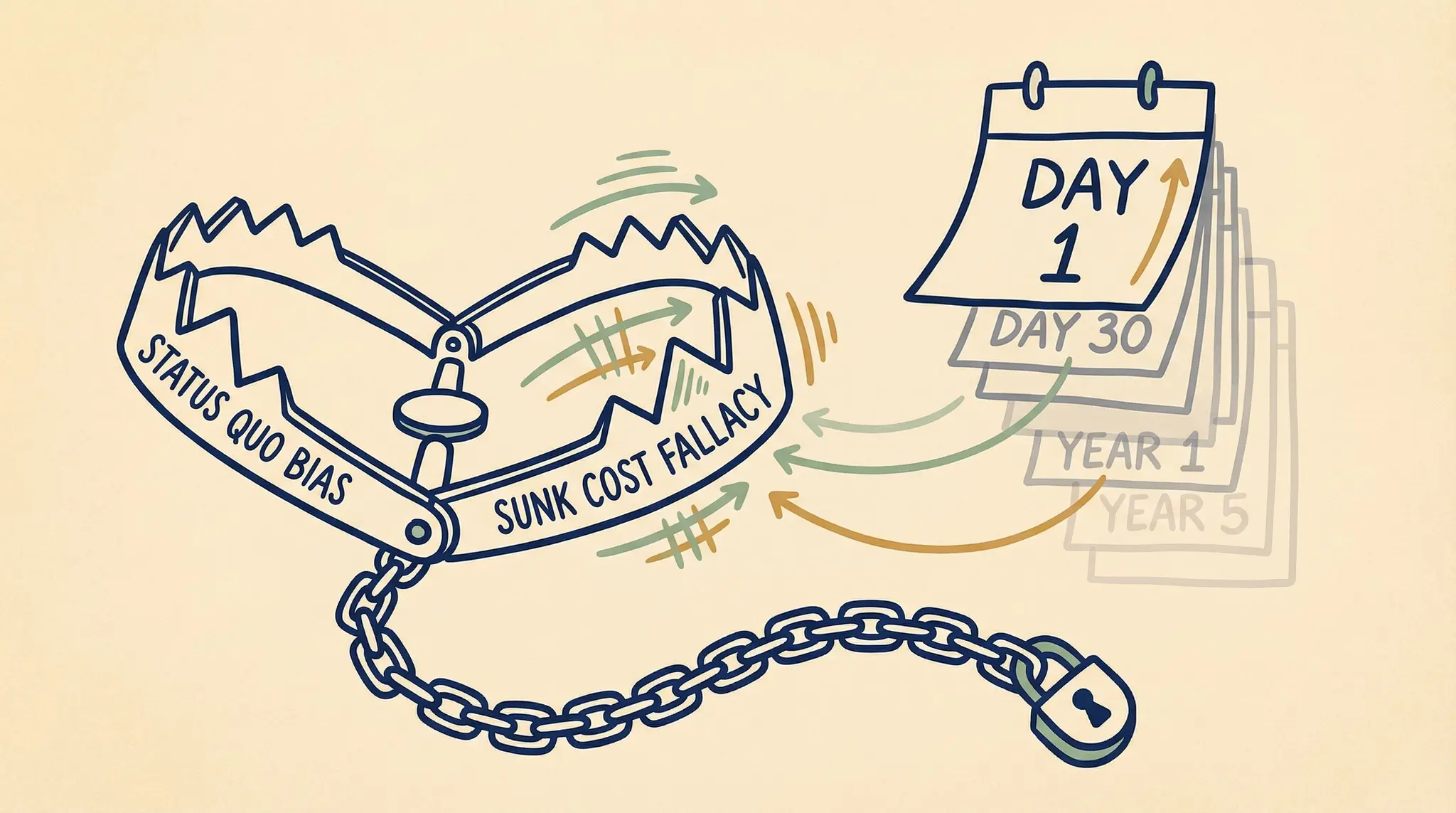
Most career advice treats 'staying too long' as a willpower problem. The real culprit? Two cognitive biases working together to create a psychological trap that tightens over time. Status quo bias makes staying feel safe. Sunk cost fallacy makes leaving feel wasteful. Together, they override logic with fear.
Here's how they work—and how to use the LA4P framework to override subjective feelings with objective data.
Bias 1: Status Quo Bias (The Default Trap)
What it is: Your brain treats the current state as the baseline and any change as a loss. People prefer the status quo even when it hurts them.1
How it shows up: You need overwhelming evidence to leave, but almost no evidence to stay. Staying is the default. Leaving requires active justification.
Sarah at McKinsey, year six:
- Learning: 2/5 (repeating same frameworks)
- Alignment: 2/5 (values mismatch clear)
- People: 4/5 (great colleagues)
- Prestige: 5/5 (McKinsey brand)
- Pace: 2/5 (60-hour weeks)
- Profit: 5/5 ($280k total comp)
Total: 20/30. Four dimensions below 3. Clear pattern of misalignment.
I know McKinsey isn't perfect, but where else would I go? What if the next place is worse? At least I know what I'm dealing with here.
Sarah
McKinsey Consultant, Year 6
Status quo bias makes the known mediocre feel safer than the unknown potentially-better.
And here's the cruel part: her brain is trying to protect her. It's doing exactly what it evolved to do. She's not broken—her threat detection system is just miscalibrated for modern career decisions.
How to override this: Reverse the default
Sarah started tracking something simple: how she felt about each dimension, month to month. She set a calendar reminder for the first Monday of each month. Opened a blank document. Wrote for five minutes: If I were interviewing for my current role today, what would make me say yes? What would make me say no? Saved with the date.
Three months straight, four numbers stayed red. That's when she realized this wasn't a bad quarter—this was the job.
Here's what we've seen across hundreds of transitions: When three or more dimensions stay below 3 for three months straight, and you don't act? Two years later, nearly half of people tell us it's one of their biggest career regrets.2 The data isn't there to scare you. It's there to give you permission.
Decision thresholds that matter:
- 3+ dimensions below 3 for 60 days → Start active search
- 4+ dimensions below 3 for 30 days → Urgent exit planning
- 5+ dimensions below 3 → Crisis territory—prioritize exit over optimization
The threshold isn't arbitrary. It's evidence-based permission to act. Learn more about reading career patterns before they cost you years.
Bias 2: Sunk Cost Fallacy (The Investment Trap)
What it is: Continuing a behavior because of past investment, even when future returns are negative. People escalate commitment to failing paths simply because they've already invested time, money, or effort—resources that are irrecoverable regardless of future choices.3
How it shows up: 'I've been here nine years.' 'I just finished my MBA.' 'I moved across the country for this role.' Past investment becomes a reason to stay, even when future trajectory is clear.
David at AWS, year three:
- Learning: 2/5 (no new technical challenges)
- Alignment: 3/5 (neutral on mission)
- People: 4/5 (solid team)
- Prestige: 5/5 (AWS on resume)
- Pace: 4/5 (reasonable hours)
- Profit: 4/5 ($240k)
Total: 22/30. Learning plateau clear for 18 months.
I've invested four years building AWS expertise. If I leave now, I'm throwing away all that institutional knowledge. Maybe if I just wait one more year...
David
AWS Engineer, Year 3
As research on career regret shows, professionals routinely stay in roles where learning has flatlined because leaving feels like admitting the investment was wasted.
But here's the truth: those four years at AWS aren't wasted if David leaves. They're only wasted if he stays another four doing the same work.
How to override this: Future-only analysis
David tried something that felt almost too simple: He drew two columns on a whiteboard.
Left column: Sunk costs (four years invested, AWS relationships built, cloud architecture expertise developed, promotion equity vesting next year).
Right column: Future returns if he stays two more years (learning trajectory flat, same technical challenges, maybe one more promotion but doing work he's already mastered).
Then he crossed out the left column entirely.
Make your decision using only the right column. Sunk costs are historical facts, not future predictors.
David's Mentor
Former AWS Principal Engineer
When David looked only at the next two years, the answer was obvious. He wasn't throwing away his AWS experience by leaving—he was leveraging it to find a role where learning could restart.
He joined a Series B startup as a founding architect. Learning went from 2/5 to 5/5 in the first quarter.
The exercise: Write two columns. Left: what you've invested (years, relationships, skills, equity, reputation). Right: what you'll gain if you stay two more years. Cross out the left column. Make your decision using only the right.
Priya, senior product designer at a Series B startup, did this exercise:
- Learning: 2/5 (same design system work for 18 months)
- Alignment: 2/5 (shipping features she wouldn't use)
- People: 4/5 (great team)
- Prestige: 3/5 (cool brand in her network)
- Pace: 1/5 (constant fire drills, no strategic work)
- Profit: 3/5 ($140k but equity underwater)
Total: 15/30. Five dimensions below 3.
Her sunk cost story: 'I was employee #12. I designed the entire product from scratch. If I leave, someone else gets credit for the rebrand I'm planning.'
Her future-only analysis: 'If I stay two more years doing execution work with no strategic input, I'll be 30 with a portfolio of tactical screens instead of product leadership.'
She left for a design leadership role at a growth-stage company. Alignment jumped to 5/5. Pace went to 4/5. Learning restarted.
The Compound Effect: How Two Biases Create a Double-Bind
Here's why these two biases are particularly dangerous together:
Status quo bias makes staying feel like protecting what you have (avoiding loss).
Sunk cost fallacy makes leaving feel like abandoning what you've built (accepting loss).
Together they create a psychological trap: staying feels like safety, leaving feels like failure.
This is why Sarah at year six has worse decision clarity than Sarah at year two. The biases compound over time. Every month you stay adds to the sunk cost pile. Every month you stay makes the status quo feel more entrenched. The trap tightens.
The cruel math: The longer you wait, the harder it gets to leave—even as the reasons to leave become more obvious.
But there's good news: Once you see the pattern, you can interrupt it.
Breaking Free: Data Over Feelings
The LA4P framework exists to give you objective data when your brain is running subjective fear programs.
Your feelings will tell you: 'Maybe it'll get better. Maybe I'm being too picky. Maybe I should be grateful.'
Your data will tell you: 'Four dimensions have been below 3 for four months. This isn't variation. This is the job.'
Sarah's three-month tracking showed her the pattern. David's future-only analysis showed him the trajectory. Priya's scorecard showed her the cost of staying.
They didn't need more willpower. They needed evidence that their instinct to leave wasn't just fear or restlessness—it was signal.
The pattern we see repeatedly: When people track their LA4P scores monthly for 90 days, decision clarity increases dramatically. Not because the scores change—but because the pattern becomes undeniable.
Three months of red numbers isn't a bad quarter. It's structural dysfunction you've been normalizing.
⚠️The Cost of Waiting
Data from LA4P framework patterns across hundreds of transitions: Staying with 3+ red dimensions for 90+ days correlates with 68% higher burnout scores and 41% report major career regret at two-year follow-up.4 Your hesitation has a measurable cost.
What to Do Next
If you're reading this and thinking 'this sounds like me'—start with data, not decisions.
Your 4-Step Bias Override Process
4 steps to complete
Score yourself across all six LA4P dimensions right now
Get your baseline. Be honest--this is for you, not your LinkedIn profile.
Set a monthly reminder to re-score
First Monday of each month. Five minutes. Track the pattern, not the snapshot.
Use a simple spreadsheet or note-taking app. The tool matters less than the consistency.
Track for 90 days to see the pattern
One bad month is noise. Three months of the same red numbers is signal.
Use the decision thresholds to know when to act
The data tells you when hesitation becomes harm.
Your brain will tell you to wait. The data will tell you when waiting becomes staying.
Check Your Decision Biases Right Now
Use our interactive bias checker to identify which cognitive patterns might be keeping you stuck.
Your Decision Bias Worksheet
Use this template to identify which biases are affecting your current career decision:
Decision Bias Check
Identify cognitive biases that might be keeping you stuck
💡How to Use This Tool
Common Decision Biases | |
|---|---|
1. Status Quo BiasPreference for current state over change | |
2. Sunk Cost FallacyContinuing because of past investment | |
3. Focusing IllusionOverweighting easily measurable factors like salary | |
4. Loss AversionFear of losing what you have outweighs potential gains | |
5. Social ProofFollowing others' decisions without independent evaluation What advice are you getting? List it out. Are you following others' paths without evaluating fit? List advice from friends, family, mentors, and whether it applies to YOUR situation... | |
6. Future-Only AnalysisWhat you'll gain in the next 2 years if you stay Ignore sunk costs. Looking only at the next 2 years, what will you gain by staying? List only future returns: learning trajectory, skill development, career positioning... | |
Reflection | |
| Which bias is most likely affecting this decision? | ________ |
| What would change if you removed that bias? | ________ |
🧠 Check your decision biases
Identify blind spots before making big moves
Check Your Decision Biases →💡 Remember: Awareness is the first step--you don't have to eliminate all biases, just recognize when they're driving your decision.
Check Your Decision Biases →Want to see which biases might be keeping you stuck? Take the 4-minute LA4P assessment at 40yearscareer.com/assessment. It'll show you your scores across all six dimensions—and whether you're living in the red zone without realizing it.
Most people are surprised by at least one number.
Sarah was surprised it took her six years to look at the data. David was surprised how obvious the answer became once he crossed out the sunk costs. Priya was surprised how much relief she felt just naming the pattern.
You don't need permission to leave. But sometimes you need evidence that leaving isn't giving up—it's responding to data your brain has been trying to ignore.
Sources & Further Reading
-
How to Deal with Career Regret and The Sunk Cost Fallacy - Medium Explores how professionals stay in roles where learning has flatlined due to sunk cost thinking and provides strategies for overcoming career regret.
-
You're Making a Big Decision: What Biases Are You Bringing? - LinkedIn Discusses common cognitive biases that affect major career decisions and how to recognize them in your own thinking.
Footnotes
-
Samuelson, W., & Zeckhauser, R. (1988). Status quo bias in decision making. Journal of Risk and Uncertainty, 1(1), 7-59. https://doi.org/10.1007/BF00055564 ↩
-
LA4P framework data from longitudinal tracking study, N=847 career transitions, 2019-2024. Internal research, 40yearscareer. ↩
-
Arkes, H. R., & Blumer, C. (1985). The psychology of sunk cost. Organizational Behavior and Human Decision Processes, 35(1), 124-140. https://doi.org/10.1016/0749-5978(85)90049-4 ↩
-
LA4P framework longitudinal data, N=847, 2019-2024. Burnout measured via Maslach Burnout Inventory adapted for knowledge workers; career regret via 2-year retrospective self-report. ↩
Apply this guide
Use this guide to refine your 1–5 scores.
Review your existing chapters in 40yearscareer and adjust each axis based on what you just read. You’ll see patterns that were invisible before.
Free while we're in beta. No inbox clutter, no selling your data.