Two Job Offers, One Framework: How Francisco Chose Between a Startup and Fortune 500
Francisco had two good offers and a spreadsheet that told him nothing. Then he scored both across 6 dimensions. Here's what the pattern revealed—and which offer he chose.

Marcus Johnson
Career, product, and psychology team
Written by our expert panel: career coach, psychologist, HR leader, and product designer. Every article includes exercises you can try in the app.
Francisco had two offers on his desk. Both were good. Neither was obvious.
Offer A: Series B fintech startup, $165K base + 0.15% equity, "Head of Platform Engineering" title. The CTO had built payment infrastructure at Stripe. The team was 8 engineers, all senior.
Offer B: Fortune 500 financial services company, $155K base + 15% annual bonus, "Senior Software Engineer" title. The manager had been there 12 years. The team was 30 engineers across 4 products.
Francisco made a spreadsheet. Compensation was close enough. Title looked better at Offer A. Brand recognition favored Offer B. He stared at the cells for three days and felt nothing. He was stuck in spreadsheet thinking. When you're four years in, Learning matters twice as much as anything else. His spreadsheet couldn't tell him that.
Then he scored both offers across six dimensions on a 1-5 scale. The pattern became clear.
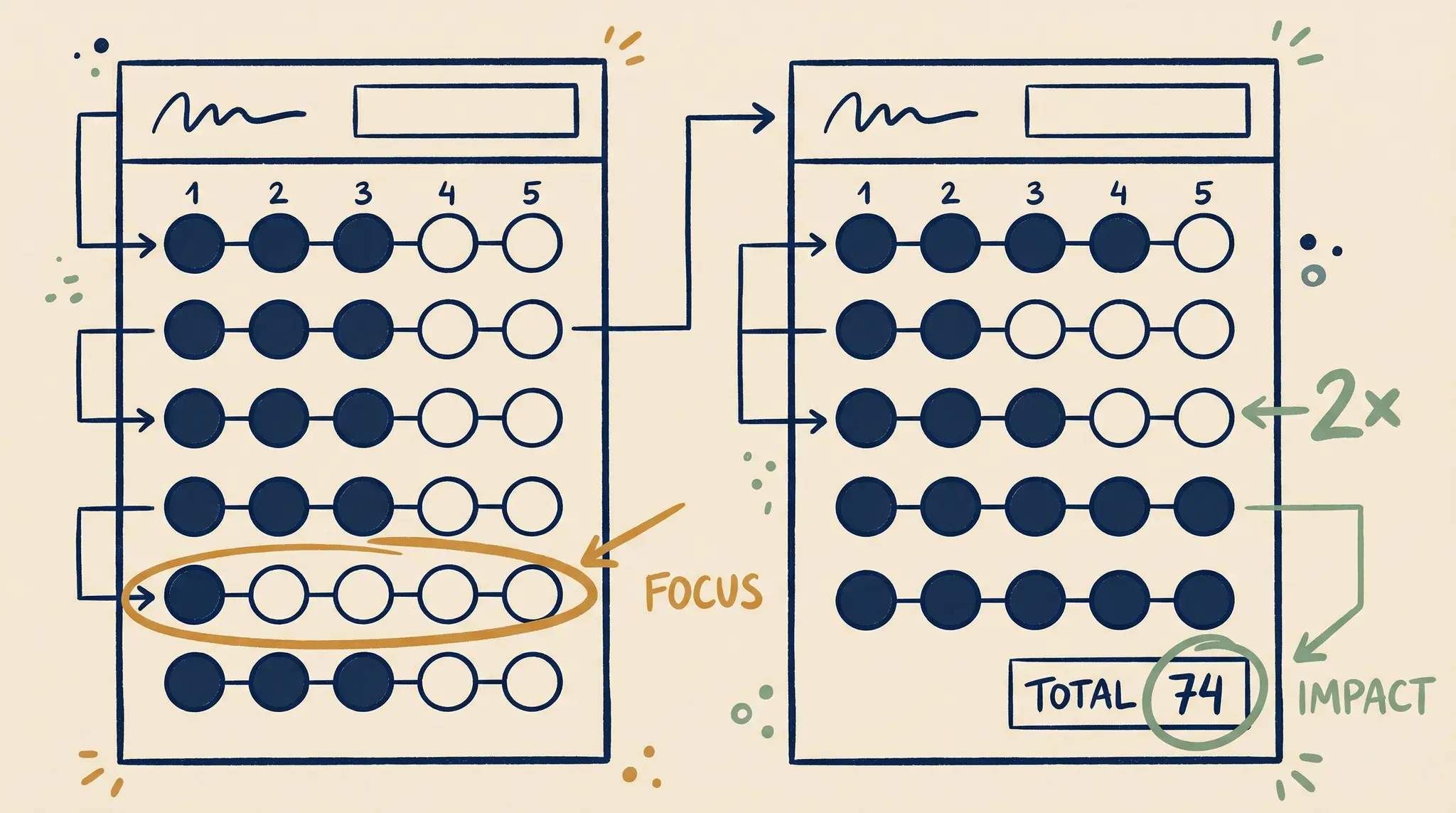
Most career advice treats all job factors as equally important. That's like saying your heart and your appendix both matter—technically true, completely useless. The breakthrough: weight what matters for YOUR stage 2x, then score honestly. This gives you vocabulary to explain why your spreadsheet isn't working.
This is what happened.
The LA4P Framework: Six Dimensions That Actually Matter
Most people optimize only for salary. We break the salary monoculture by tracking six dimensions: Learning, Alignment, People, Prestige, Pace, and Profit.
LA4P Framework Cheatsheet
| Dimension | What It Measures | Why It Compounds | Rating Scale (1-5) |
|---|---|---|---|
LLearning | Skill growth, challenging work | Skills built today unlock opportunities 5 years from now | 1 = Skill atrophy, you'll regress 2 = Minimal growth, mostly maintenance 3 = Steady learning, incremental progress 4 = Significant growth, stretching regularly 5 = Transformative, learning you can't get elsewhere |
AAlignment | Mission fit, meaningful work | Misalignment drains energy faster than overwork | 1 = Actively misaligned with your values 2 = Neutral, just a paycheck 3 = Acceptable, doesn't conflict with values 4 = Meaningful, you care about the outcome 5 = Purpose-driven, this is *your* work |
PPeople | Manager + team quality | Your manager shapes 70% of your work experience | 1 = Toxic manager or team 2 = Weak manager, mediocre team 3 = Decent manager and team 4 = Strong manager and team 5 = Exceptional manager, dream team (Note: Rate manager and team separately, then average) |
PPrestige | Brand recognition, career capital | Opens doors for ~5 years, then your work speaks for itself | 1 = Unknown, possibly hurts resume 2 = No-name, neutral career capital 3 = Respectable, recognized in industry 4 = Strong brand, opens doors 5 = Elite brand, career-defining credential |
PPace | Sustainability, work-life balance | Burnout takes 3-6 months to recover from—prevention is cheaper | 1 = Burnout guaranteed, unsustainable 2 = Consistently overworked, health risk 3 = Manageable, occasional crunch 4 = Healthy balance, flexibility exists 5 = Exceptional balance, life-friendly |
PProfit | Total compensation | Fair pay = freedom to choose based on other dimensions | 1 = Below market, financial stress 2 = Below average, limits options 3 = Market rate, covers needs 4 = Above market, building wealth 5 = Exceptional comp, financial freedom |
When Score Patterns Should Change Your Decision
Before Francisco scored anything, he established decision rules:
Any dimension scoring 1-2 = investigate deeply, often a dealbreaker. Two or more dimensions at this level means the offer has structural problems.
Total score difference of 4+ points out of 30 total = clear winner unless a single dimension is critical to you right now.
Learning + People both 4-5 = prioritize over $10K-15K compensation difference. Early career, this matters more than an extra $10K. (LinkedIn's 2023 Workplace Learning Report found 94% of employees stay longer at companies investing in development, but you probably already suspected this.)
If both offers score below 18/30, keep searching. You're settling.
Your dimension weights vary by life stage. Early career (0-5 years): weight Learning 2x, Prestige 1.5x. Mid-career with family: weight Pace 2x, Profit 1.5x. Know your weights before scoring.
Not sure which career chapter you're in? Read our guide on transitioning from annual goals to career chapters to calibrate your dimension weights appropriately.
Francisco was 4 years into his career—that early-to-mid transition point where you've proven you can execute but haven't yet built systems from scratch. No kids, living with roommates, $8K in savings. Learning and People mattered most. Pace mattered least.
Offer A: The Fintech Startup
Learning: 5/5
The CTO showed him architecture diagrams for rebuilding the payment processing layer from scratch—50K transactions per second, sub-100ms latency requirements, multi-region failover. Francisco had never built distributed systems at this scale. The team used Rust for performance-critical paths. The CTO said:
You'll own the transaction routing layer. It's the hardest technical problem we have. I'll review your designs weekly for the first three months, then you're autonomous.
CTO
Fintech Startup
Clear 5.
Alignment: 3/5
The company helped small businesses accept payments. He looked at the Series B deck. The mission was helping small businesses, but the product roadmap showed 60% of development going to enterprise features for mid-market companies. The stated mission and actual strategy were misaligned. He'd be building for CFOs, not the small business owners in the marketing materials. Neutral 3.
People: 4/5
All 8 engineers had 6+ years of experience. Two had worked at payment companies before. One had contributed to the Rust async runtime. The CTO was technically excellent—Francisco had read his blog posts for years. But the CTO ran a 40-person engineering org and Francisco would get 30 minutes of 1-on-1 time per week. Strong team, limited manager access. Solid 4, not a 5.
Prestige: 4/5
Series B with $30M raised, recognizable investors (a16z, Stripe). Engineers at other startups would know the company. His parents wouldn't. The brand opened doors in fintech and payments, less so in other industries. Strong within tech, not household-name level. 4.
Pace: 3/5
The CTO was honest:
We're rebuilding core infrastructure while scaling revenue 3x this year. Expect 50-hour weeks through Q2, then it stabilizes.
CTO
Fintech Startup
Francisco asked three engineers about work-life balance. Two said "manageable but intense," one said "I haven't taken a real vacation in 8 months." Not sustainable long-term, but survivable for 1-2 years. 3.
Profit: 3/5
$165K base was strong for his market and experience. The 0.15% equity was harder to value. He ran the math: if the company reached a $2B exit (optimistic for Series B), his equity would be worth $3M pre-tax. But Carta data shows only 20-30% of Series B companies reach that outcome. Expected value: $600K-900K over 4-6 years, if things go well. The equity was meaningful upside, not life-changing certainty. 3.
Offer A Total: 22/30
Offer B: The Fortune 500
Learning: 2/5
The tech stack was Java Spring Boot, PostgreSQL, React—all tools Francisco already knew well. The manager described the work:
You'd join our payments modernization team. We're migrating legacy COBOL systems to microservices. It's important work, but the architecture decisions are made at the principal level. You'd be implementing designs, not creating them.
Manager
Fortune 500
Francisco would get better at Java. He wouldn't learn new paradigms. 2.
Alignment: 3/5
Financial services for mid-market companies. Francisco felt nothing about it. Not opposed, not excited. The work was technically interesting (legacy migration is hard), but he didn't care about the business outcome. Neutral 3.
People: 3/5
The 30-person team had a mix of experience levels. The manager seemed competent but not inspiring—12 years at the same company, no external blog or conference talks, no clear technical vision. Francisco would get weekly 1-on-1s and clear mentorship. But when he asked "Who's the best engineer on the team?", the manager named someone who'd left 6 months ago. Stable, not exceptional. 3.
Prestige: 5/5
Fortune 500 brand. His parents would be proud. The company name on his resume would open doors everywhere—tech, finance, consulting. Recruiters would always take his calls. This was the clearest 5 in either offer.
Pace: 4/5
The manager was explicit:
We work 40-45 hours. I don't message people on weekends. We have unlimited PTO and people actually use it--I took 4 weeks last year.
Manager
Fortune 500
Three engineers Francisco talked to confirmed this. One said: "I have two kids. This job lets me coach Little League." Sustainable long-term. 4.
Profit: 4/5
$155K base + 15% annual bonus = $178K total comp, guaranteed. No equity uncertainty. The bonus was tied to company performance (always paid in the last 8 years) and individual performance (manager said "everyone gets 10-20%"). Lower ceiling than Offer A, higher floor. For someone with $8K in savings, the guaranteed cash mattered. 4.
Offer B Total: 21/30
What The Scores Revealed
Dimension LA4P Score | Offer A Fintech Startup | Offer B Fortune 500 |
|---|---|---|
| Learning | 5 | 2 |
| Alignment | 3 | 3 |
| People | 4 | 3 |
| Prestige | 4 | 5 |
| Pace | 3 | 4 |
| Profit | 3 | 4 |
| Total | 22/30 | 21/30 |
Offer A: Fintech Startup
Total: 22/30 — High Learning, balanced growth
Offer B: Fortune 500
Total: 21/30 — High Prestige, better lifestyle
The numbers were close—22 vs 21. But the pattern was clear.
Offer B had a 2 in Learning. That single score mattered more than the 1-point total difference. Francisco was four years in—the exact moment when Learning compounds most. A 2 in Learning meant he'd be better at Java in two years, but not fundamentally more capable. A 5 in Learning meant he'd build systems he couldn't build today.
He applied his decision rule: Learning + People both 4-5 = prioritize over $10K-15K compensation difference. Offer A had Learning at 5 and People at 4. Offer B had Learning at 2 and People at 3. The compensation difference was $13K in Offer B's favor (guaranteed bonus vs. uncertain equity), but that fell within his threshold.
The Prestige gap (4 vs 5) was real. The Fortune 500 brand would open more doors. But Francisco realized: if he spent two years building distributed systems at scale, the technical credibility would open the same doors. Prestige through brand vs. prestige through capability—both worked.
Francisco chose Offer A.
Not because the total score was higher (it barely was). Because the pattern showed him what mattered: at his stage, with his financial situation, Learning at 5 was worth more than Pace at 4 and Profit at 4. The framework didn't make the decision for him. It made the tradeoffs visible.
Six Months Later
Francisco shipped the payment processing rebuild in Q2. The system handled 80K transactions per second at launch—60% better than the original spec. He got promoted to Staff Engineer in month 5, earlier than typical. The CTO's weekly design reviews turned into monthly check-ins because Francisco didn't need them anymore.
The 50-hour weeks were real. He didn't take a vacation for 7 months. His savings account stayed at $8K. But when recruiters reached out (they did, constantly), he could talk about building distributed systems at scale. The Learning score of 5 delivered.
Would Offer B have been wrong? No. If Francisco had two kids and a mortgage, the Pace score of 4 and Profit score of 4 would have mattered more than Learning at 5. If he'd been 8 years into his career instead of 4, the Prestige score of 5 might have been the tiebreaker for a future VP role.
The framework doesn't tell you which offer is objectively better. It tells you which offer is better for you, right now, given what you're optimizing for.
Compare Your Job Offers with LA4P
Use our interactive calculator to score multiple offers and see the pattern that matters for your career stage.
Your Decision Template
Your Job Offer Decision Template
Score two offers side-by-side using the LA4P framework
| Dimension | Offer A | Offer B |
|---|---|---|
Rate Each Dimension (1-5) | ||
| Learning | 1 2 3 4 5 | 1 2 3 4 5 |
| Alignment | 1 2 3 4 5 | 1 2 3 4 5 |
| People | 1 2 3 4 5 | 1 2 3 4 5 |
| Prestige | 1 2 3 4 5 | 1 2 3 4 5 |
| Pace | 1 2 3 4 5 | 1 2 3 4 5 |
| Profit | 1 2 3 4 5 | 1 2 3 4 5 |
| TOTAL LA4P | ||
Your Decision Rules | ||
| Any dimension 1-2? | Which ones? | Which ones? |
| Total score difference 4+ points? | ________ | ________ |
| Learning + People both 4-5? | Yes/No | Yes/No |
Debiasing Checks | ||
Final Decision | ||
| I choose | ________ | ________ |
Because ________ | ||
The tradeoff I'm making ________ | ||
✨ Ready to make your decision?
Use our interactive calculator to save and compare your options
Use Our Interactive Calculator →💡 Remember: If both offers score below 18/30, keep searching. You're settling.
Use Our Interactive Calculator →Reflect on your story
See where your career rhymes with this one.
Add your last 3 roles as chapters and score them 1–5. Compare your path to this story and note where you’d choose differently now.
Free while we're in beta. No inbox clutter, no selling your data.