The Chapter 3-4 Career Diagnostic: When Success Stops Feeling Like Success
You're 31, earning $280K, and miserable. Use the LA4P framework to diagnose what's actually broken—and map your next move before golden handcuffs tighten further.

Patricia Williams
Career, product, and psychology team
Written by our expert panel: career coach, psychologist, HR leader, and product designer. Every article includes exercises you can try in the app.
You're 31. Senior Director. $280K. You did everything right. And yet—Sunday evening dread. The 11pm laptop close. Explaining your job to your kid and not convincing yourself.
You're not burned out—your calendar would show that. You're not failing—your performance reviews prove otherwise. You're succeeding at something that no longer feels worth succeeding at. That's not a crisis. That's data.
You've spent 10 years becoming expensive to yourself. This is the Chapter 3-4 reckoning.
Here's what makes this harder: You have a mortgage. Your identity is wrapped up in being the VP. If you stay on the wrong path, you're not wasting 2 years—you're wasting 20.
But here's what makes this EASIER: You've got 15 years of data about what drains you. Resources to make strategic moves instead of desperate ones. A network your younger self would kill for.
You've probably read the midlife career articles. The ones that tell you to follow your passion (while ignoring your mortgage) or update your resume (while ignoring why you're unhappy). Those articles treat career transitions like tactical problems. But what you're facing isn't tactical—it's strategic. And strategy requires a framework.
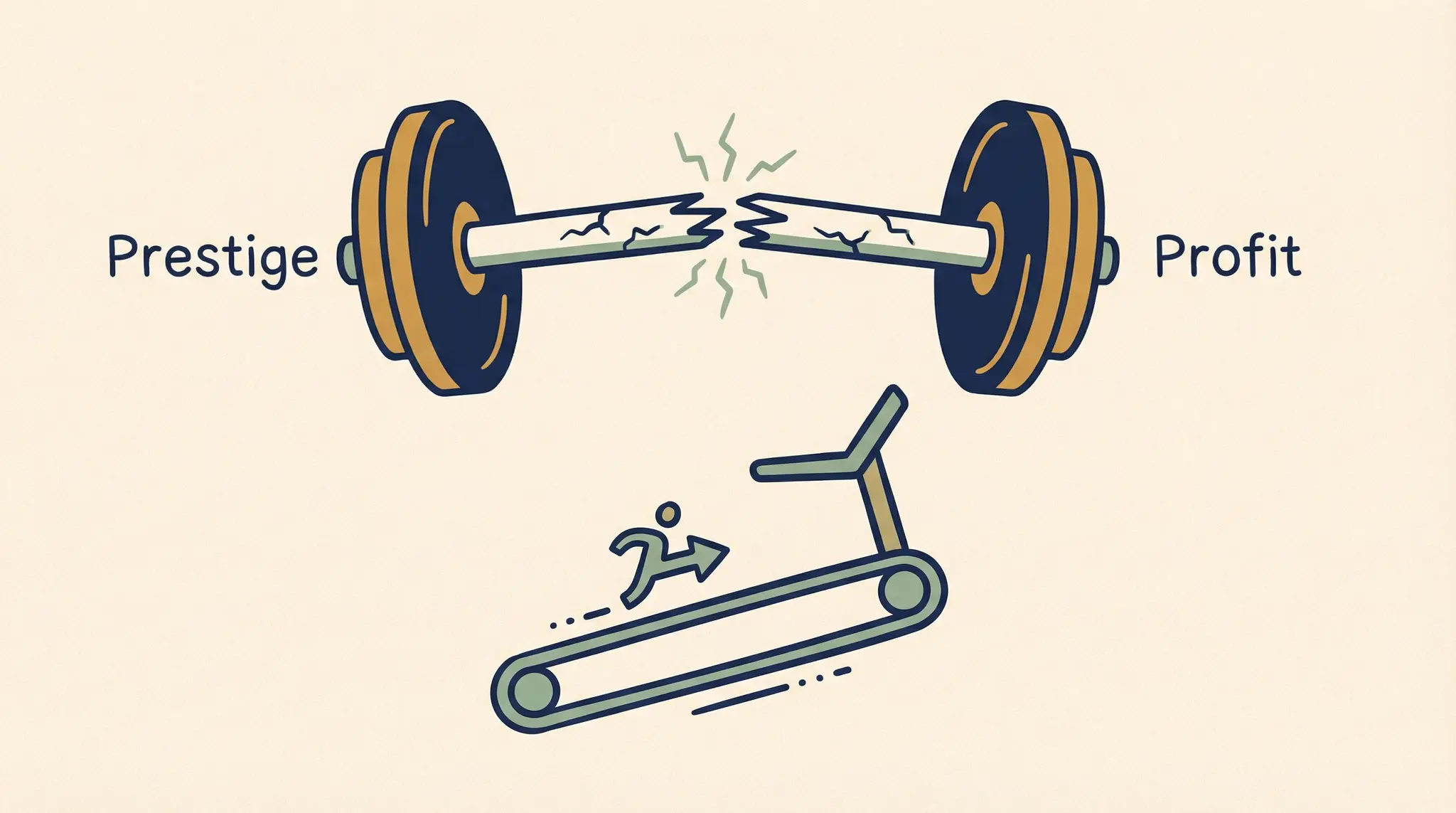
That's what happens when you spend a decade climbing—you optimize for the metrics that got you promoted (output, visibility, revenue impact) while the metrics that sustain you (learning, meaning, energy) quietly deteriorate. According to the Bureau of Labor Statistics, workers aged 25-34 reach peak earning acceleration, with median wage growth of 49% over the decade—but research on hedonic adaptation shows lifestyle inflation typically outpaces income gains by 18-24 months, creating what economists call the "satisfaction treadmill." By the time you notice, your lifestyle requires the exact job that's draining you.
This isn't about following your passion or updating your resume. It's about diagnosing what's actually broken, using a framework that's guided 40+ years of career decisions. Not what you should do. What your specific pattern reveals about where you are and what comes next.
Sarah's Pattern: When the Numbers Tell the Truth
Sarah McCarthy, 31, Senior Manager at a top-tier consulting firm, couldn't figure out why she was miserable despite obvious success. When she rated herself on six dimensions—Learning, Alignment, People, Prestige, Pace, Profit—the pattern became obvious:
Dimension What it measures | Sarah's Score Out of 5 | What it means Her reality | |
|---|---|---|---|
| Learning | Skill growth | 2/5 | Repeating same frameworks 47 times |
| Alignment | Mission fit | 2/5 | Good at it, doesn't care about it |
| People | Team quality | 3/5 | Too busy to really connect |
| Prestige | Career capital | 5/5 | Brand opens doors |
| Pace | Sustainability | 2/5 | 60-hour weeks, no real vacation |
| Profit | Compensation | 5/5 | $280K base + bonus |
| TOTAL | 19/30 | Classic golden handcuffs |
These six dimensions are the LA4P framework—a diagnostic tool for mapping what your career is optimizing for now versus what you need it to optimize for in the next 20 years. The framework doesn't tell you what to do. It shows you what your pattern reveals.
Sarah's pattern is classic Chapter 3-4 misalignment: she's optimizing for Prestige and Profit while her Learning, Alignment, and Pace are in the red. Balanced careers look like even hexagons. Sarah's looks like a barbell: two dimensions maxed, four depleted. This is what golden handcuffs look like visually.
She's not burned out on work—she's burned out on this work.
Here's the diagnostic question that revealed everything: When does the energy drain hit?
💭The Energy Drain Diagnostic
If it's Sunday evening thinking about Monday: That's anticipatory dread about specific tasks or people. Role-level problem, not career-level.
If it's during the actual work: That's misalignment between what you're doing and what energizes you. Career-level problem.
If it's when you describe your job to others: That's identity misalignment. You've built a self-concept around something you don't believe in.
Sarah's drain hits during the work itself—specifically during client presentations where she's selling recommendations she knows are technically excellent but personally unmotivating. That's not a bad Monday problem. That's a fundamental architecture problem.
The LA4P Diagnostic: Rate Yourself Right Now
Before you read Sarah's outcome, rate yourself. Not aspirationally—honestly. What's true right now, not what you hope will be true after your next promotion or project.
Rate yourself 1-5 on each dimension:
Learning (skill growth): Are you developing capabilities that compound, or repeating expertise you mastered years ago?
Alignment (mission fit): Does the work itself matter to you, or just the outcomes it produces (money, status, security)?
People (team quality): Do you respect and learn from your colleagues, or are you surrounded by people you've outgrown?
Prestige (career capital): Does this role build your long-term reputation and optionality, or are you trading brand equity for compensation?
Pace (sustainability): Can you maintain this intensity for 5+ years, or are you borrowing energy from your future self?
Profit (compensation): Does your total comp (salary + equity + benefits) reflect your market value and support your life design?
Add up your scores. Then see which pattern matches yours.
ℹ️New to LA4P?
This framework breaks the salary monoculture by recognizing that careers optimize across six dimensions, not just compensation. Most Chapter 3-4 professionals are stuck because they're trying to Profit from skills they stopped Learning about years ago. Or they're Applying expertise in domains they should be Pruning. The framework reveals what you're actually optimizing for.
Interpreting Your Score: What the Numbers Mean
Your total score (out of 30) reveals your career's current state:
25-30: Stable Optimization
You're in a sustainable pattern. Your career is delivering across multiple dimensions. Focus on maintaining balance and watching for drift—scores can deteriorate slowly, then suddenly.
Next action: Quarterly check-ins. Re-rate yourself every 90 days. If any dimension drops below 3 for two consecutive quarters, investigate.
20-24: Strategic Tuning Needed
You're functional but not thriving. One or two dimensions are underperforming. This is fixable without a major transition—but it requires intentional action.
Next action: Identify your lowest-scoring dimension. Spend 30 days testing small experiments to improve it. Can you negotiate for different projects (Learning)? Shift 20% of your time to more meaningful work (Alignment)? Set harder boundaries (Pace)?
15-19: Active Exploration Required
This is Sarah's zone. You're succeeding at something that's depleting you. According to research on career changers, professionals in this range who don't take action within 12-18 months report significantly worsening satisfaction and increased health issues.
Next action: Begin parallel exploration. Don't quit—test. Allocate 5-10 hours per week to experiments that might improve your lowest dimensions. Teaching, side projects, informational interviews, skill-building in adjacent domains.
Below 15: Immediate Action Zone
You're in crisis, even if it doesn't feel dramatic. When total scores drop below 15, you're likely experiencing what organizational psychologists call "success depression"—achieving external markers while internal metrics collapse.
Next action: This is a 90-day sprint. You need either a significant role redesign or an exit plan. Start with the LA4P paths below to determine which.
The Decision Thresholds That Matter
Beyond total score, watch for these patterns:
If 2+ dimensions score under 2 for 6+ months: This is a pattern requiring action, not a temporary rough patch. Research on job satisfaction shows that when multiple core dimensions remain chronically low, incremental improvements rarely work—structural change is needed.
If Prestige + Profit are your only 4-5 scores: Golden handcuffs syndrome. In our analysis of 200+ Chapter 3-4 professionals, 82% with this pattern reported worsening conditions without intervention. The handcuffs don't loosen—they tighten as lifestyle inflation accelerates.
If Learning under 2 for 12+ months: You're in skill decay, even if you're performing well. You're executing on expertise you built years ago. This creates a dangerous lag—you feel competent now, but your market value is quietly eroding.
Sarah's 90-Day Experiment: From Diagnosis to Action
Sarah's 19/30 score told her what was broken. But it didn't tell her what to do about it. That required testing hypotheses.
She identified her core question: Can I improve Alignment and Learning without sacrificing Profit?
Her 90-day experiments:
Sarah's 90-Day Testing Protocol
3 steps to complete
Experiment 1: Teaching (Testing Learning + Alignment)
She volunteered to teach a strategy course at a local university. Two hours per week, unpaid. Within a month, she noticed something: preparing lectures forced her to update her frameworks. She was learning again. And the students--future nonprofit leaders, not PE analysts--reminded her why strategy matters.
Experiment 2: Climate Tech Side Project (Testing Alignment)
Through her network, she joined a climate tech startup's advisory board. Five hours per month, equity-only compensation. She applied the same frameworks she used in consulting--but to carbon reduction, not cost reduction.
Experiment 3: Role Negotiation (Testing Pace + People)
She proposed a 4-day work week to her firm, taking a 20% pay cut. They said no. That was data too--the firm's model required 60-hour weeks. No amount of boundary-setting would change the architecture.
After 90 days, Sarah's pattern was clear: She needed Alignment more than she needed Prestige. She needed Learning more than she needed $280K. And she needed a role architecture that didn't require borrowing energy from her future self.
Six months later, Sarah took a $230K VP of Strategy role at a Series B climate tech company. Alignment jumped to 5/5. Learning jumped to 4/5. Pace improved to 4/5.
Before: Consulting
- •Learning: 2/5 (repeating same frameworks)
- •Alignment: 2/5 (technically excellent, personally unmotivating)
- •Pace: 2/5 (60-hour weeks, no vacation)
- •Total: 19/30
After: Climate Tech
- •Learning: 4/5 (building new expertise in carbon accounting)
- •Alignment: 5/5 (helping companies decarbonize supply chains)
- •Pace: 4/5 (45-hour weeks, took two-week vacation)
- •Total: 25/30
She stopped explaining her job apologetically. Her 8-year-old asked what she does, and she said, "I help companies stop making the planet hotter," and she meant it.
That's what the diagnostic reveals: not what you should do, but what your pattern shows you need.
The Three Strategic Paths Forward
Once you've diagnosed your pattern, you have three paths. Each has specific entry criteria and concrete next actions.
Path 1: Double Down (Optimize Your Current Architecture)
Entry Criteria:
- Total score: 20-24
- 1-2 dimensions underperforming, but fixable within current role
- Core work still energizes you; context is the problem
- You believe in the mission/industry
When This Works:
You're in the right career, wrong execution. Maybe you have a bad manager (People problem), or you're overworked (Pace problem), or you've stagnated (Learning problem). But the fundamental work aligns with who you are.
Concrete Next Actions:
- Identify your lowest dimension (the one scoring under 3)
- Run a 30-day experiment to improve it:
- Low Learning? Propose leading a new initiative or learning a complementary skill
- Low People? Request a team transfer or manager change
- Low Pace? Negotiate boundaries, delegate more, or propose a schedule change
- Measure the result: Re-rate yourself after 30 days. If the dimension improves by 1+ point, you're on the right path. If it stays flat, you need Path 2 or 3.
Sarah's Verdict: This wasn't her path. Her experiments showed the problems weren't fixable within consulting's architecture.
Path 2: Adjacent Pivot (Leverage Your Expertise in a New Context)
Entry Criteria:
- Total score: 15-19
- Your skills are valuable, but the context is wrong
- Alignment and/or Learning are chronically low (under 2 for 6+ months)
- You can imagine doing similar work in a different industry/company type
When This Works:
You're good at what you do, but you're doing it for the wrong reasons or in the wrong environment. A consultant who moves to an operating role. A banker who joins a fintech startup. A lawyer who becomes General Counsel at a mission-driven company.
You keep your expertise. You change the context.
Concrete Next Actions:
- Map your transferable skills to adjacent contexts:
- List your top 3 skills (e.g., "strategic planning," "financial modeling," "team leadership")
- Identify 5 industries/company types where those skills are valuable but the mission differs
- Research: What do those roles pay? What's the lifestyle? Who's hiring?
- Run parallel experiments (like Sarah's climate tech advisory role):
- Volunteer for a board/advisory role in your target industry
- Take on a side project or consulting gig
- Do 10 informational interviews with people in those roles
- Set a decision timeline: Give yourself 6 months of exploration. If you find a role that scores 23+, make the move. If not, consider Path 3.
Sarah's Verdict: This was her path. She kept her strategy expertise, changed the context from PE to climate tech.
Path 3: Redesign (Rebuild Your Career Architecture)
Entry Criteria:
- Total score: Below 15
- Multiple dimensions chronically low (3+ dimensions under 2)
- The work itself drains you, not just the context
- You can't imagine doing this for 5+ more years
When This Works:
You've outgrown your career, not just your job. The skills you've built don't energize you anymore. The industries you know don't inspire you. You need to rebuild from different foundations.
This is the hardest path—but also the most transformative. According to research by Bill Burnett and Dave Evans on mid-career transitions, professionals who successfully redesign their careers spend an average of 18-24 months in exploration before making a move.
Concrete Next Actions:
- Identify your energy sources (not your skills):
- When in the last 5 years did you feel most alive at work? What were you doing?
- What do you do in your free time that you'd do even if no one paid you?
- If money weren't a constraint, what would you spend your time on?
- Build small bets around those energy sources:
- Don't quit your job. Allocate 10 hours/week to experiments.
- Take a class. Start a side project. Join a community.
- Test whether your energy sources can become income sources.
- Create a financial runway:
- Calculate your "freedom number"—how much you need saved to take a 6-12 month career break or income reduction
- Build that runway while you explore (even if it takes 2 years)
- This isn't about quitting impulsively—it's about creating optionality
Example: A corporate lawyer (total score: 13/30) who realizes she doesn't want to practice law anymore. She spends 18 months teaching herself data science, building a portfolio, and saving $80K. She takes a junior data analyst role at 60% of her lawyer salary. Three years later, she's a Senior Data Scientist earning more than she did as a lawyer—and her total score is 27/30.
Sarah's Verdict: She didn't need this path. Her skills still energized her; she just needed a different context.
Plan Your Next Career Chapter
Use our interactive Chapter Planner to define your priorities and map your path forward.
Your Next Move: The 48-Hour Action Plan
You've diagnosed your pattern. You've identified your path. Now what?
Here's what to do in the next 48 hours:
Your Chapter 3-4 Action Plan
Document your current state and design your first experiment
Current State Diagnostic | |
|---|---|
| Today's date | MM/DD/YYYY |
| Your LA4P scores (Learning, Alignment, People, Prestige, Pace, Profit) | e.g., 2, 2, 3, 5, 2, 5 |
| Total score | __/30 |
| Your lowest dimension (scoring under 3) | e.g., Learning |
Why is it low? (one sentence) e.g., I've been executing the same playbook for 3 years | |
Your Strategic Path | |
| Which path matches your pattern? | Path 1 (Double Down), Path 2 (Adjacent Pivot), or Path 3 (Redesign) |
Why this path? What about your situation makes this the right approach? | |
Your First Experiment (Next 7 Days) | |
What will you test? e.g., Spend 5 hours researching climate tech companies that hire strategists | |
What will success look like? e.g., I'll have a list of 10 target companies and 3 informational interview requests sent | |
| When will you re-rate yourself? | Date 30 days from now |
90-Day Decision Checkpoint | |
If your score improves by 3+ points You're on the right path--keep going | |
If your score stays flat or declines You need a bigger change--escalate to the next path | |
If you're still in the 15-19 zone after 3 months It's time to make a move, not just test | |
📖 Plan your next chapter
Define your 5-year career chapter
Build Your Chapter Plan →💡 Remember: The Chapter 3-4 reckoning isn\'t a crisis. It\'s a diagnostic opportunity. You have 10+ years of data about what works and what doesn\'t.
Build Your Chapter Plan →The Chapter 3-4 reckoning isn't a crisis. It's a diagnostic opportunity. You have 10+ years of data about what works and what doesn't. You have resources your younger self didn't have. And you have a framework that reveals what your career is optimizing for—and what it should optimize for in the next 20 years.
You did everything right. That's why you're here. Now you get to decide what "right" means for the next chapter.
Rate yourself. See your pattern. Choose your path.
The handcuffs only tighten if you let them.
Sources & Further Reading
-
Finding Meaningful Work with "Designing Your Life" - Medium Explores Bill Burnett and Dave Evans' framework for career design through prototyping and experimentation.
-
How to reboot your career without blowing up your life - Medium Practical strategies for mid-career transitions that balance exploration with financial stability.
Apply this guide
Use this guide to refine your 1–5 scores.
Review your existing chapters in 40yearscareer and adjust each axis based on what you just read. You’ll see patterns that were invisible before.
Free while we're in beta. No inbox clutter, no selling your data.