Spike-Chasing vs. Career Compounding: Why Trajectory Beats Altitude
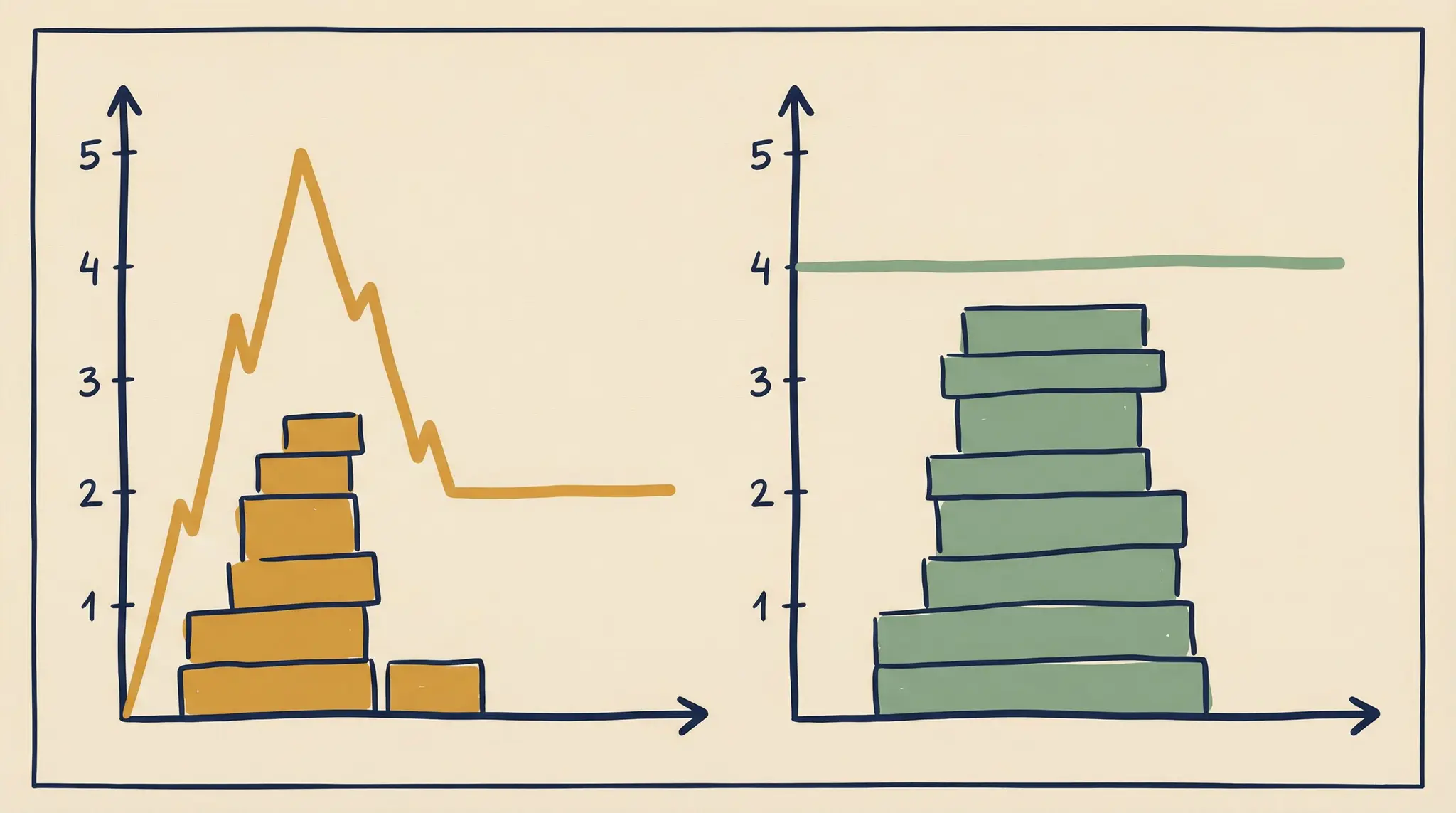
Most people optimize for their highest career score. The math shows sustained 4s compound to 2x more career capital than dramatic 5s that decay. Learn to spot trajectory patterns before you hit the decay phase.

Dr. James Chen
Behavioral Psychologist
Written by our expert panel: career coach, psychologist, HR leader, and product designer. Every article includes exercises you can try in the app.
Spike-Chasing vs. Career Compounding: Why Trajectory Beats Altitude
Francisco changed jobs four times in three years. Each move: higher title, better comp, shinier logo. David stayed at AWS for five years. Same team, boring LinkedIn.
By year six, David had built 2x more career capital. Not smarter. Different strategy.
Francisco wasn't job-hopping. He was spike-chasing—optimizing for altitude over distance.
The Math That Changes Everything
Here's what Francisco missed: A role that maintains solid scores across Learning, Alignment, and People for 5 years creates 60 dimension-years of career capital using the LA4P framework (4+4+4 per year × 5 years).
A role that starts spectacular but decays? 27 dimension-years (5+5+4 in year 1, dropping to 2+2+3 by year 2, then 4 more years of searching and resetting).
Sustained moderate gains compound. Dramatic spikes decay. The difference isn't small—it's 2x.
Your career isn't measured by your highest score. It's measured by your area under the curve.
Why We Chase Spikes Anyway
We're taught to treat career decisions like stock trading: maximize the number at this moment. Chase the highest Learning score, the best Alignment fit, the most Prestigious brand.
Three psychological traps make spike-chasing feel rational:
Recency bias: The most recent high score feels more important than the average. Research by Kahneman and Tversky on cognitive biases shows we overweight recent experiences. That incredible first month at the startup weighs heavier in memory than the mediocre 18 months that followed.
Peak-end rule: We remember the best moment and the final moment, not the average experience. Research by Kahneman on the peak-end rule shows how we judge experiences by snapshots, not averages. Francisco remembers shipping that breakthrough feature, not the year of maintenance work that followed.
Hyperbolic discounting: We overvalue immediate gains. A 5 today feels better than a 4 that stays a 4 for five years—even though the math says otherwise. Research on hyperbolic discounting shows we systematically undervalue future rewards.
Francisco wasn't reckless. Each move solved a real problem: escape a toxic manager, gain a title for credibility, join a rocketship. The strategy made sense. The execution compounded wrong.
These traps don't just make us feel bad about choices. They change which roles we take. Let me show you how this plays out across three common trajectories.
The Three Trajectory Patterns
Pattern 1: The Spike-and-Decay (Francisco's Trap)
Francisco joined a Series B startup. First six months: novel architecture, features that mattered, brilliant teammates. Then scale hit.
His novel architecture became legacy code. His features became maintenance work. The brilliant people left for the next hot thing. The mission pivoted twice—first to enterprise, then to profitability.
By month 18, he was debugging (Learning:2), not designing. The mission had drifted so far from the original vision he'd signed up for (Alignment:2). Half his team had churned (People:3). The Prestige stayed high—the logo still looked good on LinkedIn. But he'd stopped growing.
So he left. Found another spike. Repeated the pattern.
Here's what that cost him:
Period Timeline | Learning 1-5 scale | Alignment 1-5 scale | People 1-5 scale | Dimension-Years Cumulative capital |
|---|---|---|---|---|
| Year 1, First 6mo | 5 | 5 | 4 | (5+5+4) × 0.5 = 7.0 |
| Year 1, Last 6mo | 2 | 2 | 3 | (2+2+3) × 0.5 = 3.5 |
| Year 2, Job Search | 0 | 0 | 0 | 3 months at 0 = 0 |
| Year 2, New Role Start | 5 | 5 | 4 | (5+5+4) × 0.5 = 7.0 |
| Year 2, Decay Begins | 3 | 3 | 3 | (3+3+3) × 0.25 = 2.25 |
| Year 3, More Decay | 2 | 2 | 3 | (2+2+3) × 0.5 = 3.5 |
| Year 3, Job Search | 0 | 0 | 0 | 3 months at 0 = 0 |
| Year 3, New Role | 5 | 5 | 4 | (5+5+4) × 0.25 = 3.5 |
| Year 4, Decay Again | 3 | 2 | 3 | (3+2+3) × 0.5 = 4.0 |
| Year 4, Job Search | 0 | 0 | 0 | 3 months at 0 = 0 |
| Year 4-5, New Role | 4 | 4 | 3 | (4+4+3) × 1.25 = 13.75 |
| 5-Year Total | -- | -- | -- | ~44 dimension-years |
The trap: Each reset costs you. New codebases, new teams, new context. You spend 3-6 months ramping up, then 6-12 months productive, then you're hunting again. You never compound.
Pattern 2: The Sustained-4 (David's Advantage)
David joined AWS as a mid-level engineer on the S3 team. Not the sexiest role. Not the highest comp. But sustainable.
Year 1: He learned distributed systems at scale (L:4). The mission was clear—make storage reliable (A:4). His manager was solid, not spectacular (People:4). Work-life balance was reasonable.
Year 2: Still learning, now about operational excellence (L:4). Mission unchanged (A:4). Team stability meant deeper relationships (People:4). He shipped a major reliability improvement that built directly on his Year 1 architecture work. The codebase he wrote in Year 1 became the foundation for Year 2's features.
Year 3: Learning shifted to organizational systems—how decisions get made at scale (L:4). Mission still clear (A:4). His manager became a mentor (People:5). He started mentoring two junior engineers, teaching them the patterns he'd learned in Years 1-2. His architectural decisions from Year 1 were now referenced in design docs across the org.
Year 4: Deep domain expertise emerged (L:4). He could see patterns others missed because he'd lived through three years of edge cases. Mission unchanged (A:4). He'd built a network across AWS (People:5). When other teams hit storage problems, they called David. Promoted to senior engineer. The promotion wasn't just a title—it reflected career capital he'd actually accumulated.
Year 5: Learning continued—now about architecture and strategy (L:4). He was designing systems, not just implementing them. Mission still aligned (A:4). His network was an asset (People:5). He mentored five engineers. Three of his Year 1-2 mentees were now senior engineers themselves, creating a compounding network effect. His Prestige had grown organically (P:5) as he became known as "the S3 reliability expert."
Here's what compounding looks like:
Year Timeline | Learning 1-5 scale | Alignment 1-5 scale | People 1-5 scale | Dimension-Years Annual capital | Compounding Effects How it builds |
|---|---|---|---|---|---|
| Year 1 | 4 | 4 | 4 | (4+4+4) × 1 = 12 | Built foundation architecture |
| Year 2 | 4 | 4 | 4 | (4+4+4) × 1 = 12 | Year 1 code → Year 2 features |
| Year 3 | 4 | 4 | 5 | (4+4+5) × 1 = 13 | Started mentoring, designs referenced |
| Year 4 | 4 | 4 | 5 | (4+4+5) × 1 = 13 | Network effects, domain expertise |
| Year 5 | 4 | 4 | 5 | (4+4+5) × 1 = 13 | Mentees became seniors, org-wide impact |
| Cumulative | -- | -- | -- | ~63 dimension-years | 2.3x Francisco's total |
David's Year 5 work was only possible because of Years 1-4. Francisco's Year 3 work had no connection to Year 1. That's the difference between compounding and resetting.
As Cal Newport describes in "So Good They Can't Ignore You", career capital compounds through deliberate practice in a stable context. David built rare and valuable skills. Francisco built a resume.
Pattern 3: The Intentional Spike (When Short-Term Makes Sense)
Not all spikes are traps. Sometimes a short-term role strategically builds long-term capital.
Maya joined a failing startup for 18 months. She knew it would fail. She went anyway.
Why? The CTO was the former VP of Engineering at Stripe. Maya wanted to learn how elite teams operate. She got 18 months of mentorship (People:5) that would have taken 5 years to access elsewhere.
Here's what made this spike strategic:
Period Timeline | Learning 1-5 scale | Alignment 1-5 scale | People 1-5 scale | Dimension-Years Capital built | Compounding Effect How it transferred |
|---|---|---|---|---|---|
| Failing Startup (18mo) | 4 | 3 | 5 | (4+3+5) × 1.5 = 18 | Elite mentorship + network |
| Scale-Up Senior Role (Y2-Y3) | 5 | 5 | 5 | (5+5+5) × 2 = 30 | Hired at senior level, network effect |
| Scale-Up Continued (Y4-Y5) | 5 | 4 | 5 | (5+4+5) × 2 = 28 | Deep expertise + leadership pipeline |
| 5-Year Total | -- | -- | -- | ~76 dimension-years | Strategic spike → sustained excellence |
The startup gave Maya:
- A reference from a Stripe executive (opened doors to senior roles)
- Direct experience with practices used at top-tier companies (Learning advantage)
- A network of senior engineers who'd worked at Google, Facebook, Stripe
The 5-year payoff: When the startup shut down, Maya's CTO reference got her interviews at top companies. She joined a scale-up as a senior engineer, skipping 2 years of ladder-climbing. Over the next 3.5 years, she maintained high scores because her foundation was elite. The intentional spike enabled 76 dimension-years over 5 years, beating David's sustained approach (63) and crushing Francisco's pattern (44).
Maya's spike was intentional. She knew:
- What rare asset she was acquiring (mentorship from elite practitioner)
- How it would compound (skills and network transfer to next role)
- Her exit timeline (18 months, regardless of company outcome)
When spikes make sense:
- You're acquiring a rare skill unavailable elsewhere (e.g., ML at OpenAI, scaling at Stripe)
- You're accessing a network that opens future doors (e.g., working for a well-connected executive)
- You have a clear exit plan based on learning goals, not company success
- The spike compounds into your next role (the skills/network transfer)
When spikes are traps:
- You're chasing Prestige or Profit without rare skill acquisition
- You have no plan for how this compounds into future roles
- You're running from problems rather than toward opportunities
- The company's success is your only exit strategy
Francisco chased spikes reactively. Maya used them strategically. The difference: intentionality and compounding logic.
Beyond Tech: How This Plays Out Across Professions
The spike-vs-compound pattern isn't unique to software engineering. It shows up everywhere—but the decay triggers differ by field.
Consulting: The classic spike-and-decay trap. Year 1: learning frameworks, client exposure, prestigious projects (L:5, A:4, People:4). Year 2-3: Same frameworks on repeat, travel burnout, junior analysts doing your work (L:2, A:3, People:2). The spike decays because consulting optimizes for knowledge transfer, not knowledge building. You learn the method, then apply it endlessly.
Law: BigLaw associates chase the Cravath spike—$200k+ starting salary, prestigious deals, partner track. Years 1-2: novel transactions, mentorship from partners, learning complex structures (L:5, A:4, People:4). Years 3-5: Document review, 80-hour weeks, partner relationships sour as you become expensive (L:2, A:2, People:2). Many leave for in-house roles where they rebuild from scratch. The sustained-4 path? Boutique firms or specialized practices where expertise compounds—regulatory specialists, IP litigators who become domain experts in biotech or semiconductors.
Medicine: Residents spike-chase prestigious fellowships and academic hospitals (Prestige:5), then burn out on administrative burden and insurance paperwork (Learning:2, Alignment:2). The sustained path? Specialists who join stable group practices, compound clinical expertise over decades, build patient relationships that refer for 20+ years. The strategic spike? 2-3 years at Mayo or Hopkins to build network and reputation, then return to regional practice with elevated credibility.
Management Consulting → Corporate Strategy: The intentional spike. 2-3 years at MBB (McKinsey, Bain, BCG) to learn frameworks and build network, then exit to VP Strategy at a growth company. The spike only works if you extract rare assets (analytical rigor, executive presence, network) that compound in the next role. Otherwise, you're just a former consultant without domain expertise.
Sales: Enterprise AE jobs are spike factories. Year 1: new patch, green accounts, high Learning (4-5). Year 2: territory saturated, quotas rise, no new logos (Learning:2, Profit:3). The compounding path? Account executives who go deep on one vertical (healthcare SaaS, supply chain tech) and become the go-to expert. Their domain knowledge compounds—each sale teaches them more about buyer patterns, budget cycles, org structures.
Academia: Tenure-track positions at R1 universities create intentional spikes—high Learning (cutting-edge research), low Profit, brutal hours. The 6-year pre-tenure grind is designed as a strategic spike: extract research skills, publication record, and network, then leverage into tenured role or industry transition. The trap? Assistant professors who stay post-tenure at institutions that stopped investing in their field—they plateau instead of compounding.
The pattern holds: spikes work when you extract rare, compounding assets. They fail when you chase Prestige or Profit without building transferable capital.
Your Current Role Sustainability Check
Score your role today on Learning, Alignment, and People (1-5 each). Use the LA4P framework to evaluate each dimension systematically.
If your total is 9+: Stay and compound. You're in a sustainable trajectory. Focus on deepening expertise, building relationships, and expanding impact. Track your scores quarterly to catch decay early.
If your total is 6-8: Diagnose which dimension is declining. Create a recovery plan:
- Learning declining? Propose a new project, change teams internally, or invest in deliberate skill-building
- Alignment declining? Revisit your mission clarity. Has the company pivoted? Can you find alignment in a different team?
- People declining? Is it your manager, your team, or the culture? Evaluate manager quality systematically—manager issues might be fixable through internal mobility
If your total is below 6 for two consecutive quarters AND you've exhausted internal mobility options: You're in decay phase. Start exploring, but do it strategically:
- Identify what rare asset your next role must provide
- Ensure it compounds with your existing career capital
- Compare offers systematically to avoid reactive spike-chasing (running from vs. running toward)
Using the LA4P framework, you can calculate your trajectory before you hit the decay phase. This isn't about perfect scores. It's about sustainable compounding.
Calculate Your Career Trajectory Before You Hit Decay
Track your dimension-years in real-time and project your 3-year trajectory based on your current scores.
Your Trajectory Worksheet
Your Spike vs. Sustained Trajectory Analysis
Compare your current trajectory against a sustained-4 baseline to see if you're spike-chasing or compounding.
| Dimension | Current Trajectory (Last 3 Years) | Sustained-4 Baseline |
|---|---|---|
Rate Your Average Scores (Last 3 Years) | ||
| Learning | 1 2 3 4 5 | 1 2 3 4 5 |
| Alignment | 1 2 3 4 5 | 1 2 3 4 5 |
| People | 1 2 3 4 5 | 1 2 3 4 5 |
| TOTAL (per year) | ||
| Years at current role/pattern | e.g., 2.5 years | 3 years |
| Dimension-Years (Total × Years) | __ | 36 |
Trajectory Pattern Check | ||
Compounding Analysis | ||
What rare asset are you building? ________ | ||
How does this year build on last year? ________ | ||
What would a sustained-4 role look like for you? ________ | ||
✨ Ready to make your decision?
Use our interactive calculator to save and compare your options
Calculate Your Full Trajectory →💡 Remember: If you checked 2+ boxes in 'Trajectory Pattern Check,' you're likely spike-chasing. A sustained-4 trajectory (12/15 per year × 3 years = 36 dimension-years) beats most spike patterns.
Calculate Your Full Trajectory →The Question That Changes Everything
David understood something Francisco didn't: Your career isn't a single climb. It's a series of seasons.
The question isn't "How high can I jump right now?"
It's "How far can I travel over the next decade?"
Francisco optimized for altitude. David optimized for distance. By Year 6, the difference was undeniable.
If you've been Francisco—and most of us have—you're not behind. You're just optimizing for the wrong variable.
The math is clear. The patterns are predictable. The choice is yours.
How do I calculate dimension-years for my current role?
Sum your LA4P scores across all 6 dimensions (Learning + Alignment + People + Prestige + Profit + Pace) for each period and multiply by years. A role with scores of 4+4+4+3+4+2=21 total over 3 years = 63 dimension-years.
Is job-hopping always bad for career capital?
No. Strategic spikes (like Maya's 18-month startup stint) can build rare skills and networks that compound. The trap is reactive spike-chasing without a compounding plan.
What if I'm already in a spike-and-decay role?
Score your current LA4P dimensions. If your total is below 6 for two consecutive quarters, start exploring strategically. Don't wait until you're fully decayed.
How long should I stay in a sustainable role?
As long as your scores stay above 9+ total. Track quarterly. Decay is gradual--you'll see it coming if you measure regularly.
Can I recover from years of spike-chasing?
Yes. Francisco's pattern is common, not fatal. Switch to sustained-4 strategy now. Your next 5 years matter more than your last 5.
Want to see your own trajectory before you hit the decay phase?
LA4P Tracker calculates your dimension-years in real-time and projects your 3-year trajectory based on your current scores. Score your current role in 3 minutes. If you've been spike-chasing, this tool helps you spot decay patterns early--before you're debugging legacy code at a company whose mission pivoted twice.
Apply this guide
Use this guide to refine your 1–5 scores.
Review your existing chapters in 40yearscareer and adjust each axis based on what you just read. You’ll see patterns that were invisible before.
Free while we're in beta. No inbox clutter, no selling your data.