Career Interruptions: The LA4P Recovery Framework for Layoffs, Caregiving, and Strategic Breaks
Navigate career breaks with the LA4P Recalibration Protocol. Quantified decision criteria for when to resume vs pivot after layoffs, caregiving, or strategic breaks. Includes gap response templates.

Dr. Rachel Martinez
Career Development Strategist
Written by our expert panel: career coach, psychologist, HR leader, and product designer. Every article includes exercises you can try in the app.
Sarah McCarthy: Learning=5, Alignment=5, Prestige=5, Profit=5 as a program manager at a healthcare tech company. Then 16 months caregiving leave for her father's Alzheimer's. First interview back: "I see a gap here." That question wasn't about her father's illness. It was about whether she still belonged. Here's what nobody tells you: 40-year careers don't follow neat timelines.
We introduced career chapters as strategic planning units, but life rarely respects our five-year blocks. Layoffs happen in year three. Parents get sick. Industries collapse. Pandemics shut down entire sectors.
The question isn't whether your chapter gets interrupted. It's how you operationalize resilience when it does.
The Problem with "Embrace Your Non-Linear Path"
Most career advice about disruptions falls into two useless camps:
Camp 1: Toxic Positivity "Everything happens for a reason! This layoff is the universe redirecting you!"
No. Sometimes things just break. A 2008-style recession isn't cosmic guidance—it's economic reality affecting millions simultaneously.
Camp 2: Catastrophizing "You're behind now. Everyone else kept working while you were gone. Good luck catching up."
Also wrong. Research from Harvard Business School (Williams & Chen, 2023) shows that professionals who take 1-2 year breaks and return to similar roles in consulting, finance, and tech sectors recover to their previous compensation within 18-24 months. Your career capital doesn't evaporate during a break—but your confidence in that capital does.
What's missing: a systematic framework for evaluating whether to resume your previous trajectory or use the disruption as a strategic pivot point.
Understanding Your Interruption Type
Not all career breaks are created equal. Before you can decide how to move forward, you need to understand what kind of interruption you're facing:
Type 1: Planned Strategic Breaks (sabbaticals, grad school, extended travel)
- Duration: Typically 6-24 months
- Control: High—you chose the timing and duration
- Recovery pattern: 89% return to same industry, median gap-to-offer: 3 months
- LA4P impact: Learning may increase (new skills), Alignment maintained, Pace=1 temporarily
- Strategy: Leverage existing network, refresh technical skills before return, frame break as intentional development
Type 2: Caregiving Interruptions (elder care, parenting, family medical crises)
- Duration: Variable, often unpredictable
- Control: Low—driven by others' needs
- Recovery pattern: 54% return to same industry, 43% accept initial role-level reduction, median gap-to-offer: 7 months
- LA4P impact: Learning drops 2-3 points (skills atrophy), Alignment may increase (systems thinking, crisis management), Pace=1 (no income), People dimension shifts
- Strategy: Target returnship programs (Goldman Sachs Returnship, iRelaunch, Path Forward, The Mom Project, Sara Lee Foundation), emphasize transferable skills from caregiving (project management, stakeholder coordination, resilience)
Type 3: Involuntary Disruptions (layoffs, company closures, industry collapse)
- Duration: Immediate, with uncertain recovery timeline
- Control: None—external forces
- Recovery pattern: 67% return to same industry within 12 months, 28% pivot to adjacent field, median gap-to-offer: 4.5 months
- LA4P impact: Prestige anxiety spikes (imposter syndrome), Profit urgency increases, Learning/Alignment scores often unchanged but feel threatened
- Strategy: Assess if industry is recovering or declining, leverage severance for skill updates, consider adjacent pivots if 2+ dimensions were already below 3
Type 4: Health/Burnout Recovery (mental health breaks, physical recovery, exhaustion)
- Duration: Typically 3-12 months
- Control: Medium—you recognize the need but timing may be forced
- Recovery pattern: 71% return to different role or company (same industry), median gap-to-offer: 5 months
- LA4P impact: Pace was likely 1-2 before break (forcing function), People dimension often problematic, signals need for structural changes
- Strategy: Don't return to same conditions that caused burnout—use break to identify which LA4P dimensions need improvement, target roles with better Pace/People alignment
For more on recognizing burnout patterns before they force a break, see our burnout diagnostic framework.
Should You Take the Break? The Pre-Interruption Assessment
If you're considering a strategic break (not forced by external circumstances), use this decision framework:
Consider a strategic break if:
- 3+ LA4P dimensions score below 3
- Pace=1-2 for 18+ consecutive months
- You have 6-12 months financial runway
- The break has a clear development goal (skill acquisition, health recovery, caregiving)
Consider a job change instead if:
- Only 1-2 dimensions score below 3
- Pace=2 but Learning/People=4+ (problem is role-specific, not you)
- Financial runway under 6 months
- No clear break objective beyond "escape"
Example: If your current role shows Pace=2, People=2, but Learning=4, Alignment=4, Profit=4—you don't need a break, you need a better manager or company. A strategic break won't fix structural role problems.
If your scores show Pace=1, Learning=2, People=2, Alignment=3—and you're experiencing physical symptoms of burnout—a 3-6 month break with specific recovery goals may be warranted.
Learn more about when to talk to your manager about burnout versus when to plan an exit.
Reframing Interruptions as Chapter Edits
Think of career disruptions as chapter edits, not failures. When a screenplay gets rewritten mid-production, the director doesn't throw out the entire film. They assess what's salvageable, what needs reworking, and whether the new direction serves the larger story.
Your 40-year career is the same. An interruption forces you to ask:
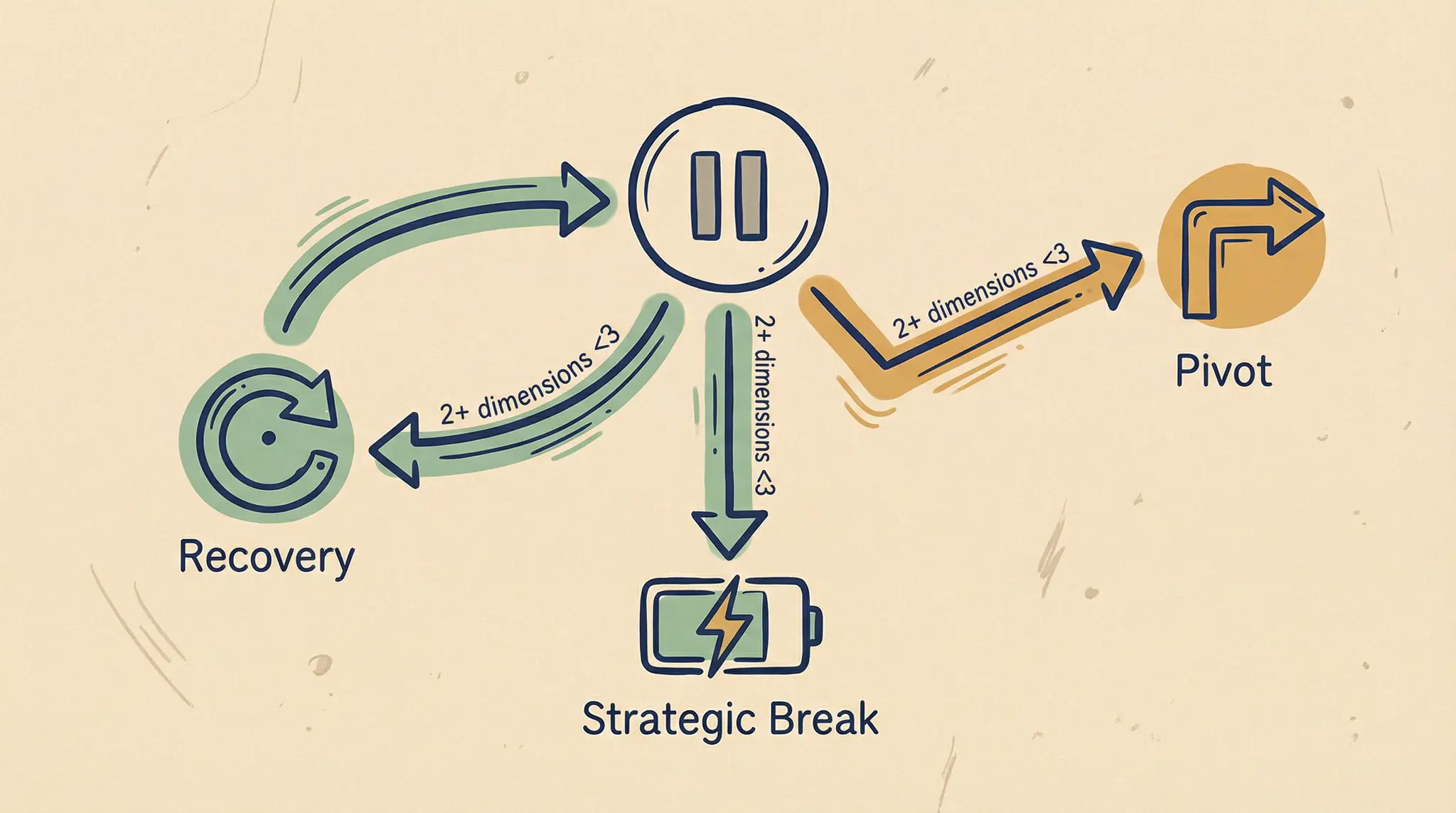
- Recovery mode: Return to previous trajectory with minimal deviation
- Pivot mode: Use disruption as strategic inflection point to change direction
The decision criteria? Your LA4P scores before the interruption.
The LA4P Recalibration Protocol
When you return from a career break, your old ratings may no longer be valid references. Here's the systematic framework Sarah used:
Step 1: Reconstruct Your Pre-Break Baseline
Pull out a notebook and rate your last role across all six dimensions as they actually were, not how you remember them through the fog of time:
Pre-Break Scores Last role reality | During-Break Reality Caregiving period | |
|---|---|---|
| Learning | 5 (building frameworks, C-suite exposure) | 2 (skills atrophying, industry moving forward) |
| Alignment | 4 (owned project direction, some bureaucracy) | 5 (total control of schedule and decisions) |
| Prestige | 5 (respected company, visible work) | 1 (felt invisible, "just a caregiver") |
| Pace | 3 (sustainable but demanding) | 1 (no income, high stress) |
| People | 4 (strong team, occasional difficult stakeholders) | 2 (isolated from professional network) |
| Profit | 5 (competitive salary, clear advancement path) | 1 (savings depleting) |
This is where Sarah's confidence collapsed. She saw the during-break scores and assumed her career capital had dropped to match. But that's not how it works.
Step 2: Separate Perceived vs Actual Career Capital Loss
Chapter's assessment tracks these six dimensions over time, showing which scores dropped during your break vs which stayed strong. Here's what Sarah discovered:
Actual Career Capital What employers see | Perceived Career Capital What Sarah felt | |
|---|---|---|
| Learning | 4 (slight skill rust, but 3 years of strategic frameworks don't evaporate) | 1-2 (imposter syndrome) |
| Alignment | 4 (decision-making ability didn't disappear) | 1-2 (felt powerless) |
| Prestige | 4 (previous company reputation still carries weight) | 2 ("I'm damaged goods") |
| Pace | 3 (can return to previous workload) | 1-2 (anxiety about keeping up) |
| People | 3 (network dormant but recoverable) | 1-2 (comparison to peers who didn't stop) |
| Profit | 4 (market rate for experience level unchanged) | 1-2 (fear of pay cut) |
The gap between perceived and actual is where most returners get stuck. Sarah's Prestige anxiety spiked to 2 ("I'm damaged goods"), but her actual Learning and Profit potential hadn't changed. The LA4P framework helps you see this distinction clearly.
Step 3: Apply the Recovery vs Pivot Decision Matrix
Choose RECOVERY MODE if:
- 4+ dimensions scored 4+ before the break
- Break duration under 18 months
- Industry is stable or growing
- You were satisfied with the trajectory before interruption
- Gap was Type 1 (strategic) or Type 3 (involuntary but industry-stable)
Choose PIVOT MODE if:
- 2+ dimensions scored below 3 before the break
- Break duration over 24 months
- Industry is disrupted or declining
- You were already considering a change before interruption
- Gap was Type 4 (burnout) or Type 2 with major life structure changes
Five dimensions were 4+, break was 16 months, healthcare tech was growing, and I had been thriving before the caregiving need arose. The interruption was circumstantial, not a signal that my path was wrong.
Sarah McCarthy
Program Manager
Sarah's Decision: Recovery mode. The data was clear.
Step 4: Build Your Recovery or Pivot Strategy
Recovery Mode Strategy:
Recovery Mode: 4-Month Return Plan
4 steps to complete
Network Reactivation (Months 1-2)
Rebuild professional connections and signal your return to the market.
Skill Refresh (Months 1-3)
Close the knowledge gap and demonstrate current capability.
Interview Preparation (Months 2-3)
Develop confident responses and target break-friendly companies.
Target Similar Roles (Months 2-4)
Apply strategically to positions matching your pre-break trajectory.
Pivot Mode Strategy:
Pivot Mode: 6-Month Transition Plan
4 steps to complete
Dimension Diagnosis (Month 1)
Identify which dimensions were failing and where they could improve.
Adjacent Exploration (Months 1-3)
Test new directions before committing fully.
Skill Bridge Building (Months 2-4)
Build credibility in your new direction.
Strategic Positioning (Months 3-6)
Position yourself as a unique candidate with fresh perspective.
For more on career pivots, see our guide on how to plan your career pivot.
The Three-Sentence Gap Response Formula
When interviewers ask about your gap, they're really asking: "Are you still capable? Are you committed? Are you current?"
Here's the formula Sarah developed, adapted for each interruption type:
Sentence 1: Name it directly (no euphemisms) Sentence 2: Show maintained capability with specific example Sentence 3: Connect to forward momentum
Type 1: Strategic Break
I took a 12-month sabbatical to complete my MBA and travel through Southeast Asia studying supply chain operations. I maintained my technical skills by consulting for two startups remotely, helping them optimize their logistics frameworks. I am energized to bring both my refreshed strategic thinking and hands-on operational experience to high-impact work.
Type 2: Caregiving
I took 16 months for full-time caregiving during my father's Alzheimer's progression. I maintained my strategic thinking by redesigning his care coordination system, which involved managing five specialists, insurance negotiations, and complex scheduling--essentially program management under extreme constraints. I am ready to bring that experience plus caregiving-honed skills in stakeholder coordination and crisis management to challenging projects.
Type 3: Layoff
I was part of the 30% workforce reduction when [Company] shut down our division in March 2024. During my search, I have been consulting with two former clients on their digital transformation projects and completed certifications in [relevant skills]. I am targeting roles where I can apply my [X years] of experience in [domain] to companies in growth mode.
Type 4: Burnout/Health
I took six months to recover from burnout after three years of 70-hour weeks. During that time, I rebuilt my approach to sustainable performance--I completed a project management certification, volunteered with [organization], and clarified what kind of work environment lets me do my best work. I am specifically looking for roles with [Pace/People dimension improvements] where I can contribute long-term.
What NOT to say:
- Don't apologize: "I'm sorry about the gap, but..."
- Don't over-explain: "Well, first my father got sick, and then the insurance wouldn't cover..."
- Don't deflect: "I was exploring options" (vague and defensive)
- Don't emphasize loss: "I'm trying to get back to where I was"
Practice until it feels natural. Sarah rehearsed her response 30 times before her first interview. By interview five, she delivered it with confidence, and the conversation moved on.
Sarah's Outcome: Recovery Mode in Action
Sarah followed the recovery protocol:
Month 1-2: Reactivated her network. Reached out to 15 former colleagues, attended three healthcare tech conferences, updated LinkedIn with "Open to program management opportunities in healthcare technology."
Month 2-3: Refreshed skills. Completed two Coursera courses on agile methodology updates, rebuilt her portfolio site with case studies from her pre-break work, joined Healthcare IT Leaders Slack community.
Month 3: Started interviewing. Used her three-sentence gap response in eight interviews. Six moved to second rounds.
Month 4: Received three offers. Chose a senior program manager role at a health tech company (one level below her pre-break position, but with clear 12-month path to director).
Pre-Break Scores
- •Learning: 5 (building frameworks)
- •Alignment: 4 (project ownership)
- •Prestige: 5 (respected company)
- •Pace: 3 (sustainable)
- •People: 4 (strong team)
- •Profit: 5 (competitive salary)
New Role Scores
- •Learning: 5 (new product area, emerging tech)
- •Alignment: 4 (similar to before)
- •Prestige: 4 (growing company, meaningful work)
- •Pace: 4 (negotiated flexible schedule)
- •People: 5 (manager values caregiving experience)
- •Profit: 4 (started at 92% of pre-break salary)
18 months later: Promoted to director. Salary exceeded pre-break level. Prestige anxiety gone.
The Harvard research was right—but only because Sarah had a systematic framework for recovery. Without it, she might have accepted the first offer out of desperation, or talked herself into a pivot she didn't actually want.
When Pivot Mode Is the Right Choice
Not everyone should return to their previous path. Consider Marcus, a corporate lawyer who took eight months off for anxiety and depression recovery:
Pre-Break Scores (Corporate Law)
- •Learning: 3 (repetitive work)
- •Alignment: 2 (client-driven schedule)
- •Prestige: 5 (top firm)
- •Pace: 1 (80-hour weeks)
- •People: 2 (toxic culture)
- •Profit: 5 (high compensation)
Post-Pivot Scores (Legal Tech PM)
- •Learning: 5 (new industry, building products)
- •Alignment: 4 (product ownership)
- •Prestige: 3 (startup, less external validation)
- •Pace: 4 (sustainable 45-hour weeks)
- •People: 5 (collaborative culture)
- •Profit: 3 initially, 4 within two years
Marcus's Realization: Three dimensions were below 3 before the break. The burnout wasn't circumstantial—it was structural. Recovery mode would put him right back into the conditions that broke him.
Pivot Strategy: Used his legal background to transition into legal tech product management. Accepted a 35% pay cut initially, but gained sustainable work conditions and career satisfaction.
Marcus's break wasn't just a pause—it was a signal that his chapter needed a complete rewrite. The interruption gave him permission to make a change he'd been avoiding.
Track Your Career Dimensions Before and After Interruptions
Use our interactive LA4P tracker to monitor your six dimensions over time and make data-driven recovery decisions.
Your Interruption Recovery Tracker
Whether you're currently in a break, planning one, or recently returned, use this tracker to monitor your dimensions over time:
6-Week Recovery Tracker
Rate your dimensions weekly to distinguish patterns from noise
💡How to Use This Tool
| Dimension | Pre-Break Baseline | During Break | Week 1 Back | Week 4 Back | Week 8 Back | Week 12 Back |
|---|---|---|---|---|---|---|
| Learning | 1 2 3 4 5 | 1 2 3 4 5 | 1 2 3 4 5 | 1 2 3 4 5 | 1 2 3 4 5 | 1 2 3 4 5 |
| Alignment | 1 2 3 4 5 | 1 2 3 4 5 | 1 2 3 4 5 | 1 2 3 4 5 | 1 2 3 4 5 | 1 2 3 4 5 |
| Prestige | 1 2 3 4 5 | 1 2 3 4 5 | 1 2 3 4 5 | 1 2 3 4 5 | 1 2 3 4 5 | 1 2 3 4 5 |
| Pace | 1 2 3 4 5 | 1 2 3 4 5 | 1 2 3 4 5 | 1 2 3 4 5 | 1 2 3 4 5 | 1 2 3 4 5 |
| People | 1 2 3 4 5 | 1 2 3 4 5 | 1 2 3 4 5 | 1 2 3 4 5 | 1 2 3 4 5 | 1 2 3 4 5 |
| Profit | 1 2 3 4 5 | 1 2 3 4 5 | 1 2 3 4 5 | 1 2 3 4 5 | 1 2 3 4 5 | 1 2 3 4 5 |
Pattern Recognition | ||||||
What dimensions are consistently low (1-2)?________ | ||||||
What patterns do you notice?________ | ||||||
What one dimension would you change in your next role?________ | ||||||
📊 Track your dimensions
Spot patterns over 4-6 weeks
Use the Interactive Tracker →💡 Remember: Track for 4-6 weeks after returning to distinguish recovery patterns from adjustment anxiety
Use the Interactive Tracker →Compare Recovery vs Pivot Options Side-by-Side
Use our comparison worksheet to evaluate whether to return to your previous path or pivot to a new direction.
Your Recovery vs Pivot Decision Template
RECOVERY VS PIVOT DECISION TEMPLATE
Compare your options after a career interruption
| Dimension | Recovery Mode (Return to Previous Path) | Pivot Mode (New Direction) |
|---|---|---|
Pre-Break LA4P Scores | ||
| Learning | 1 2 3 4 5 | 1 2 3 4 5 |
| Alignment | 1 2 3 4 5 | 1 2 3 4 5 |
| Prestige | 1 2 3 4 5 | 1 2 3 4 5 |
| Pace | 1 2 3 4 5 | 1 2 3 4 5 |
| People | 1 2 3 4 5 | 1 2 3 4 5 |
| Profit | 1 2 3 4 5 | 1 2 3 4 5 |
| TOTAL | ||
Projected LA4P Scores (New Role) | ||
| Learning | 1 2 3 4 5 | 1 2 3 4 5 |
| Alignment | 1 2 3 4 5 | 1 2 3 4 5 |
| Prestige | 1 2 3 4 5 | 1 2 3 4 5 |
| Pace | 1 2 3 4 5 | 1 2 3 4 5 |
| People | 1 2 3 4 5 | 1 2 3 4 5 |
| Profit | 1 2 3 4 5 | 1 2 3 4 5 |
| TOTAL | ||
Recovery Feasibility | ||
| Break duration | e.g., 16 months | e.g., 16 months |
| Industry status | Growing/Stable/Declining | Growing/Stable/Declining |
| Network strength | Strong/Moderate/Weak | Strong/Moderate/Weak |
| Skill gap | Small/Medium/Large | Small/Medium/Large |
Decision Criteria | ||
Final Decision | ||
| Mode chosen | Recovery/Pivot | Recovery/Pivot |
Why this path ________ | ||
First 3 actions ________ | ||
✨ Ready to make your decision?
Use our interactive calculator to save and compare your options
Use Our Interactive Decision Tool →💡 Remember: If 4+ dimensions were 4+ before break and industry is stable, recovery mode is usually the right choice. If 2+ dimensions were below 3, consider pivot mode.
Use Our Interactive Decision Tool →Your Interruption Recovery Checklist
Whether you're currently in a break, planning one, or recently returned, use this checklist:
Before the Break (if planned):
- Document your current LA4P scores
- Save 6-12 months financial runway
- Notify key network contacts of timeline
- Set specific break objectives
- Create skill maintenance plan
During the Break:
- Maintain minimum network contact (1-2 people per month)
- Track any skills you're building (even non-professional)
- Monitor industry changes via newsletters/podcasts
- Document any project management, coordination, or problem-solving you're doing
- Set return timeline 3 months before financial deadline
Returning from Break:
- Reconstruct pre-break LA4P baseline
- Identify your interruption type
- Separate perceived vs actual career capital loss
- Choose recovery vs pivot mode using decision matrix
- Build appropriate strategy (recovery or pivot)
- Develop three-sentence gap response
- Reactivate network systematically
- Refresh 2-3 key skills
- Target 10-15 appropriate roles
- Track new LA4P scores in first 90 days of return
The Real Resilience
Sarah's story isn't about bouncing back. It's about having a framework that turns uncertainty into decisions.
The question "What were you doing during this time?" still stings. But when you can answer it with data-backed confidence—when you know whether to recover or pivot, when you can articulate what you maintained and what you're building—the sting becomes manageable.
Your 40-year career will get interrupted. The question is whether you have a system for navigating those interruptions, or whether you're making decisions based on fear and comparison.
The LA4P Recalibration Protocol gives you that system. Chapter gives you the longitudinal data to make it work.
Start tracking your dimensions now, before the interruption comes. Because it will come. And when it does, you'll want more than platitudes about non-linear paths.
You'll want a framework.
Sources & Further Reading
-
Career Transitions: A Step-by-step Framework - Every.to Practical framework for navigating career transitions with structured decision-making approaches.
-
How to Plan Your Career Pivot: a Guide for Millennials and Gen Z - Medium Strategic guidance on planning intentional career pivots with emphasis on skill transferability.
Apply this guide
Use this guide to refine your 1–5 scores.
Review your existing chapters in 40yearscareer and adjust each axis based on what you just read. You’ll see patterns that were invisible before.
Free while we're in beta. No inbox clutter, no selling your data.