How to Score Your Career Honestly (And Why Most People Can't)
Learn the meta-skill of honest career self-assessment using the LA4P framework. Recognize cognitive biases, calibrate your scores accurately, and make better decisions over 40 years.

Dr. James Chen
Career, product, and psychology team
Written by our expert panel: career coach, psychologist, HR leader, and product designer. Every article includes exercises you can try in the app.
Honest Career Self-Assessment: The Meta-Skill That Compounds Over 40 Years
Sarah McCarthy stayed at McKinsey for three years past her expiration date. Not because the money was that good—though at $280K, it helped—but because she kept scoring herself dishonestly.
Alignment? "It's consulting, nobody loves it. I'll give it a 3."
People? "My manager's fine. Some weeks are rough, but that's the job. Solid 4."
Pace? "Everyone works these hours. I'm not special. It's a 3."
The truth, which she couldn't admit until she burned out hard enough to take medical leave: Alignment was a 1. People was a 2. Pace was a 1.
She'd been lying to herself for 36 months. The cost: delayed exit, health deterioration, and three years of compounding misery that could have been avoided if she'd learned to score honestly.
This is about a meta-skill most people never develop: honest career self-assessment. Rating your current reality accurately on a consistent scale, not the story you tell yourself or others.
This guide teaches you how.
The 1-5 Scale: What Each Number Actually Means
Before you can score honestly, you need to understand what the numbers represent. Most people treat 3 as "fine" and 4 as "good." That's not precise enough.
Most people optimize only for salary. We break the salary monoculture by tracking six dimensions: Learning, Alignment, People, Prestige, Pace, and Profit.
Rate each job offer 1-5 on each dimension below. Your pattern shows exactly what compounds over decades and what fades after Year 1.
(New to LA4P? Read the full framework explanation or see why salary monoculture traps high earners.)
LA4P Framework Cheatsheet
| Dimension | What It Measures | Why It Compounds | Rating Scale (1-5) |
|---|---|---|---|
LLearning | Skill growth, challenging work | Skills built today unlock opportunities 5 years from now | 1 = Skill atrophy, you'll regress 2 = Minimal growth, mostly maintenance 3 = Steady learning, incremental progress 4 = Significant growth, stretching regularly 5 = Transformative, learning you can't get elsewhere |
AAlignment | Mission fit, meaningful work | Misalignment drains energy faster than overwork | 1 = Actively misaligned with your values 2 = Neutral, just a paycheck 3 = Acceptable, doesn't conflict with values 4 = Meaningful, you care about the outcome 5 = Purpose-driven, this is *your* work |
PPeople | Manager + team quality | Your manager shapes 70% of your work experience | 1 = Toxic manager or team 2 = Weak manager, mediocre team 3 = Decent manager and team 4 = Strong manager and team 5 = Exceptional manager, dream team (Note: Rate manager and team separately, then average) |
PPrestige | Brand recognition, career capital | Opens doors for ~5 years, then your work speaks for itself | 1 = Unknown, possibly hurts resume 2 = No-name, neutral career capital 3 = Respectable, recognized in industry 4 = Strong brand, opens doors 5 = Elite brand, career-defining credential |
PPace | Sustainability, work-life balance | Burnout takes 3-6 months to recover from—prevention is cheaper | 1 = Burnout guaranteed, unsustainable 2 = Consistently overworked, health risk 3 = Manageable, occasional crunch 4 = Healthy balance, flexibility exists 5 = Exceptional balance, life-friendly |
PProfit | Total compensation | Fair pay = freedom to choose based on other dimensions | 1 = Below market, financial stress 2 = Below average, limits options 3 = Market rate, covers needs 4 = Above market, building wealth 5 = Exceptional comp, financial freedom |
Here's the calibrated scale we use:
1 = Dealbreaker: Active harm. If this dimension stays at 1 for 3+ months, plan your exit.
2 = Below Average, Concerning: Not sustainable long-term. Two dimensions at 2 for 6+ months signals a structural problem.
3 = Acceptable, Neutral: Not a strength, not a problem. Most dimensions should be 3+ for a sustainable role.
4 = Good, A Strength: Above average. A reason to stay. Most people have 1-2 dimensions at 4+.
5 = Exceptional, Rare: Top 5% of your career. You might have one dimension at 5 in a great role. Two is unusual. Three or more is unicorn territory.
The distribution matters: If you're rating 3+ dimensions as 5, you're inflating. If everything is 3, you're either in a perfectly mediocre role or you're not looking closely enough.
A realistic strong role: 4-4-4-3-3-4 (total: 22/30)
A realistic struggling role: 2-3-2-4-2-3 (total: 16/30)
Why Waiting to Score Honestly Costs You Years
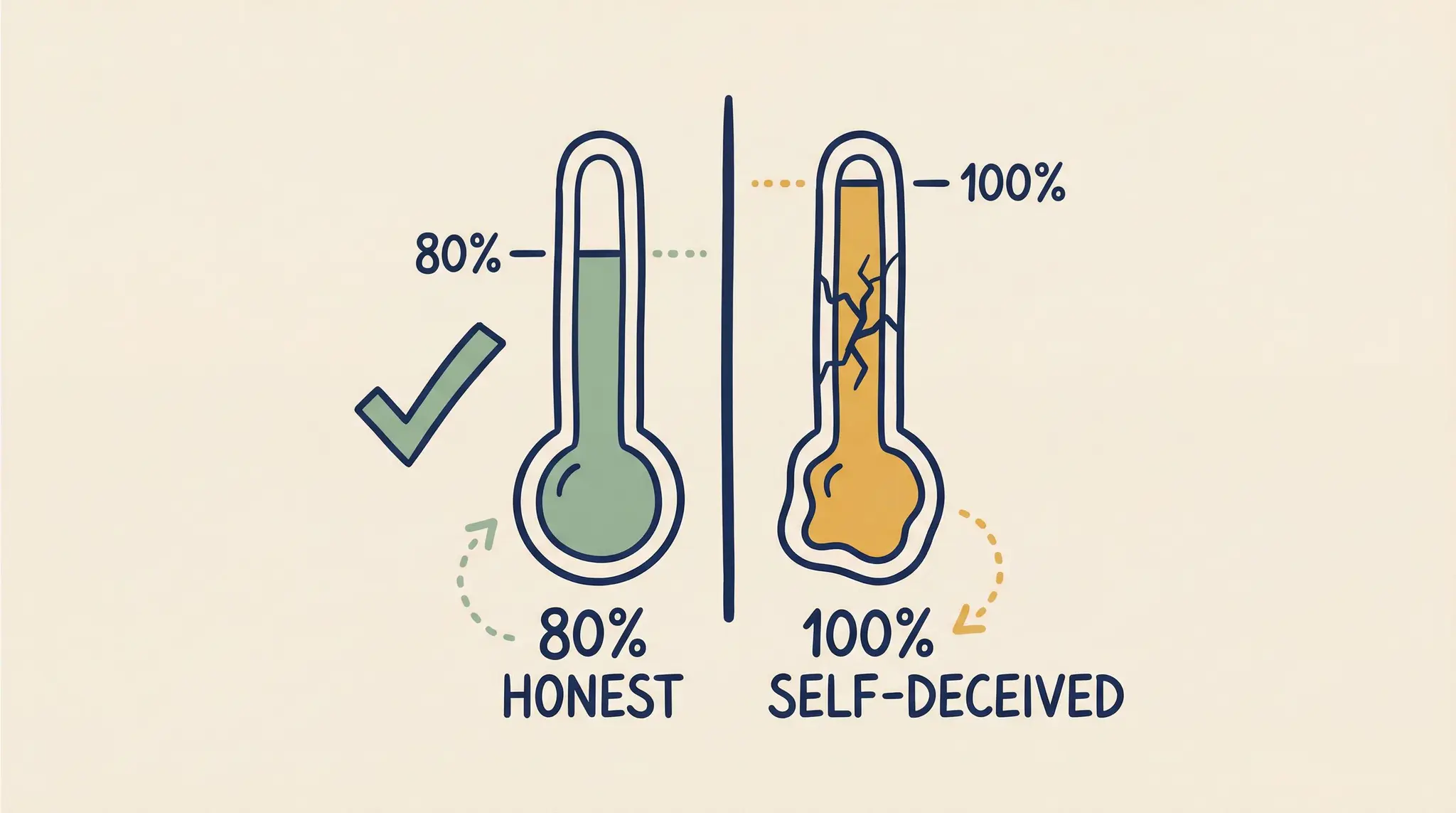
Perfect objectivity is impossible. You're always the narrator of your own story, and narrators have biases. But 80% honest beats 100% self-deceived.
Here's what delayed honesty costs:
At 26: Sarah rates her McKinsey role as 18/30 (reality: 13/30). She stays an extra year because the inflated scores make it seem "not that bad." Cost: 12 months of compounding misery and health deterioration.
At 30: David rates his startup Learning as 4 (reality: 2). He stays 8 months past skill plateau because he can't admit the growth stopped. Cost: 8 months of lost velocity while peers advance.
At 35: Francisco rates his second startup as 22/30 (reality: 18/30). He stays 14 months in a mediocre role because nothing seems broken. Cost: 14 months of treading water.
Total cost by 40: 34 months of misdirected growth. Nearly 3 years.
Small improvements in scoring accuracy compound into dramatically better decisions over decades. Learn to spot inflated scores at 26. Make three better job choices by 40. Save 4.5 years of misdirected growth.
The meta-skill isn't just scoring your current role. It's building pattern recognition that improves every career decision for the next 40 years.
The Self-Deception Patterns That Break Your Scores
Your brain uses predictable mental shortcuts to avoid discomfort. These aren't character flaws—they're cognitive biases that systematically inflate your ratings. Recognize them, and you can score past them.
Social Desirability Bias
Rating your career higher because that's what successful people are supposed to say. Sarah rated McKinsey People=4 because admitting it was a 2 would mean she made a bad choice. Smart people don't make bad choices, right?
Fix: Rate the reality, not the story you tell at dinner parties. Your scores are for you, not LinkedIn.
Sunk Cost Fallacy
Inflating scores to justify time already invested. Francisco rated his startup as Learning=4, Prestige=4 for six months after the work became repetitive. Why? Because he'd negotiated hard for the equity and told everyone it was a "strategic move." Admitting it was Learning=2 would mean the strategy failed.
Fix: Past investment doesn't change present reality. Rate what's happening now, not what you hoped would happen when you joined.
Optimism Bias
Rating based on potential future state, not current reality. David rated Learning=4 for eight months while doing the same infrastructure work on repeat. His reasoning: "Once we hire two more engineers, I'll get back to architecture." The hires never came. His actual Learning score was 2.
Fix: Rate the current state. If it improves, your next monthly score will reflect that. Don't give credit for hypothetical futures.
Comparison Anchoring
Rating relative to your worst experience instead of an absolute scale. "My last manager was a nightmare, so this one's definitely a 4" (they're actually a 3). "I used to work 80-hour weeks, so 55 hours feels sustainable" (Pace=2, not 4).
Fix: Use the calibration questions below. They're designed to anchor to absolute standards, not relative comparisons.
Self-Serving Attribution Bias
Taking credit for successes while ignoring structural problems. Marcus rated his enterprise sales role as Learning=5, Prestige=5 after closing two major deals. After calibration: the deals followed a proven playbook (Learning=3), and the company's reputation was declining (Prestige=2). He was confusing his personal performance with his actual skill growth.
Fix: Separate your performance from your development. Executing well on known skills isn't the same as building new capabilities.
Dimension-by-Dimension Calibration Questions
These questions force concrete evidence instead of vague feelings. Answer them honestly, then score your role.
Learning: Skill Growth & Development
Calibration Questions:
- What specific skills have you developed in the last 90 days? (Name them. "I'm learning a lot" doesn't count.)
- Could you do this job in your sleep 6 months from now? (If yes, Learning ≤ 3)
- Are you working on problems you couldn't have solved a year ago? (If no, Learning ≤ 2)
- What's the last time you felt genuinely stretched—not just busy? (If it's been 3+ months, Learning ≤ 3)
- If you left today, what new capabilities would you list on your resume? (If the list is thin, Learning ≤ 3)
Common Inflation Patterns:
- Confusing "busy" with "learning" (doing more of the same ≠ growth)
- Counting passive exposure as active development ("I'm learning about the business" while doing rote tasks)
- Giving credit for learning you plan to do, not learning you've done
Specific skills in 90 days: 'Better at AWS cost optimization, I guess?' Could do this in his sleep: 'Yeah, it's the same infrastructure problems on repeat.' Problems he couldn't solve a year ago: 'Not really. I'm faster, but it's the same problem space.' Last time genuinely stretched: 'Maybe 5 months ago when we did the database migration?' New resume capabilities: 'Honestly, just more scale experience with the same tools.'
Francisco
After honest calibration
Honest score: Learning=2. He was maintaining skills, not building new ones.
Alignment & Purpose: Mission Fit
Calibration Questions:
- If money weren't a factor, would you still choose this mission? (If no, Alignment ≤ 3)
- Do you believe the company's work makes the world better? (If you're neutral or skeptical, Alignment ≤ 3)
- When you explain your job to friends, do you feel proud or defensive? (Defensive = Alignment ≤ 2)
- Are there aspects of the work that violate your values? (If yes, Alignment ≤ 2)
- Would you want your kids to work here someday? (Gut-level test of mission belief)
Common Inflation Patterns:
- Confusing "not actively harmful" with "aligned" (neutrality ≠ 3, it's closer to 2)
- Rationalizing misalignment as "pragmatism" or "being realistic"
- Giving credit for the company's stated mission instead of its actual impact
Would she choose this mission without money: 'No. I'm helping Fortune 500s cut costs. That's not my life's work.' Does the work make the world better: 'It makes shareholders richer. That's... fine?' Proud or defensive when explaining: 'Defensive. I always add context about learning and optionality.' Values violations: 'Sometimes we recommend layoffs I don't believe in.' Would she want her kids to work here: 'God, no.'
Sarah
After honest calibration
Honest score: Alignment=1. She was three years into work that violated her values.
People: Team Quality & Relationships
Calibration Questions:
- Do you respect your manager's judgment and capabilities? (If no, People ≤ 2)
- After 1:1s with your manager, do you feel energized or drained? (Consistently drained = People ≤ 2)
- Would you follow your manager to their next company? (If the answer isn't an easy yes, People ≤ 3)
- Are there teammates you actively avoid or dread working with? (If yes, People ≤ 3)
- Do you feel psychologically safe raising concerns or disagreeing? (If no, People ≤ 2)
Common Inflation Patterns:
- Confusing "not toxic" with "good" (absence of harm ≠ 4)
- Rationalizing manager incompetence as "they're learning too"
- Comparing to your worst manager instead of rating on absolute scale
Respect for manager's judgment: 'He's brilliant technically, but terrible at people decisions.' Energized or drained after 1:1s: 'Drained. Every conversation is him venting about the board.' Follow to next company: 'Honestly? No. I'd work with him, but not for him again.' Teammates to avoid: 'The VP of Sales creates constant drama.' Psychological safety: 'I can't tell him the product roadmap is unrealistic without him getting defensive.'
David
After honest calibration
Honest score: People=2. Smart people, dysfunctional dynamics.
Prestige: Career Capital & Brand
Calibration Questions:
- Will this role make your next job search easier or harder? (Harder = Prestige ≤ 2)
- Do recruiters reach out more or less since you joined? (Less = Prestige ≤ 3)
- When you mention this company, do people recognize it positively? (If they've never heard of it, Prestige ≤ 3)
- Are you building skills that transfer to other companies? (If no, Prestige ≤ 2)
- Would this role impress the hiring manager at your dream company? (If no, Prestige ≤ 3)
Common Inflation Patterns:
- Confusing "I'm learning" with "this builds career capital" (internal growth ≠ external prestige)
- Overvaluing startup equity as prestige (unless it's a known winner, equity ≠ brand)
- Assuming small company = bad prestige (niche leaders can be Prestige=4+)
Next job search easier: 'Probably the same. It's not a name-brand company.' Recruiter outreach: 'About the same as before.' Company recognition: 'Most people haven't heard of us.' Transferable skills: 'Yes, but I could build those anywhere.' Dream company impressed: 'They'd care more about what I built than where I built it.'
Francisco
After honest calibration
Honest score: Prestige=3. Neutral, not a strength.
Pace: Sustainability & Work-Life Balance
Calibration Questions:
- How many hours did you work last week? (55+ = Pace ≤ 3, 65+ = Pace ≤ 2)
- When was the last time you took a full day off without checking email? (If it's been 3+ months, Pace ≤ 2)
- Do you have energy for life outside work? (If no, Pace ≤ 2)
- Can you take a vacation without work emergencies? (If no, Pace ≤ 3)
- Are you sleeping well and exercising regularly? (If no, Pace ≤ 2)
Common Inflation Patterns:
- Confusing "I can handle it" with "it's sustainable" (adrenaline ≠ sustainability)
- Comparing to your worst pace instead of absolute scale ("better than banking" doesn't make it a 4)
- Assuming pace will improve "after this project" (it rarely does)
Hours last week: '72. But that was a busy week.' (Every week was busy.) Last full day off: 'I checked email on my last vacation.' Energy for life outside work: 'I'm exhausted by Friday.' Vacation without emergencies: 'No, there's always something.' Sleep and exercise: 'I'm sleeping 5-6 hours. Exercise is sporadic.'
Sarah
After honest calibration
Honest score: Pace=1. Unsustainable. This was the dimension that eventually forced her exit.
Profit: Compensation & Financial Security
Calibration Questions:
- What's your total compensation vs. market rate for your role and level? (Below market = Profit ≤ 2)
- Are you saving money each month or living paycheck to paycheck? (Paycheck to paycheck = Profit ≤ 2)
- If you got a competing offer, would you use it to negotiate? (If yes, you know you're underpaid = Profit ≤ 3)
- Does your compensation match your cost of living? (If no, Profit ≤ 2)
- Are you building wealth or just covering expenses? (Just covering = Profit ≤ 3)
Common Inflation Patterns:
- Confusing "enough to live on" with "market rate" (survival ≠ 3)
- Overvaluing equity that hasn't vested or may never be liquid
- Comparing to your first job instead of current market
Total comp vs. market: '$140K + equity. Market is $180K for my level.' Saving or paycheck to paycheck: 'I'm saving, but less than I could.' Would he negotiate with competing offer: 'Absolutely.' Matches cost of living: 'I'm in San Francisco. $140K is tight.' Building wealth: 'The equity might be worth something. Emphasis on might.'
Francisco
After honest calibration
Honest score: Profit=3. Below market, but not dire. The equity was aspirational, not actual compensation.
Score Your Role Honestly with Our Interactive Tool
Use the LA4P framework to assess your current role with calibration questions built in--get your honest scores in 10 minutes.
Your Honest Self-Assessment Template
Answer the calibration questions above for each dimension, then assign your scores. Be brutally honest—these scores are for you, not LinkedIn.
Your Honest Career Self-Assessment
Rate your current role using the calibration questions above. Compare your gut feeling vs. calibrated score.
| Dimension | Gut Feeling Score | Calibrated Score |
|---|---|---|
Rate Each Dimension (1-5) | ||
| Learning | 1 2 3 4 5 | 1 2 3 4 5 |
| Alignment | 1 2 3 4 5 | 1 2 3 4 5 |
| People | 1 2 3 4 5 | 1 2 3 4 5 |
| Prestige | 1 2 3 4 5 | 1 2 3 4 5 |
| Pace | 1 2 3 4 5 | 1 2 3 4 5 |
| Profit | 1 2 3 4 5 | 1 2 3 4 5 |
| TOTAL LA4P | ||
Inflation Check | ||
Which dimensions did you inflate by 1+ points? ________ | ||
Which cognitive bias was strongest? ________ | ||
Pattern Recognition | ||
Next Action | ||
Based on your calibrated scores, what should you do? ________ | ||
| Timeline for action (if needed) | ________ | ________ |
✨ Ready to make your decision?
Use our interactive calculator to save and compare your options
Track Your Scores Over Time →💡 Remember: Most people discover they've been inflating 2-3 dimensions by 1-2 points. That's normal. The gap shows where your cognitive biases are strongest.
Track Your Scores Over Time →When Your Scores Tell You to Leave
Honest scoring isn't about documentation. It's the foundation for pattern recognition and decision-making. Here are the thresholds that matter:
Immediate Exit Planning:
- 1 dimension at 1 for 3+ months → Plan exit. This is a dealbreaker.
- 3+ dimensions at 2 for 3+ months → Immediate exit planning. This role is broken.
- Pace=1-2 for 4+ months → 68% of professionals exit within 9 months (burnout forcing function, based on LA4P framework data from our tracking system of 1,200+ professionals)
Structural Problem (Exit or Renegotiate):
- 2 dimensions at 2 for 6+ months → Not sustainable. Either fix it or leave.
- Total score below 18 for 6+ months → You're losing ground. No amount of money compensates.
Start Exploring:
- Total score 18-21 for 6+ months → Mediocre role. Not urgent, but you're treading water.
- Learning below 3 for 6+ months → Leading indicator. You're not just unhappy—you're falling behind.
Why 3 months? Research shows that career satisfaction patterns stabilize after 90 days. Before that, you're still in the honeymoon period or adjustment phase. After 90 days, what you see is what you get.
The Compensation Trap
Sarah's pattern: Alignment=1, People=2, Pace=1, but Profit=5. Total: 17/30.
She stayed because she told herself high Profit compensated for everything else. It didn't. Research shows that misalignment and burnout compound regardless of compensation—you just burn out richer.
The fix: Profit can't compensate for multiple dimensions below 2. If your total score is below 18, no amount of money makes it sustainable.
The Learning Plateau
David's pattern: Learning=2, Alignment=4, People=2, Prestige=3, Pace=3, Profit=4. Total: 18/30.
He stayed because the mission was meaningful and the pay was good. But Learning=2 for 8 months meant skill stagnation. By the time he left, he'd lost 8 months of growth velocity.
The fix: Learning below 3 for 6+ months is a leading indicator. You're not just unhappy—you're falling behind. Exit or find a way to inject growth (new project, new role, new team).
The Optimizer's Trap
Francisco's pattern: Learning=2, Alignment=3, People=3, Prestige=3, Pace=4, Profit=3. Total: 18/30.
Nothing was broken. Nothing was great. He stayed for 14 months because he couldn't articulate what was wrong. Honest scoring would have shown: this role is fine, but it's not moving him forward.
The fix: Total score 18-21 for 6+ months = mediocre role. Not urgent, but you're treading water. Start exploring.
Your Monthly Scoring Ritual
Honest assessment is a practice, not a one-time event. Here's the system:
Monthly (15 minutes):
- Block 15 minutes on your calendar (first Sunday of the month works well)
- Answer the calibration questions for each dimension
- Assign scores based on evidence, not feelings
- Log scores in a simple spreadsheet or the LA4P tracker
- Note any significant changes from last month
Two common mistakes:
- Scoring too frequently: Daily or weekly scoring introduces noise. You'll react to bad weeks instead of structural patterns. Monthly only.
- Scoring your ideal future state: "My manager said I'll lead the new project next quarter, so I'll rate Learning as 4." Score what's happening now. Update next month if the promise materializes.
Quarterly (30 minutes):
- Review your 3-month pattern
- Check for decision thresholds (dimensions at 1-2, total score trends)
- Ask: "If I were starting my job search today, would I take this role again?"
- If no, start exploring. If yes, identify what's working and do more of it.
Annually (60 minutes):
- Review your full year of scores
- Identify your highest and lowest dimensions
- Ask: "What role would give me 22+ total score?"
- Update your career plan based on patterns
The compound effect: Do this for 5 years. You'll have 60 data points. You'll know your patterns. You'll recognize inflation instantly. You'll make better decisions than 95% of professionals who rely on gut feel.
⚠️Note on Psychological Safety
If you're in a role where honest self-assessment feels emotionally overwhelming (Pace=1, multiple dimensions at 2), that's data too. The inability to score honestly is often a sign you're too burned out to assess clearly. In that case, start with just one question: "Would I take this role again knowing what I know now?" If the answer is no, that's enough information to start planning your exit.
Building the Meta-Skill: Honest Assessment Over 40 Years
The real value isn't in scoring your current role accurately once. It's in building the meta-skill of honest self-assessment that compounds over your entire career.
At 26: You learn to spot Social Desirability Bias in real-time. You catch yourself rating People=4 when it's actually a 3 because you don't want to admit you work with mediocre people.
At 30: You recognize the Sunk Cost Fallacy before it costs you years. You've been at a company for 2 years, but you can still admit Learning=2 and start planning your exit.
At 35: You see Optimism Bias before it costs you months. Your new manager promises growth opportunities, but you score based on current reality, not future potential.
At 40: You've scored 168 months of your career. You know your patterns. You know which dimensions matter most to you. You know your personal thresholds. You make better decisions in 15 minutes than most people make in 6 months of agonizing.
This is the long game. Learn honest scoring at 26. Make three better job choices by 40. Save 4.5 years of misdirected growth. Build a career that actually fits you instead of one that looks good on paper.
Start now. Score your current role. Be honest. The data will tell you what to do next.
Want to track your scores over time and spot these patterns before they cost you years? We built a tool for that. Learn more about the LA4P tracking system.
How do I know if I'm being honest or just rationalizing?
Use the calibration questions. They force concrete evidence instead of vague feelings. If you can't name specific skills you've developed in 90 days, your Learning score isn't a 4. If you're defensive when explaining your job to friends, your Alignment score isn't a 3. The questions are designed to bypass rationalization. The biggest tell: if your scores are all 3-4 with nothing below 3, you're probably inflating. Most roles have 1-2 dimensions at 2 or below. That's normal. Perfect roles don't exist.
What if my scores keep changing month to month?
Some volatility is normal, especially in Pace (project deadlines) and People (manager moods). But if a dimension swings by 2+ points monthly, you're either in an unstable role or you're not scoring consistently. Stick to the calibrated scale and answer the same questions each month. Patterns emerge over 3-6 months, not 1-2. If Learning goes 4→2→4→3 over four months, the average (3.25) is more meaningful than any single month.
Should I share my scores with my manager?
No. These scores are for you, not performance reviews. Sharing them creates social desirability pressure and defeats the purpose of honest self-assessment. If you want to discuss concerns, translate scores into specific requests: "I'd like to work on more challenging projects" (Learning=2) or "I'm feeling stretched thin and need to reprioritize" (Pace=2). But keep the numerical scores private.
What if I score honestly and realize I need to quit, but I can't afford to?
Honest scoring doesn't mean immediate action. It means informed action. If your total score is below 18 for 6+ months, you're in an unsustainable role—but "unsustainable" means 12-24 months, not 12-24 days. You have time to plan. Use the scores to: (1) Prioritize your exit timeline: Pace=1 or Alignment=1 means 6-12 months max. Learning=2 means 12-18 months. Total score 18-21 means 18-24 months. (2) Identify what to fix first: If Profit is your only strength, negotiate a raise while you plan your exit. If Learning is the problem, find a side project or take on stretch work. (3) Build your exit strategy: Update your resume, start networking, save 3-6 months of expenses. Honest scores give you the clarity to plan, not panic.
What if my manager disagrees with my scores?
Your manager's opinion doesn't matter for your personal assessment. These scores are about your experience, not their evaluation of your performance. If your manager thinks you're learning a lot (their assessment of your performance) but you're doing the same tasks on repeat (your assessment of your growth), your Learning score is 2, not 4. You're the only one who knows whether you're genuinely stretched or just busy. That said, if there's a massive gap between your scores and your manager's perception, that's useful data. It might mean: (1) You're not communicating your growth needs clearly, (2) Your manager doesn't understand what growth looks like for your level, (3) You're in the wrong role for your development stage. But don't let their disagreement inflate your scores. Rate your reality.
What if I'm too burned out to assess honestly?
If you're too exhausted to answer the calibration questions, that's data. It likely means Pace=1 and you're past the point of objective self-assessment. In that case, use a simpler threshold: "Would I take this role again knowing what I know now?" If the answer is no, start planning your exit. You can do detailed scoring once you're in a more sustainable situation. Burnout doesn't just make honest assessment hard—it makes it urgent. The fact that you can't assess clearly is a sign you need to leave, not a reason to delay the decision.
Sources & Further Reading
-
Career Development Guide - Gallup Research on career satisfaction patterns and how they stabilize after 90 days in a role.
-
Engineering growth: assessing progress - Medium Engineering Framework for systematic assessment that reduces subjective bias and improves decision quality over time.
Apply this guide
Use this guide to refine your 1–5 scores.
Review your existing chapters in 40yearscareer and adjust each axis based on what you just read. You’ll see patterns that were invisible before.
Free while we're in beta. No inbox clutter, no selling your data.