Why Your Job Decision Matters Less Than You Think (And What to Optimize Instead)
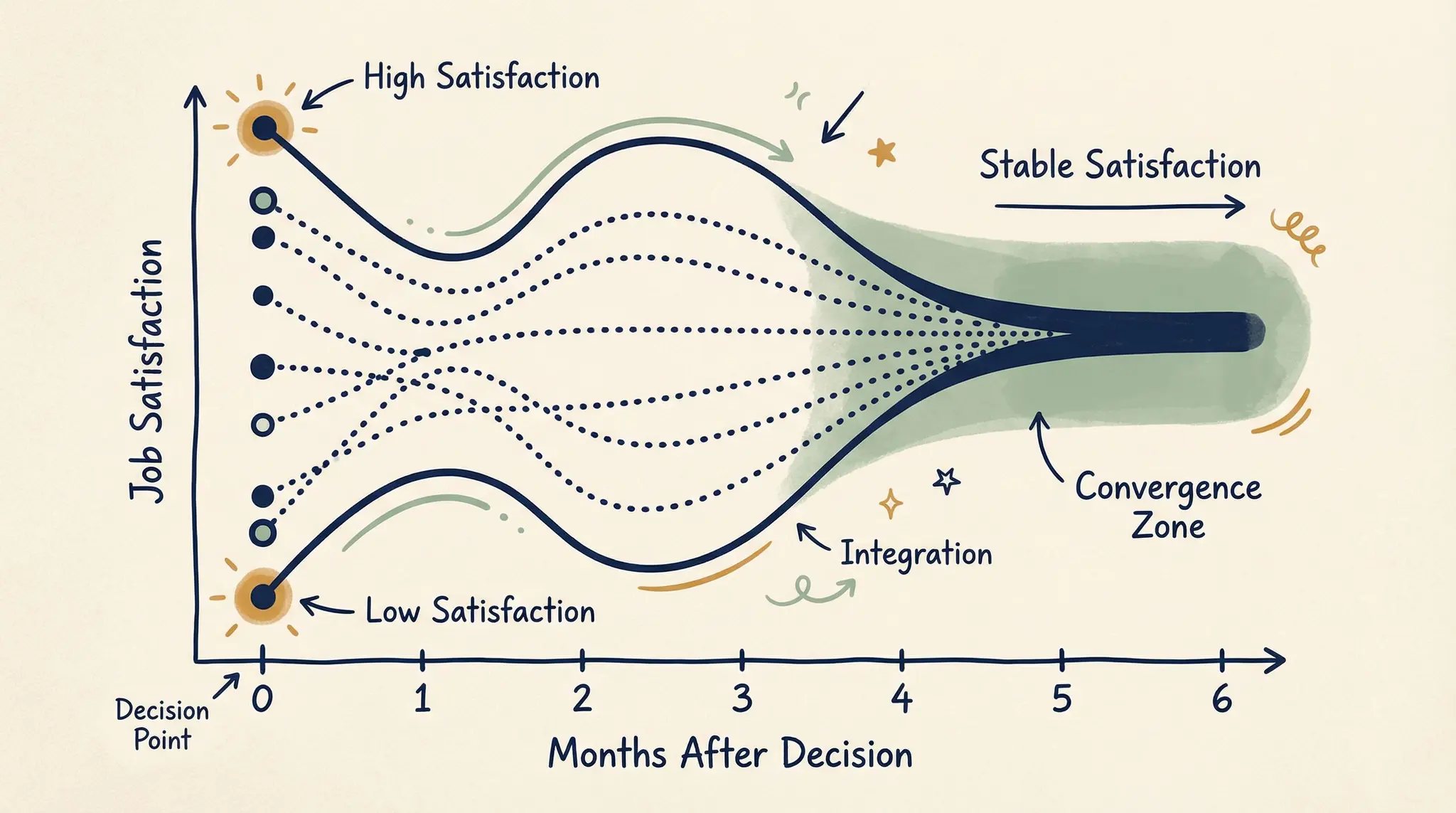
You'll feel roughly the same satisfaction in 6 months regardless of which job you choose. Here's why that's liberating—and what to optimize instead of predicted happiness.

Dr. James Chen
Career Strategy Researcher
Written by our expert panel: career coach, psychologist, HR leader, and product designer. Every article includes exercises you can try in the app.
The decision you're agonizing over matters less than you think—and that's the best news you'll hear today.
Here's why: You'll feel roughly the same satisfaction in 6 months regardless of which job you choose.
This isn't nihilism. It's liberation from the paralysis of trying to predict an unpredictable future. And it points to a better way to make career decisions.
You're Not Bad at Decisions. You're Optimizing for the Wrong Timeframe.
You're trying to predict how you'll feel in month 1 instead of identifying what compounds in year 5.
Daniel Kahneman called this the focusing illusion: "Nothing in life is as important as you think it is while you're thinking about it."
You fixate on the most obvious difference between two offers—usually salary or title—and assume it determines overall satisfaction. You're staring at that 50% pay bump, imagining how it will feel to see the bigger number hit your account. The relief of financial breathing room. The validation of being worth more.
Meanwhile, the factor you barely considered—manager quality, skill trajectory, team dynamics—will define your daily experience for the next two years.
This is the prediction trap. And it's costing you more than you realize.
The Prediction Trap
Francisco, a 15-year veteran engineering leader, spent three weeks agonizing over two VP offers:
Startup A: Higher equity, Learning=5 (cutting-edge ML infrastructure), but Pace=2 (60-hour weeks, always-on culture)
Corporate B: Learning=3 (incremental optimization work), but Pace=4 (sustainable hours) and Profit=5 (30% more cash compensation)
He had the spreadsheet open on his phone at 2am, recalculating equity scenarios for the 47th time. His partner asked what he was doing. He couldn't explain why this decision felt so paralyzing when he'd made harder choices before.
Francisco built elaborate happiness scenarios for each role. All of them were wrong.
Here's what Francisco didn't know: research on hedonic adaptation shows we systematically overestimate how long emotional reactions to life changes will last. The technical term is impact bias—we predict that major events (new job, promotion, pay cut) will affect our happiness more intensely and for longer than they actually do.
The data is striking: 50% of emotional intensity fades within 8 weeks. 80% fades within 6 months. The 60-hour weeks at the startup? You think they'll crush you forever. They won't. The emotional intensity peaks around week 3, then decays rapidly. The corporate work-life balance? Same pattern. The relief feels significant for 8-12 weeks, then becomes the new normal.
But here's the critical nuance: This applies to your emotional reaction to the change itself, not to ongoing job conditions. Job satisfaction is more dynamic than one-time life events like winning the lottery or moving to California (classic hedonic adaptation studies). Unlike those discrete events, your job satisfaction responds to continuous factors—manager quality, skill utilization, team dynamics, career trajectory. You don't just adapt once and return to baseline. You're constantly adapting to evolving conditions.
Important caveat: Pure set-point theory (the idea that we all return to a fixed happiness baseline) has been challenged. Research by Ed Diener shows life circumstances DO matter—but less than we predict, and through different mechanisms. Job satisfaction doesn't return to a fixed baseline; it fluctuates around a range influenced by ongoing conditions. This is why tracking multiple dimensions matters—you're monitoring dynamic patterns, not predicting a static happiness level.
Six months later, Francisco chose the startup. His satisfaction level? 7/10—exactly where he was in his previous corporate role. The Learning=5 he predicted mattered less than expected in the moment. The Pace=2 grind mattered more initially, but he adapted to it by month 4.
But here's what actually compounded: The startup equity vested quarterly, building wealth he couldn't have predicted in week 1. The ML infrastructure work became the foundation for three conference talks. The network access opened doors to advisory roles. The technical depth positioned him for CTO opportunities.
The things that mattered weren't the things he tried to predict.
The paradox: If emotional predictions systematically fail, then optimizing for predicted happiness is just another form of single-variable thinking that ignores what actually compounds over 40 years.
The Salary Difference That Stops Mattering
When comparing job offers, you fixate on the most obvious difference—usually salary or title—and assume it determines overall satisfaction.
You're staring at that 50% pay bump. You imagine how it will feel to see the bigger number hit your account. The relief of financial breathing room. The validation of being worth more. You're convinced this difference will matter for years.
Here's what actually happens: The emotional intensity of the pay bump peaks with the first paycheck. Maybe the second. By month 3, you've mentally adjusted to the new income level. The Profit=5 role and Profit=3 role feel roughly equivalent. The salary difference that dominated your decision-making now feels like background noise.
Meanwhile, the factor you barely considered—manager quality—defines your daily experience. You're comparing Profit=5 vs Profit=3, but you ignored that one role has People=2 (toxic manager who micromanages and takes credit) while the other has People=5 (exceptional mentor who advocates for you and creates growth opportunities).
Six months in, the salary difference feels irrelevant. The manager quality compounds daily. Every 1-on-1. Every project review. Every moment of autonomy or frustration. The thing you didn't focus on becomes the thing that matters.
This is why we break the salary monoculture by tracking six dimensions: Learning (skill growth), Alignment (mission fit), People (team quality), Prestige (career capital), Pace (sustainability), and Profit (compensation). (New to LA4P? Read the full framework explanation.)
LA4P Framework Cheatsheet
| Dimension | What It Measures | Why It Compounds | Rating Scale (1-5) |
|---|---|---|---|
LLearning | Skill growth, challenging work | Skills built today unlock opportunities 5 years from now | 1 = Skill atrophy, you'll regress 2 = Minimal growth, mostly maintenance 3 = Steady learning, incremental progress 4 = Significant growth, stretching regularly 5 = Transformative, learning you can't get elsewhere |
AAlignment | Mission fit, meaningful work | Misalignment drains energy faster than overwork | 1 = Actively misaligned with your values 2 = Neutral, just a paycheck 3 = Acceptable, doesn't conflict with values 4 = Meaningful, you care about the outcome 5 = Purpose-driven, this is *your* work |
PPeople | Manager + team quality | Your manager shapes 70% of your work experience | 1 = Toxic manager or team 2 = Weak manager, mediocre team 3 = Decent manager and team 4 = Strong manager and team 5 = Exceptional manager, dream team (Note: Rate manager and team separately, then average) |
PPrestige | Brand recognition, career capital | Opens doors for ~5 years, then your work speaks for itself | 1 = Unknown, possibly hurts resume 2 = No-name, neutral career capital 3 = Respectable, recognized in industry 4 = Strong brand, opens doors 5 = Elite brand, career-defining credential |
PPace | Sustainability, work-life balance | Burnout takes 3-6 months to recover from—prevention is cheaper | 1 = Burnout guaranteed, unsustainable 2 = Consistently overworked, health risk 3 = Manageable, occasional crunch 4 = Healthy balance, flexibility exists 5 = Exceptional balance, life-friendly |
PProfit | Total compensation | Fair pay = freedom to choose based on other dimensions | 1 = Below market, financial stress 2 = Below average, limits options 3 = Market rate, covers needs 4 = Above market, building wealth 5 = Exceptional comp, financial freedom |
What to Optimize Instead
This is why Francisco eventually used the LA4P framework—not to predict which choice would make him happier, but to identify which factors would compound over 40 years regardless of how he felt in month 3.
The framework shifts focus from unpredictable emotional states to measurable variables that resist adaptation:
- Learning: Skills that compound and remain valuable
- Alignment: Mission fit that sustains motivation through adaptation cycles
- People: Network and mentorship quality that opens future doors
- Prestige: Career capital that expands option space
- Pace: Sustainability that prevents burnout before compounding occurs
- Profit: Compensation adequate to remove financial anxiety
Since emotional predictions systematically fail, you need an external scoring system. You can't trust your gut about whether you'll love the job in month 1. You need to track what actually compounds.
The Compounding Alternative: Three Questions That Actually Matter
Instead of asking "Which role will make me happier?", ask:
1. Which role expands my option space in 24 months?
Francisco's startup role scored Learning=5 and built ML infrastructure expertise that positioned him for CTO opportunities. The corporate role scored Learning=3 and would have kept him in the same technical tier.
The question isn't "Will I enjoy the work more?" (you'll adapt either way). The question is "Which role makes me more valuable and opens more doors?"
Look at:
- Skill trajectory: Which role builds skills that compound? (Learning dimension)
- Network effects: Which role connects me to people who expand future opportunities? (People dimension)
- Career capital: Which role adds credentials that unlock next-level options? (Prestige dimension)
2. Which mismatches am I willing to endure for compounding gains?
Francisco's Pace=2 was a known mismatch. He valued work-life balance. But he consciously chose to endure 60-hour weeks because the Learning=5 and equity upside justified the temporary sacrifice.
The key word: temporary. He set a 24-month threshold. If the compounding gains didn't materialize or the pace became unsustainable, he'd exit.
Identify your acceptable mismatches:
- "I'll accept Pace=2 for 18 months if Learning stays above 4"
- "I'll accept Profit=3 if People=5 and Alignment=5"
- "I'll accept Prestige=2 if Pace=5 and I'm building a specific skill"
The mismatches you consciously choose are different from the ones you discover after you've adapted to the salary bump.
3. What's my exit threshold if adaptation fails?
Adaptation is predictable, but it's not guaranteed to be positive. Sometimes you adapt to a toxic situation by lowering your standards. Sometimes the compounding gains don't materialize.
Set monitoring criteria:
If satisfaction drops below 6/10 for 3 consecutive months post-adaptation period (after month 6), that's a signal.
But don't just track overall satisfaction. Track your LA4P dimensions:
- If Learning drops from 5 to 2 and stays there for 3 months → Exit signal
- If People drops from 4 to 1 (toxic manager hired) → Exit signal
- If Pace drops from 3 to 1 (burnout territory) for 4+ months → Exit signal
The framework gives you objective criteria instead of relying on your adapted emotional state ("Maybe this is just how jobs are?").
The Liberation
You'll feel roughly the same satisfaction in 6 months regardless of which job you choose.
But what compounds over 40 years—skills, network, career capital, financial security—depends entirely on which factors you optimize for today.
Stop trying to predict which choice will make you happier in March. Start tracking which choice builds the career you want by 2030.
That's the difference between optimizing for adaptation and optimizing for compounding.
Stop Predicting Happiness. Start Tracking What Compounds.
Use our interactive comparison tool to score your options across all 6 dimensions--and see which choice builds the career you want by 2030.
Your Hedonic Adaptation Decision Template
Use this template to make decisions that account for adaptation while optimizing for compounding:
Your Hedonic Adaptation Decision Template
Compare two options while accounting for emotional adaptation and long-term compounding
| Dimension | Current Role / Offer A | Alternative / Offer B |
|---|---|---|
Rate Each LA4P Dimension (1-5) | ||
| Learning | 1 2 3 4 5 | 1 2 3 4 5 |
| Alignment | 1 2 3 4 5 | 1 2 3 4 5 |
| People | 1 2 3 4 5 | 1 2 3 4 5 |
| Prestige | 1 2 3 4 5 | 1 2 3 4 5 |
| Pace | 1 2 3 4 5 | 1 2 3 4 5 |
| Profit | 1 2 3 4 5 | 1 2 3 4 5 |
| TOTAL LA4P | ||
Compounding Questions | ||
Which role expands my option space in 24 months? ________ | ||
Which mismatches am I willing to endure temporarily? ________ | ||
What is my exit threshold if adaptation fails? ________ | ||
Debiasing Checks | ||
Final Decision | ||
| Decision | ________ | ________ |
Why (focus on compounding, not predicted happiness) ________ | ||
Monitoring plan (how will I track if this is working?) ________ | ||
✨ Ready to make your decision?
Use our interactive calculator to save and compare your options
Use Our Interactive Calculator →💡 Remember: Remember: You will adapt to either choice emotionally. Focus on what compounds over 40 years, not what feels good in month 1.
Use Our Interactive Calculator →Sources & Further Reading
-
Beyond the hedonic treadmill: revising the adaptation theory of well-being - PubMed/American Psychologist, 2006
Seminal research on hedonic adaptation showing how we systematically overestimate the duration and intensity of emotional reactions to life changes. -
The pursuit of happiness as a forecasting problem - Medium
Explores why we're bad at predicting what will make us happy and how to make better decisions despite this limitation. -
The Happiness Prediction Paradox: Why We're Surprisingly Bad at Knowing What Will Make Us Happy - LinkedIn
Discusses the cognitive biases that lead us to make poor predictions about future happiness and satisfaction.
Ready to stop optimizing for predicted happiness? The LA4P Career Framework helps you track the six dimensions that actually compound over 40 years—Learning, Alignment, People, Prestige, Pace, and Profit. Start measuring what matters.
Apply this guide
Use this guide to refine your 1–5 scores.
Review your existing chapters in 40yearscareer and adjust each axis based on what you just read. You’ll see patterns that were invisible before.
Free while we're in beta. No inbox clutter, no selling your data.